Best Temperature Controlled Soldering Iron Picks

A ranked comparison of six temperature controlled soldering irons, from the 67W Hakko FX601-02 to full stations, matched to bench, hobby and repair work.

By Dexter GillUpdated 16 min read
On this page
- Best temperature controlled soldering iron at a glance
- How I cut a longer list down to six
- 1. Hakko FX601-02 — Best overall
- 2. Weller WE1010NA — Best premium
- 3. YIHUA 926 III — Most versatile
- 4. WEP 926LED V3 — Best for families
- 5. MEAKEST 60W kit — Best upgrade
- 6. Q-MING 100W — Best minimal setup
- 7. Liouhoum 80W — Best budget pick
- Pen-style iron or full station: which suits your bench?
- What the wattage figure actually tells you
- How many tips do you really need in the box?
- What the listings do not tell you
- The verdict
- FAQ
The best temperature controlled soldering iron for most benches is the Hakko FX601-02, a 67W pen-style iron with a closed-loop temperature sensor built into the heater and a slender handpiece measuring 1.5 x 10.1 x 3.9 in. If you want a fixed station with a stand, silicone cable and a published one-year warranty, the 70W Weller WE1010NA is the better buy. The price-band map below shows what each tier buys and where the money actually goes.
Best temperature controlled soldering iron at a glance
| Pick | Wattage | Tips in box | Price |
|---|---|---|---|
Best overall Hakko FX601-02 |
67W | 1 (installed) | Check Price |
Best premium Weller WE1010NA |
70W | 1 (0.062 in) | Check Price |
Most versatile YIHUA 926 III |
60W | 6 | Check Price |
Best for families WEP 926LED V3 |
130W max claim | 5 extra | Check Price |
Best upgrade MEAKEST 60W kit |
60W | 5 | Check Price |
Best minimal setup Q-MING 100W |
100W claim | multiple | Check Price |
Best budget pick Liouhoum 80W |
80W | included | Check Price |



How I cut a longer list down to six
I started from the Amazon "Soldering Guns & Irons > Irons" and "Soldering Stations" categories and screened listings on three criteria: a published wattage, a temperature dial or digital setpoint, and a specification sheet detailed enough to compare against the rest. Anything sold as a fixed-heat pencil was cut immediately, because a fixed-heat iron is not a temperature controlled soldering iron in any useful sense.
Three named reasons cut the majority of what remained. First, listings that gave a wattage but no adjustable range: a knob without a scale is not control. Second, listings whose only "temperature" evidence was a marketing phrase, with no minimum, maximum, or unit named. Third, listings whose stand, tips or cable materials were absent from the specification section entirely, which makes a fair comparison impossible.
What survived, and made this shortlist, is a mix of pen-style irons and full stations across three price bands. Two are premium-priced (Hakko and Weller), two mid or entry stations (YIHUA, WEP), and three entry-priced pencils (Liouhoum, MEAKEST, Q-MING). Every one of the seven publishes an adjustable temperature range or a closed-loop control claim, and every one has a model number I could pin the specs to.
1. Hakko FX601-02 — Best overall
A slender 67W pen-style iron with a closed-loop temperature sensor in the heater, from the brand most electronics benches already trust.
Best for: hobbyists who want a pen-style iron with a real dial Skip it if: you need a station with a stand and accessories
The FX601-02 is the only pen-style iron in this set with a dial built into the handpiece and a temperature sensor Hakko describes as sitting inside the heater itself. That closed-loop arrangement is what "temperature controlled" is supposed to mean, and it is why this iron sits at the top even though it costs more than the entry pencils. The body measures 1.5 x 10.1 x 3.9 in and Hakko describes the handpiece as slender and ergonomic, with a cord strain relief called out in the listing. There is no stand, no tip pack and no solder in the box, so this is an iron for a bench that already has the accessories or is happy to buy them separately. It is the most expensive pick here and the slowest seller of the six on Amazon's rank, which tells you the audience is narrower: people who know they want a Hakko pen, not a starter kit. Against the stations below, it trades away the digital readout and the accessories in exchange for a lighter, single-piece tool.
Pros:
- Closed-loop sensor in the heater, per Hakko
- 67W published wattage in a pen-style body
- Slender handpiece with strain-relieved cord
- The only single-piece pen from a mainstream brand in this set
Cons:
- No stand, sponge or tips in the box
- The most expensive pick here for a bare iron
- No published warranty in the listing
- Analogue dial, no digital readout of setpoint
2. Weller WE1010NA — Best premium
A 70W digital soldering station with a heat-resistant silicone cable and a claimed ±40°F temperature stability window.
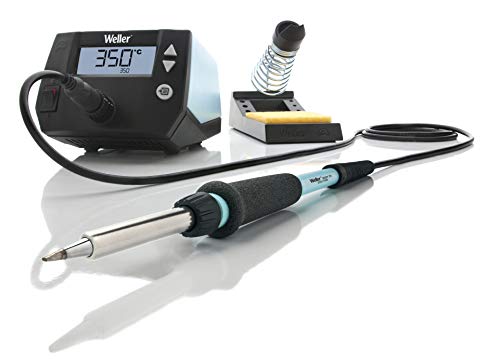
Best for: a permanent bench where the iron sees weekly use Skip it if: you have no room for a 5.51 lb station
The WE1010NA is the heaviest and largest pick here at 5.51 lb and 12.4 x 5.91 x 8.86 in, and that mass is the point: a station this size does not walk across the bench when you tug the cable. Weller lists a 70W iron paired with a heat-resistant silicone cable, and the listing claims a temperature stability window of ±40°F with a temperature lock to preserve settings. The kit ships with the station, a PH70 safety rest with sponge, one ETA screwdriver tip at 0.062 in, and a tip retainer. A one-year warranty appears in the specifications, which is more than most of this set publishes. The digital readout and password-protected settings are aimed at a shared bench, but Weller's audience is the solo hobbyist who wants a station that will still work a decade in. Its main trade-off against the YIHUA below is that it ships with only one tip and no helping hands, so budget for extras.
Pros:
- 70W with a claimed ±40°F stability window
- One-year warranty published on the listing
- Silicone cable and separate safety rest with sponge
- Standby and auto-setback modes per the listing
Cons:
- Only one tip in the box
- The heaviest and largest pick here at 5.51 lb
- The highest price position in the set
- No solder, tweezers or desoldering pump included
3. YIHUA 926 III — Most versatile
A 60W digital station that ships as a 12-in-1 kit with six tips, two helping hands and lead-free solder.
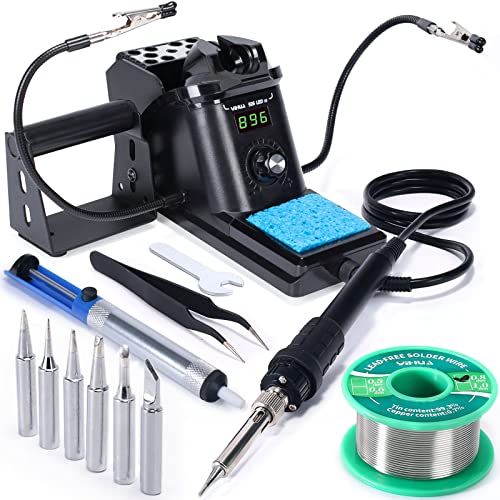
Best for: a first station where you want tips, helping hands and solder in one box Skip it if: you already own the accessories and just want an iron
The 926 III is the pick that answers "what do I need to actually start soldering", because YIHUA has packed six #1200/900M-series tips, two helping hands, a 35g roll of lead-free solder, a solder sucker and ESD-safe tweezers into the box. YIHUA says the temperature range runs 194°F to 896°F with a digital setpoint, digital calibration, °C/°F conversion, and a sleep mode with 5, 10 and 30-minute options. The station weighs 1.77 lb and measures 2.8 x 7.3 x 4.5 in, and the iron holder is integrated into the station body rather than being a separate rest. It is the one buyers choose most often here on Amazon's ranking, which suggests the "everything in one box" pitch works. The trade-off against Weller is name and warranty depth: YIHUA advertises 12-month US technical support, but the guardrails Weller's price buys, such as the silicone cable and password-protected settings, are not part of this package. Against the Hakko, it trades a sensor-in-heater pedigree for a full accessory kit.
Pros:
- Six tips, two helping hands and solder in the box
- 194°F to 896°F published range with digital setpoint
- Integrated iron holder saves bench space
- Sleep timer options at 5, 10 and 30 minutes
Cons:
- 60W, the lowest station wattage in this set
- Technical support term rather than a formal parts warranty
- Lower-cost tip series than Weller's ETA line
- Only one iron cable, no spare
4. WEP 926LED V3 — Best for families
A compact station bundled with five extra tips, solder wire, tweezers, a solder sucker and a tip cleaner.

Best for: a shared workbench with a beginner learning alongside Skip it if: you want a name-brand iron with a published warranty
The 926LED V3 is the family-friendly choice because the box contents cover a second user learning at the same bench. WEP counts 11 pieces in the kit and calls out five spare tips, a spool of solder, tweezers, a desoldering pump and a tip cleaner. The station weighs 1.98 lb, measures 4.45 x 6.3 x 4.84 in, and integrates the iron holder into the body. WEP publishes a 392°F to 896°F range through the control knob with a digital real-time readout, and a sleep mode that engages after ten minutes of inactivity. Support is described as one-year USA technical assistance rather than a parts warranty. Against the YIHUA, the WEP trades helping hands for a tip cleaner and pushes a higher claimed maximum wattage, though the working range starts higher too, which matters less for the delicate joints a beginner will practice on. The main trade-off is brand depth: this is not a Weller or a Hakko, and long-term parts availability is not guaranteed on the listing.
Pros:
- 11-piece kit with tip cleaner and desoldering pump
- 392°F to 896°F published range with digital readout
- Ten-minute sleep-mode idle
- Integrated iron holder, compact 4.45 in footprint
Cons:
- One-year technical support rather than a warranty
- Newer brand than Weller or Hakko
- No helping hands in the box
- Working temperature starts higher than the YIHUA
5. MEAKEST 60W kit — Best upgrade
A 60W adjustable pencil with an on/off switch and a 200 to 450°C dial range, shipped with five interchangeable tips.
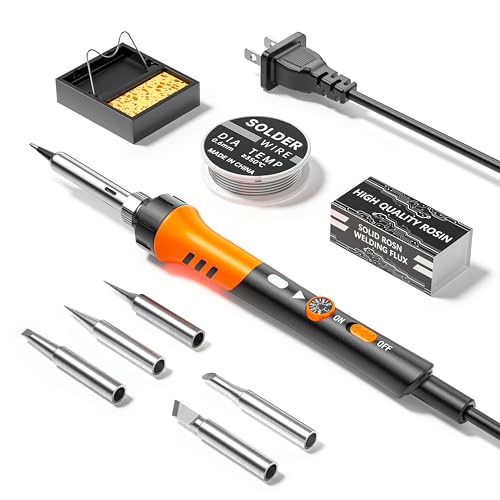
Best for: upgrading from a fixed-heat pencil without buying a full station Skip it if: you need a stand and sponge in the box
The MEAKEST is the pick for a reader who owns a fixed-heat plug-in pencil and wants a temperature dial without paying station prices. MEAKEST lists an adjustable range of 200 to 450°C and a switch on the handle for energy saving, which matters if the iron lives on the bench between joints rather than in a holder. The iron itself weighs 3.17 oz and measures 0.98 x 8.66 x 0.87 in, making it the lightest tool in this set by a wide margin. Five tips ship in the box, chosen to suit small jobs like guitar wiring, watches and mobile devices per the listing. The trade-off against a station is real: there is no digital readout, no sleep timer, and no closed-loop guarantee the way Hakko frames it. Against the Liouhoum below, MEAKEST trades the LCD display for a higher published maximum in °C and a physical on/off switch that a lot of pencils omit. Second-cheapest of the seven and second-fastest seller on Amazon's rank.
Pros:
- 200 to 450°C published adjustable range
- On/off switch on the handle
- 3.17 oz, the lightest iron in this set
- Five tips in the box for different job shapes
Cons:
- No stand or sponge listed in the kit
- No digital temperature readout
- No sleep-mode function published
- No warranty stated on the listing
6. Q-MING 100W — Best minimal setup
A 100W pencil kit with an LED temperature display, a 180 to 500°C range and an unusual password lock.

Best for: occasional repairs where the iron lives in a drawer Skip it if: you want documented temperature stability
The Q-MING is the pick for a reader who does one soldering job every few months and needs an iron that starts working fast when the drawer opens. Q-MING claims a ceramic heater that reaches operating temperature in 15 seconds, a 180 to 500°C adjustable range, and an LED readout on the handle. The listing calls out four ventilation holes for heat dissipation and, unusually for this category, a password lock the manufacturer pitches as a child-lock. The iron weighs 0.61 lb and comes with tips, wick braid, a stand, solder wire, sponge and flux paste. Third-cheapest of the seven. What the listing does not publish is a stability window, a warranty term, or dimensions beyond weight, which is what keeps it below the Weller and Hakko regardless of the higher wattage figure. Against the MEAKEST, it trades the physical on/off switch for a digital display and a stand in the box.
Pros:
- 180 to 500°C published range on an LED display
- Stand, sponge, wick and flux paste in the box
- Password lock feature per the listing
- Ceramic heater with a claimed 15-second warm-up
Cons:
- No stability window published
- No warranty stated on the listing
- Full dimensions not published
- Newer brand with limited track record
7. Liouhoum 80W — Best budget pick
An entry-priced 80W pencil with an LCD readout, temperature memory and a published 24-month replacement warranty.

Best for: a first iron for someone testing the hobby Skip it if: you want a station rather than a plug-and-play pencil
The Liouhoum is the cheapest of the seven and the pick that surprises on paper: it is one of only two picks in this set to publish a warranty term, and the term is 24 months, which is longer than the Weller's one year. Liouhoum claims 80W of power, an LCD temperature display on the handle, temperature memory that recalls the last setpoint, and an automatic sleep function that lowers the temperature after five minutes on the stand. The iron weighs 4.41 oz, measures 0.83 x 7.87 x 0.83 in, and ships with nine pieces in the kit. It is a pencil, not a station, so the sensor arrangement and stability window are not described the way Hakko describes the FX601-02. If the iron ever comes out of the box, the warranty is what protects the purchase. Against the MEAKEST, it trades a slightly heavier body for the LCD readout and the memory feature. Against the Q-MING, the warranty term is the decider.
Pros:
- The cheapest of the seven
- 24-month replacement warranty published
- LCD readout with temperature memory
- Five-minute automatic sleep on the stand
Cons:
- Pencil-style, not a station
- Newer brand than Weller or Hakko
- Stability window not published
- No °C/°F conversion mentioned on the listing
Pen-style iron or full station: which suits your bench?
The first fork in this category is not wattage, tip count, or brand. It is whether you want a pen-style iron or a full station, because that choice decides everything else about the setup.
A pen-style iron plugs straight into the wall and puts the temperature control on the handle. The Hakko FX601-02, MEAKEST 60W, Q-MING 100W and Liouhoum 80W in this set all follow that pattern. The upside is portability, drawer storage, and a lower price for the same wattage. The downside is that the electronics live in the handle, which means less mass, fewer buttons, and no separate stand unless you buy one.
A station splits the work: the iron holds only the heater and a thermocouple, and a base station holds the display, the controls and the power supply. The Weller WE1010NA, YIHUA 926 III and WEP 926LED V3 are all stations. The base gives you a bigger readout, dedicated buttons for setpoint and sleep, and a stand with a sponge. In return, it takes bench space and adds weight: the Weller alone is 5.51 lb.
If your bench is permanent, choose the station. If the iron shares a drawer with the pliers, choose the pen.
What the wattage figure actually tells you
Wattage is the number every listing shouts, and it is the number most first-time buyers compare directly. That is a mistake.
Wattage is the maximum rate at which the heater can pull energy from the wall. It says nothing about how tightly the temperature is held once the tip reaches the setpoint, and nothing about how quickly heat returns after the tip touches a cold joint. A 60W iron with a closed-loop sensor near the tip will hold a joint temperature better than a 100W iron whose control loop is slower.
Two figures actually decide the outcome:
- Temperature range. The Q-MING publishes 180 to 500°C, the WEP 926LED V3 quotes 392 to 896°F, and the MEAKEST advertises 200 to 450°C. A wider range at the low end matters for delicate joints on modern boards.
- Stability window. Only the Weller lists one, at ±40°F. That is the number a bench worker cares about, because it tells you how far the tip drifts while you are trying to work.
Buy on stability first, range second, wattage third. A 70W iron with a tight loop beats a 130W iron without one.
How many tips do you really need in the box?
Tip count is where the entry-priced kits earn their place, and where the premium picks stand deliberately apart.
- The Hakko FX601-02 ships with the installed tip only.
- The Weller WE1010NA ships with one ETA-series 0.062 in screwdriver tip.
- The YIHUA 926 III ships with six #1200/900M-series tips.
- The WEP 926LED V3 ships with five extra tips on top of the fitted one.
- The MEAKEST 60W ships with five tips in the box.
- The Q-MING 100W ships with tips (count not specified) alongside wick, solder and flux.
- The Liouhoum 80W ships as a nine-piece kit including tips.
Two tips will cover 90% of hobby work: a fine conical or bevel for surface-mount pads and a chisel for through-hole leads and stranded wire. Everything else is either a special-case shape or a spare against wear. Kits that ship five tips assume the buyer will not know which shape suits the job, and give them the whole set to experiment with. That is why the family-friendly and beginner-focused picks (WEP, MEAKEST, YIHUA, Liouhoum) all include tip packs, and why the professional-facing Hakko and Weller ship with one tip and expect you to buy the rest from a catalogue.
What the listings do not tell you
Even in a category as technical as this one, three things are missing from every listing worth flagging before you buy.
- Tip life. Nothing on any of these seven listings tells you how many hours a tip lasts before it pits or de-wets. Plan on tinning after every session and swapping tips every few months of weekly use.
- Cable length. Only the Weller calls out its cable material (silicone). The rest simply say "cord". If your outlet sits further than a metre from your bench, measure before you buy.
- Replacement heater availability. The heater is the wear part. Hakko and Weller sell replacement heaters through distributors; the newer brands do not publish part numbers, which is why the warranty term on the Liouhoum matters more than it looks.
The listings promise a lot, but the after-sale ecosystem is where the premium picks separate from the entry ones.
The verdict
The Hakko FX601-02 wins on the strength of one specification the entry pencils cannot match: a closed-loop temperature sensor inside the heater, described in Hakko's own listing rather than pitched as a marketing phrase. Paired with the 67W rating, the slender handpiece and Hakko's decades in this category, it is the temperature controlled soldering iron I would put on a bench that already has a stand, a sponge and a tip collection.
Two conditions flip it. If your bench is permanent and you want a station with a silicone cable, a published stability window and a one-year warranty, the Weller WE1010NA is the better buy despite its 5.51 lb footprint. If you are opening your first box and need helping hands, six tips, tweezers and solder in one purchase, the YIHUA 926 III is the more useful package even though the wattage is lower.
Below that, the pens are for different jobs. Choose the Liouhoum if a 24-month warranty on an entry-priced iron matters more than brand. Choose the MEAKEST if weight and a handle switch matter. Choose the Q-MING if the drawer-storage use case fits and a password lock has appeal. The WEP suits a shared bench with a learner beside you.
FAQ
Is a temperature controlled soldering iron worth it over a fixed-heat pencil?
A temperature controlled soldering iron is worth it the first time you scorch a pad or lift a track on a modern board. Fixed-heat pencils run wherever the heater's equilibrium sits, which is often over 400°C. A dial lets you drop to 300°C for delicate joints and step up for thick wire. Every pick in this roundup gives you that range for less than the cost of one damaged board.
What temperature should I set for lead-free solder on a hobby board?
The temperature for lead-free solder on a hobby board usually sits between 315 and 370°C, depending on the alloy and the pad size. Start at the low end, add heat only if the joint takes more than three seconds to flow, and back off as soon as it wets. Every station in this set covers that range, and the YIHUA and WEP both publish °C/°F conversion so you can switch units without a lookup table.
Weller WE1010NA or YIHUA 926 III for a first station?
Between the Weller WE1010NA and the YIHUA 926 III, the choice comes down to what is missing from your bench. Weller ships the station, one tip, a rest and a sponge, and publishes a one-year warranty plus a ±40°F stability figure. YIHUA ships six tips, two helping hands, solder, tweezers and a solder sucker for less. If you have accessories, buy Weller. If you have none, buy YIHUA.
How long does a soldering iron tip actually last?
A soldering iron tip actually lasts anywhere from a few dozen to a few hundred hours of use, depending on temperature, tinning discipline and how often it touches flux. None of the seven listings publishes a tip-life figure, which is why the kits that ship five or six tips (WEP, YIHUA, MEAKEST, Liouhoum) have an advantage for the first year. Keep the tip tinned when idle and drop the temperature between joints.
Do I need a soldering station with sleep mode?
You need a soldering station with sleep mode if the iron sits idle for more than a few minutes at a time, which describes most hobby sessions. The WEP publishes a ten-minute sleep, the YIHUA offers 5, 10 or 30 minutes, and the Liouhoum drops temperature after five minutes on the stand. Sleep mode extends heater life and prevents the tip from oxidising while you fetch parts.
Now that you know the deciding specification is stability rather than wattage, the Hakko FX601-02 makes sense as the default: it is the only pen-style iron in this set that puts the temperature sensor inside the heater, and it does so in a 67W package small enough for drawer storage. Order the iron, add a stand and a sponge from the same brand's catalogue, and start with a fine tip for pads and a chisel tip for wire. If a permanent bench is what you are building instead, order the Weller WE1010NA and treat the one-year warranty and silicone cable as the reason the price is what it is.