Best Soldering Iron for DIY: Deciding Spec Guide

A ranked shortlist of seven soldering irons for hobby electronics, guitar wiring and small repairs, with the deciding specifications laid out side by side.

By Dexter GillUpdated 17 min read
On this page
- Best soldering iron for diy enthusiasts at a glance
- How I cut the field down to seven
- What actually decides a hobby soldering iron?
- 1. Q-MING Soldering Iron Kit — Best overall
- 2. Liouhoum Soldering Iron Kit — Best budget pick
- 3. MEAKEST Soldering Iron Premium Kit — Best for heavy use
- 4. YIHUA 926 III LED Display Soldering Iron Station — Best for families
- 5. Larlarsa Soldering Gun Kit — Most versatile
- 6. Fanttik T1 Max Soldering Iron Kit — Best premium
- 7. Q-MING 100W LED Digital Soldering Iron Kit — Best upgrade
- Pencil iron, gun or station: which suits your bench?
- Is a cordless soldering iron worth it for DIY?
- Tips, sponges and the accessories that matter
- Head-to-head: Q-MING 60W vs Liouhoum 80W
- The verdict
- FAQ
The best soldering iron for diy enthusiasts is the Q-MING 60W Kit, because it pairs a 392°F to 842°F adjustable range with five interchangeable tips and a 15-second heat-up, which is enough headroom for guitar wiring, breadboards and small repairs from one pencil. If you need a stable base for longer sessions, the YIHUA 926 III station steps in with a 194°F to 896°F range and a built-in stand. Everything below is ranked by how well the published specifications match a home workshop.
Best soldering iron for diy enthusiasts at a glance
| Pick | Temp range | Kit contents | Price |
|---|---|---|---|
Best overall Q-MING 60W Kit |
392°F to 842°F | 10-in-1, 5 tips | Check Price |
Best budget pick Liouhoum 80W Kit |
LCD, adjustable (claim) | 9-piece set | Check Price |
Best for heavy use MEAKEST 60W Premium Kit |
200°C to 450°C | 12-in-1 kit | Check Price |
Best for families YIHUA 926 III Station |
194°F to 896°F | Station, 6 tips, 2 helping hands | Check Price |
Most versatile Larlarsa 120W Gun Kit |
180°C to 600°C | Auto-feed, 2 tips | Check Price |
Best premium Fanttik T1 Max Cordless |
6 levels, up to 840°F | Cordless, 4 C210 tips | Check Price |
Best upgrade Q-MING 100W LED Kit |
356°F to 932°F | 100W, LED, wick braid | Check Price |


How I cut the field down to seven
Three named reasons trimmed the shortlist before I ranked anyone. First, listings without a stated temperature range came out: a soldering iron you cannot adjust between rosin-core solder and lead-free is a single-task tool. Second, kits without a stand were cut, because a hot tip resting on a bench edge is how DIY projects catch cardboard. Third, anything without at least one spare tip went, since a chisel tip and a fine conical tip do very different jobs.
What survived was seven kits or stations that publish a temperature range, ship with at least one accessory pack, and cover the three shapes a hobbyist actually encounters: pencil iron, soldering gun, and bench station. Five of the seven are pencil-style irons, one is a station and one is a soldering gun with auto-feed. One is cordless. The rest run on 110V mains.
I lined up the published specifications side by side and let the deciding criterion, which I explain in the next section, do the ranking. Sales-rank order was not used to rank anything, because a hobbyist's needs are not the same as the average buyer's.
What actually decides a hobby soldering iron?
Most guides compare wattage. That is not what decides it for a DIY enthusiast. Wattage tells you how much heat the iron can dump into a joint, but what you actually need is a tip that reaches the right temperature quickly, holds it under load, and does not scorch the flux. The best soldering iron for diy enthusiasts is the one whose adjustable range covers both leaded solder near 620°F and lead-free work closer to 700°F, with headroom for large pads.
Look at the four irons here that publish a temperature range in Fahrenheit or Celsius. The Q-MING 60W runs 392°F to 842°F. The YIHUA 926 III station covers 194°F to 896°F. The Q-MING 100W upgrade reaches 356°F to 932°F. The Larlarsa gun claims 180°C to 600°C, which is 356°F to 1,112°F.
All four clear the working range you need. The gap between them is control: an LCD or LED digital readout beats a dial for lead-free work, because a 20°F miss on lead-free solder is the difference between a shiny joint and a cold one. Three of the seven picks show digital readouts. That, more than wattage, is the deciding specification.
1. Q-MING Soldering Iron Kit — Best overall
A 60W pencil iron with a 392°F to 842°F range and five tips out of the box, sized for almost anything a home workshop throws at it.
Best for: hobbyists who want a plug-and-play kit with room to grow Skip it if: you need bench-top temperature stability for long sessions
Within this set, the Q-MING 60W stands out for two published numbers. The adjustable range of 392°F to 842°F covers leaded solder, lead-free solder, and heat-shrink work from the same tip, and Q-MING says the ceramic heater reaches temperature within 15 seconds. Five interchangeable tips arrive in the box, which is more than the Larlarsa gun's two and matches the Fanttik's four. The whole iron weighs 1.76 oz, which is the lightest in the group by a wide margin and makes long sessions less tiring.
The 10-in-1 kit includes a stand, sponge, 0.6mm solder wire and a rosin flux paste, so a first-time buyer does not need a second order. Q-MING calls it a thermostatic pencil-type iron, which is their word for a dial-set target temperature. It is not a digital readout, and that is the trade-off it makes against the two picks below with LCD or LED screens. If your work is mostly through-hole electronics and repairs, the dial is fine. If you plan to move to lead-free at fixed 700°F sessions, one of the digital picks is safer.
Pros:
- Wide 392°F to 842°F adjustable range
- Five interchangeable tips in the box
- Q-MING claims 15-second heat-up
- Lightest pencil iron here at 1.76 oz
- Sells faster than the rest of this set
Cons:
- Dial control, no digital temperature readout
- No published warranty
- Simple stand rather than a heavy base
2. Liouhoum Soldering Iron Kit — Best budget pick
The cheapest of the seven, and the only entry-price pick that ships with a 24-month replacement warranty and an LCD readout.

Best for: first-time solderers who want a digital readout without spending much Skip it if: you dislike LCD menus and prefer a simple dial
The Liouhoum is the cheapest of the seven and the only one in the entry tier with a published 24-month replacement warranty. That combination is rare. Liouhoum says the 80W ceramic core reaches operating temperature in 10 seconds, which is quicker than the 15-second figure Q-MING lists for its 60W and 100W kits. The listing describes an automatic sleeping function that steps the temperature down after five minutes on the stand, which spares the tip during coffee breaks.
Its 9-piece count is the second-largest bundle here after the MEAKEST 12-in-1, and at 4.41 oz the pencil is still light in the hand. What holds it out of a higher rank is the display: Liouhoum shows a clear LCD but does not publish a Fahrenheit or Celsius range in the specifications, so a buyer is trusting the marketing text rather than a spec. It is the slowest seller among the four picks at the entry and mid tier, which suggests it is less well known rather than less capable. For a first iron, the warranty alone is worth more than the price difference.
Pros:
- Lowest priced kit in this set
- 24-month replacement warranty
- Liouhoum claims 10-second heat-up
- Automatic sleep after five minutes
- LCD temperature display
Cons:
- Numerical temperature range not in the spec sheet
- Slowest seller here among entry and mid picks
- LCD menu adds a step over a simple dial
3. MEAKEST Soldering Iron Premium Kit — Best for heavy use
Twelve pieces in the box, an on/off switch on the handle, and a published 200°C to 450°C range for makers who solder more than once a month.

Best for: makers who tackle guitars, wires and small appliance repairs in the same week Skip it if: you only solder headphone cables once a year
The MEAKEST 12-in-1 is the largest accessory bundle here. Twelve pieces means more spare tips, more solder wire and more flux paste, so a heavy user reorders less often. The adjustable range is 200°C to 450°C, which is 392°F to 842°F, matching the Q-MING 60W on the top and bottom. What separates it is the on/off key on the handle: two of the seven picks include one, and it matters when you set the iron down between joints without wanting to unplug.
At 1.26 lb, it is heavier than the Q-MING pencils, and that is the trade-off for the fatter kit and the ergonomic silicone grip MEAKEST describes. The listing highlights the increased capacity of solder wire and paste, which is a real advantage over the smaller entry kits: running out of flux halfway through a job is worse than running out of tips. It does not publish a warranty, unlike the Liouhoum, and there is no digital readout, only a dial. For a DIY enthusiast who solders often but works at one bench, that is a fair trade.
Pros:
- 12-in-1 kit is the largest accessory bundle
- 200°C to 450°C adjustable range
- On/off switch on the handle
- Silicone protective sleeve
- Larger solder wire and flux paste capacity
Cons:
- Heaviest pencil iron here at 1.26 lb
- No published warranty
- Dial control, no digital readout
4. YIHUA 926 III LED Display Soldering Iron Station — Best for families
The only bench station in the shortlist, with a 194°F to 896°F range, calibration support and two helping hands for a shared workbench.
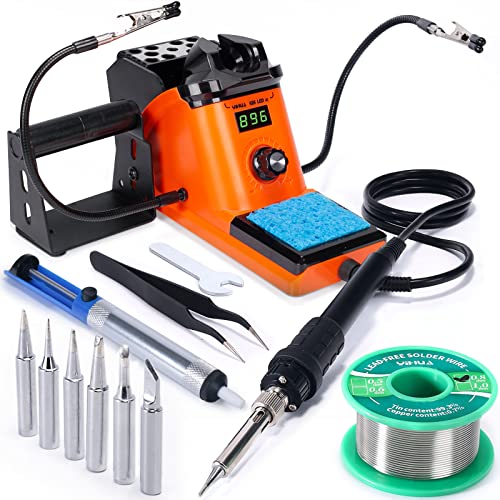
Best for: a shared workbench where more than one person will solder Skip it if: portability matters more than a stable base
A station gives you three things a pencil iron cannot. A wide temperature range: YIHUA lists 194°F to 896°F, which is the widest published range in this set. Real calibration: the 926 III supports temperature calibration and PID heat control, so the tip temperature you read is the tip temperature you get. And a heavy base that will not tip over when someone leans on the bench. The 1.96 lb weight is the whole unit, not just the iron, and it is meant to sit still.
For a family workshop, the YIHUA arrives with 15 extras, including two helping hands with alligator clips and six tips. That is enough for a parent and a teen to work on separate projects without swapping kit. YIHUA publishes a 12-month manufacturer technical coverage in the listing. The trade-off is that a station is not portable: it lives on a bench and it needs mains power. The 926 III is the most expensive pick here, and it is the only one that will not fit in a drawer.
Pros:
- Widest published range, 194°F to 896°F
- Temperature calibration and PID control
- Six tips plus two helping hands in the box
- 12-month manufacturer technical coverage
- Digital LED display in °C or °F
Cons:
- Highest price position in this set
- Not portable, needs bench space
- Overkill for occasional headphone repairs
5. Larlarsa Soldering Gun Kit — Most versatile
A 120W gun with an auto-feed tin mechanism, aimed at one-handed soldering when the other hand is holding the board.

Best for: one-handed soldering when the other hand holds the board Skip it if: you want a proven design with a long track record
The Larlarsa is the only gun-shape iron here with a trigger-fed solder mechanism. Larlarsa says the auto-feed system lets you solder with one hand while the other holds the wire, the board or the clip. That changes what jobs are practical: soldering a wire onto a vertical terminal is far easier when one hand is free. The gun claims 120W internal heating, which is the highest wattage in the shortlist, and a 180°C to 600°C range, which is 356°F to 1,112°F.
At 4.41 oz, it matches the Liouhoum for weight, though the pistol grip changes how it balances. What holds it back from a higher rank is its sales rank: it is the slowest seller of the seven by a wide margin, which is a sign that the auto-feed format is a niche pick rather than a common choice. The kit includes two tips, a high-suction desoldering pump, anti-static tweezers and solder wire. For repetitive same-joint work, the auto-feed is a real advantage. For fine surface-mount, a pencil iron gives finer control.
Pros:
- Auto-feed solder mechanism
- 120W internal heating, highest here
- Digital temperature display
- Desoldering pump and tweezers included
- Pistol grip suits one-handed work
Cons:
- Slowest seller of the seven
- Only two tips in the kit
- Gun format is heavier than a pencil in use
- No published warranty
6. Fanttik T1 Max Soldering Iron Kit — Best premium
A cordless soldering iron with a 2,600 mAh battery, four C210-series tips, and up to 60 minutes of runtime at 840°F.

Best for: repairs away from a wall outlet, in the car or on a ladder Skip it if: you always solder next to a power socket
The Fanttik T1 Max is the only cordless iron in the shortlist, and cordless is the specification that decides it. Fanttik lists a built-in 2,600 mAh battery with a maximum DC output of 12W in wireless mode, for up to 60 minutes at 840°F, and compatible AC operation when a cable is plugged in. That covers a real DIY case a mains iron cannot: fixing a doorbell wire, a car stereo harness or a garden low-voltage light without running an extension cord.
The four C210-series tips are a step up in quality from generic replacements, and Fanttik describes them as rapid-heating and anti-oxidation. Gravity sensing puts the iron to sleep after 30 seconds of stillness, which extends both battery life and tip life. Six temperature levels are set on a tail knob rather than a screen, which is less precise than the YIHUA station's calibration but simple enough for battery work. The aluminium stand is included. The trade-off is price: this is the most expensive pick in the set, and a corded iron will always give you longer runtime.
Pros:
- Cordless, up to 60 minutes at 840°F
- 2,600 mAh battery, AC or DC use
- Four C210-series rapid-heat tips
- Gravity sensing sleep after 30 seconds
- Aluminium storage stand included
Cons:
- Most expensive pick in this set
- Six temperature levels rather than a digital target
- 60-minute battery cap on wireless jobs
7. Q-MING 100W LED Digital Soldering Iron Kit — Best upgrade
A 100W pencil iron with a 356°F to 932°F digital range and a child-lock password, for DIYers stepping up to larger joints.

Best for: a DIYer stepping up to thicker wire, battery tabs and larger joints Skip it if: you only work on fine surface-mount boards
The Q-MING 100W is the upgrade path from the 60W overall winner from the same brand. The wattage jump matters when you move from PCB work to thicker jobs: 14-gauge speaker wire, battery-tab spot solders and larger through-hole components pull heat out of a 60W tip faster than the ceramic can replace it. Q-MING lists a 356°F to 932°F range on this one, which is 90°F higher at the top than the 60W kit's ceiling, and the LED display gives you a numerical target rather than a dial position.
The child-lock password is a feature the other six do not offer. In a household where a curious child might switch on the bench, that lock is worth more than another spare tip. Q-MING says the 100W ceramic core hits temperature in 15 seconds, same as the 60W, and four ventilation holes handle heat dissipation. The kit adds a wick braid, useful for cleaning up bridged joints. The trade-off is that a 100W pencil is overkill for delicate surface-mount work, where a lower-wattage tip is easier to control.
Pros:
- 356°F to 932°F range, digital
- 100W ceramic core, 15-second heat-up
- Password child-lock function
- LED numerical readout
- Includes desoldering wick braid
Cons:
- 100W is more than fine SMD work needs
- No published warranty
- Second-highest sales rank in this set
Pencil iron, gun or station: which suits your bench?
Three shapes, three different jobs. Five of the seven picks here are pencil irons: Q-MING 60W, Liouhoum 80W, MEAKEST, Fanttik T1 Max and Q-MING 100W. One is a station, the YIHUA 926 III. One is a soldering gun, the Larlarsa.
- Pencil irons are what most DIY guides recommend, because the pen-like grip suits fine work: through-hole PCBs, guitar pots, headphone cables. All five here weigh between 1.76 oz and 1.26 lb, so they sit comfortably in the hand for a full session.
- Stations trade portability for stability. The YIHUA 926 III has a heavy base, a numerical readout with calibration, and a stand built in. For a shared workbench or long sessions, the base is worth its weight.
- Guns are the specialist tool. The Larlarsa's auto-feed trigger makes it faster for repetitive same-joint work, but the pistol grip is less precise on fine boards.
The right shape is a function of where you solder. If it is a corner of a desk that gets tidied every night, a pencil iron wins. If it is a permanent bench, a station pays off. If it is same-joint production runs, the gun format earns its place.
Is a cordless soldering iron worth it for DIY?
Cordless irons trade runtime for reach. The Fanttik T1 Max is the only cordless pick in the shortlist, and its spec sheet is honest about the trade: 60 minutes at 840°F on the 2,600 mAh battery, and AC operation whenever you plug the cable in.
For a DIY enthusiast, the answer depends on where the jobs are. If most of your work is at a desk with a power socket in reach, a corded pencil iron gives you unlimited runtime for less money. If a real chunk of your work is on the car, in the garden, up a ladder or in a shed without power, the cordless option earns its price. A dead battery mid-joint is worse than a coiled cable, but a cable that will not reach the job is worse still.
Tips, sponges and the accessories that matter
Read the kit contents before the wattage. What is in the box decides how quickly you can start.
- Tips. The Q-MING 60W ships with five; the MEAKEST 12-in-1 lists twelve pieces including tips; the YIHUA 926 III includes six; the Fanttik T1 Max includes four C210-series tips; the Larlarsa includes two.
- Solder wire. Q-MING lists 0.6mm solder wire in the 60W kit. MEAKEST specifically increased its solder wire capacity based on feedback. Both are useful for fine electronics.
- Stand. Every pick here includes a stand of some kind. The YIHUA and Fanttik have proper metal bases; the pencil kits ship simpler wire stands.
- Sponge or brass wool. The Q-MING 60W and Q-MING 100W both list a sponge. Brass wool works better with lead-free solder because it does not cool the tip.
- Flux paste and wick braid. Rosin flux improves joint wetting. A wick braid pulls solder off a bridged joint. The Q-MING 100W kit includes both.
If a kit lacks two of those five items, you will place a second order in the first week.
Head-to-head: Q-MING 60W vs Liouhoum 80W
These two are the closest match in the shortlist. Both are entry-tier pencil irons, both sell as complete kits, and both are aimed at first-time and hobbyist buyers. The picks split on three points.
Weight and size: the Q-MING 60W is 1.76 oz and 10.4 in long. The Liouhoum 80W is 4.41 oz and 7.87 in long. The Q-MING is lighter and longer; the Liouhoum is more compact but heavier in the hand.
Control and warranty: the Q-MING uses a thermostatic dial with a stated 392°F to 842°F range. The Liouhoum uses an LCD screen and adds a 24-month replacement warranty, which no other entry pick offers.
Kit and heat-up: Q-MING lists a 10-in-1 kit with five tips; Liouhoum lists a 9-piece set. Q-MING claims 15-second heat-up on 60W; Liouhoum claims 10 seconds on 80W.
Pick the Q-MING for its published temperature range, its extra tip, and its lighter body. Pick the Liouhoum for the LCD readout and the two-year replacement warranty.
The verdict
The Q-MING 60W Kit is the best soldering iron for diy enthusiasts because it does the widest range of DIY jobs from one pencil at an entry price, with a published 392°F to 842°F range, five interchangeable tips, and a full accessory bundle out of the box. It is the most sensible default for a first iron, a replacement iron, or a second iron kept in a toolbox.
Two conditions flip the recommendation. If your work lives on a permanent bench and more than one person will use it, the YIHUA 926 III Station is the better buy: its 194°F to 896°F range is the widest here, its PID heat control and calibration make lead-free work predictable, and its 12-month manufacturer technical coverage protects a bigger spend. And if a serious share of your soldering happens away from mains power, the Fanttik T1 Max is the pick, because a corded iron cannot do 60 minutes of untethered work at 840°F.
If you upgrade later, the Q-MING 100W is a natural step from the 60W: same brand, same layout, but with a digital readout, a 932°F ceiling and a child-lock.
FAQ
What temperature should a DIY soldering iron reach?
What temperature should a DIY soldering iron reach depends on the solder. Leaded 60/40 flows near 620°F. Lead-free typically needs 700°F to 750°F. A range that covers 350°F to 850°F handles both without pushing the ceramic core. Five of the seven picks here clear that window, and the Q-MING 60W's 392°F to 842°F is a good general default.
Is a soldering station worth it for a beginner?
Is a soldering station worth it for a beginner depends on where you will use it. A station like the YIHUA 926 III adds temperature calibration, a heavy base, and space for helping hands, all useful on a permanent bench. If soldering is a rare weekend job at a kitchen table, a pencil iron kit like the Q-MING 60W is cheaper, portable, and enough to learn on.
How does the Q-MING 60W compare to the MEAKEST 12-in-1?
The Q-MING 60W compares to the MEAKEST 12-in-1 on kit size, weight and control. Both list a top temperature of 842°F (450°C). MEAKEST ships twelve pieces to Q-MING's ten and adds an on/off handle switch and a silicone grip. Q-MING is lighter, at 1.76 oz to MEAKEST's 1.26 lb. Pick MEAKEST for heavier use; pick Q-MING for a lighter hand feel.
Can a cordless soldering iron replace a corded one?
Can a cordless soldering iron replace a corded one for DIY? Only partially. The Fanttik T1 Max lists 60 minutes of wireless runtime at 840°F on its 2,600 mAh battery, and it also runs on AC power. That covers portable jobs and desk sessions, but a heavy day of soldering still favours a mains iron, because a station like the YIHUA 926 III has no battery limit.
What is the biggest mistake DIY buyers make with soldering irons?
The biggest mistake DIY buyers make with soldering irons is buying on wattage alone. A 100W iron sounds better than a 60W iron, but if the tip lacks a digital readout or calibration, the extra power is hard to control on fine boards. Look at the temperature range, the number of tips, and whether the kit includes flux, wick and a stand before you look at wattage.
Pick a soldering iron in the order the specifications matter to you: temperature range first, kit contents second, format third, wattage last. The Q-MING 60W Kit is the sensible default because it clears the temperature window that covers both leaded and lead-free solder, ships with the accessories that stop a first project from stalling, and weighs almost nothing in the hand. Open the listing, check the current price, and if a permanent bench is in your future, keep the YIHUA 926 III bookmarked as the upgrade path.