Best Small Soldering Iron by Wattage and Heat-Up

Six compact soldering kits ranked by wattage, heat-up time and what actually comes in the box. The Q-MING 60W pencil kit wins for most benchtop repairs.

By Dexter GillUpdated 15 min read
On this page
- Best small soldering iron at a glance
- How I cut the field down to six
- 1. Q-MING Soldering Iron Kit — Best overall
- 2. Fanttik T1 Max Soldering Iron Kit — Best premium
- 3. Q-MING Soldering Iron Kit 80W LCD — Most versatile
- 4. MEAKEST 60W Adjustable Temperature Kit — Best upgrade
- 5. MEAKEST Soldering Iron Premium Kit — Best minimal setup
- 6. Liouhoum Soldering Iron Kit — Best budget pick
- Watts, heat-up time and what actually decides this
- What comes in the box, and what you still need to buy
- Corded or cordless: which suits your bench?
- Small mistakes that ruin a first solder joint
- The verdict
- FAQ
The best small soldering iron for most benches is the Q-MING 60W pencil kit, a 1.97 x 10.4 x 5.71 in pen with a ceramic core that Q-MING says reaches temperature in 15 seconds and adjusts from 392°F to 842°F. If you solder away from an outlet, the Fanttik T1 Max cordless kit is the better buy: a 2600mAh battery, C210 tips and six temperature levels up to 840°F. Pencil-style irons like these all look similar in listing photos. The specification that splits the field is heat-up time paired with tip count.
Best small soldering iron at a glance
| Pick | Wattage | Heat-up (claim) | Price |
|---|---|---|---|
Best overall Q-MING 60W Kit |
60W | 15 seconds | Check Price |
Best premium Fanttik T1 Max Cordless |
12W DC (cordless) | Not listed | Check Price |
Most versatile Q-MING 80W LCD Kit |
80W | 20 seconds | Check Price |
Best upgrade MEAKEST 60W 9-in-1 |
60W | Not listed | Check Price |
Best minimal setup MEAKEST 12-in-1 Premium |
60W | Not listed | Check Price |
Best budget pick Liouhoum 80W LCD |
80W | 10 seconds | Check Price |


How I cut the field down to six
I started with the Soldering Guns & Irons category on Amazon and screened out anything that was not a pencil-style unit a beginner or hobbyist would call a small soldering iron. Full base stations, hot-air rework units and gun-shaped 100W+ transformers were cut. What remained were pen-format kits with ceramic cores, most of them 60W to 80W at 110V.
Three cuts brought the list to six:
- Format. Pencil-style only. If the picture showed a pistol grip or a bench transformer, it was out.
- Kit completeness. Every pick had to include at least one tip, a stand or sponge, and enough consumables to attempt a first joint without a second order.
- Temperature control. Every pick had to publish a range, not a single fixed temperature. The lowest floor in this set is 200°C and the ceiling is 450°C, and picks that did not name a range were cut.
The keyword also carries "small". Amazon's search treats that loosely, so the six here vary from a 1.76 oz pen to a 1.26 lb kit measured with the case. Any of them is small compared with a station. None of them is a micro pen, so read the dimensions carefully if desk space is your first constraint.
1. Q-MING Soldering Iron Kit — Best overall
A 60W pencil kit that heats fast, adjusts across a wide range and arrives with everything a first project needs.
Best for: hobbyists doing occasional through-hole and wire repairs at a bench Skip it if: you need a real base station with closed-loop temperature control
Q-MING publishes the numbers that decide this pick. The iron is 60W at 110V, adjustable from 392°F to 842°F (200°C to 450°C), and Q-MING says the ceramic core reaches operating temperature in 15 seconds. The pen itself is 1.97 x 10.4 x 5.71 in and weighs 1.76 oz on its own, which is the lightest handle in this set. The kit ships as a 10-in-1: iron, stand, sponge, five interchangeable tips, 0.6 mm solder wire and a no-clean rosin flux paste.
That combination is why it wins. The Liouhoum below claims a faster 10-second heat-up but comes at 80W with a heavier 4.41 oz handle. The Fanttik T1 Max is more portable but only 12W in cordless mode. For a first bench iron plugged into a wall, 60W with a 15-second claim and five tips is the balance most buyers want.
The trade-off is honest. There is no digital display, no memory, and Q-MING publishes no warranty. It is a knob-adjusted analogue pen with a printed dial.
Pros:
- 60W ceramic core, 15-second heat-up claim
- Wide 392°F to 842°F adjustable range
- Ships with five tips, wire, paste, sponge and stand
- Lightest pen in this set at 1.76 oz
- Sells faster than most of the picks here
Cons:
- No LCD readout, only a printed dial
- No published warranty
- No sleep mode or temperature memory
2. Fanttik T1 Max Soldering Iron Kit — Best premium
A cordless C210-tip pen with a 2600mAh battery, gravity sleep and six temperature levels.

Best for: someone who solders away from an outlet and wants a cordless pen Skip it if: you sit at one bench and never move
The T1 Max is the only cordless small soldering iron in this set, and that decides it. Fanttik pairs a built-in 2600mAh battery with DC and AC modes: in cordless mode the maximum output is 12W for up to 60 minutes at 840°F (450°C). The pen ships with four tailor-made C210 tips (C210-I, C210-IS and two C210-K), the same tip family used in some professional stations. Total kit weight is 1.04 lb with its aluminum storage stand.
Two smart-behaviour features matter here. Gravity sensing drops the iron into sleep after 30 seconds of stillness, which protects the tip and stretches the battery. A tail knob picks between six temperature levels rather than freely dialling a number, which is a limitation next to a full LCD.
The premium price position is the trade-off. In this set it is the most expensive pick, and the 12W cordless output is well below the 60W and 80W corded pens beside it. Use it for field repairs, quick tacks and tinning. If you plan long sessions on heavy pads, keep a corded iron on the bench.
Pros:
- Only cordless pen in this set
- 2600mAh battery, up to 60 minutes at 840°F
- Compatible with C210 tip family
- Gravity sleep after 30 seconds
- Aluminum storage stand doubles as pop-up tray
Cons:
- 12W in cordless mode limits heavy joints
- Six preset levels, not a free digital setpoint
- Most expensive pick here
- Heavier 1.04 lb overall
3. Q-MING Soldering Iron Kit 80W LCD — Most versatile
An 80W pen with an LCD readout and a seven-piece kit at an entry price position.

Best for: a first digital-display kit for mixed electronics jobs Skip it if: you want a published warranty in writing
Q-MING's 80W version is the digital sibling of the winner. The wattage steps up to 80W, the display becomes an LCD showing the temperature status rather than a printed dial, and Q-MING says heat-up takes 20 seconds. The kit ships as a seven-piece bundle: iron, five tips, stand, sponge, solder wire and flux paste. The vent holes on the tip are called out as a heat-dissipation feature.
This is the best small soldering iron in the set if the LCD matters to you and you want to keep the price position low. It is the second-cheapest of the six. Compared with the Liouhoum below at the same 80W, this pen loses the automatic sleep function and the published warranty. Compared with the winning Q-MING 60W, it gains the digital readout and 20W but loses four seconds of claimed heat-up time.
Choose it if you like watching a number rise on a screen rather than trusting a dial. Skip it if a written warranty is a hard requirement.
Pros:
- 80W ceramic core, 20-second heat-up claim
- LCD digital temperature display
- Seven-piece kit with tips, stand, wire and paste
- Second-cheapest pick here
- Vented tip for heat dissipation
Cons:
- No sleep mode or temperature memory
- No published warranty
- Handle weight and dimensions not listed
4. MEAKEST 60W Adjustable Temperature Kit — Best upgrade
A 9-in-1 pen with an on/off switch, silicone grip cover and five tip shapes for small-electronics work.
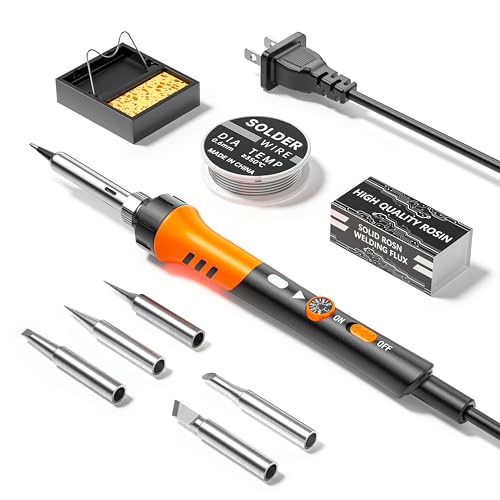
Best for: guitar, watch and small-electronics repair with tip variety Skip it if: you want a digital readout
The MEAKEST 9-in-1 is the pick for buyers who care more about grip and tip choice than about a screen. It is 60W with an adjustable 200°C to 450°C range and comes with five tip shapes MEAKEST calls out for guitars, watches, wires, mobile devices and small electronics. The pen is 0.98 x 8.66 x 0.87 in and weighs 3.17 oz, so it sits between the Q-MING 60W and the heavier Fanttik in the hand.
Two design details push this into the upgrade slot. There is an on/off switch on the handle, which is not present on either Q-MING pen and matters more than it sounds during a long session. A high-temperature silicone protective cover wraps the grip area, which is what MEAKEST leans on for the ergonomic claim.
Where it loses to the two 80W picks is heat-up time: MEAKEST does not publish one, so you are buying on the switch, the grip and the tip variety rather than on speed. It is also mid-priced in this set, above both entry picks.
Pros:
- On/off switch on the handle
- Silicone protective cover on the grip
- Five tip shapes for varied jobs
- 200°C to 450°C adjustable range
- Compact 8.66 in body
Cons:
- No heat-up time published
- No LCD readout
- No stated warranty
5. MEAKEST Soldering Iron Premium Kit — Best minimal setup
A 12-in-1 kit that adds a desoldering pump and larger consumables so a first-timer stops at one order.

Best for: a first-timer who wants desoldering pump and paste in one box Skip it if: you already own solder wire and a pump
MEAKEST's premium kit is the completeness pick. Same 60W adjustable body as the 9-in-1 above, same 200°C to 450°C range, same 0.98 x 8.66 x 0.87 in dimensions. What changes is the box: 12 pieces instead of 9, with a desoldering pump added and larger volumes of solder wire and paste. MEAKEST calls out the capacity increase directly, saying the amounts were raised in response to customer feedback.
The rest of the story matches its sibling. The on/off switch is on the handle. The silicone protective cover is on the grip. The tips cover guitars, watches, wires and small electronics. Kit weight rises to 1.26 lb because of the extra contents.
The trade-off is the price position. It is one of the two most expensive picks here, and the pen itself is not upgraded over the 9-in-1. You are paying for the pump and the extra wire and paste. If you already own those, the 9-in-1 is the smarter buy. If you own nothing, this is the shorter path to a first working joint.
Pros:
- 12-piece kit including desoldering pump
- Larger solder wire and paste volumes
- On/off switch on the handle
- Silicone protective cover on the grip
- 200°C to 450°C adjustable range
Cons:
- Same pen as the 9-in-1 at a higher price position
- No heat-up time published
- No stated warranty
- 1.26 lb kit weight
6. Liouhoum Soldering Iron Kit — Best budget pick
An 80W LCD pen with a 10-second heat-up claim, sleep mode and a 24-month replacement warranty.

Best for: buyers who want a 10-second heat-up and a written replacement warranty Skip it if: you want a heavier, sturdier handle
The Liouhoum is the cheapest of the six and, on paper, the fastest. It is 80W with a ceramic core Liouhoum says reaches operating temperature in 10 seconds, five seconds quicker than the Q-MING winner and ten quicker than the Q-MING 80W. It has an LCD screen showing the setpoint, an anti-scalding handle, and, unusually for this set, a printed 24-month replacement warranty. Model 936H.
Two behaviours give it real staying power on the bench. If the iron sits on its stand for five minutes it drops temperature automatically to extend heater life, and it remembers the last temperature you set. That is closer to base-station behaviour than any other corded pen here. The pen is 0.83 x 7.87 x 0.83 in and weighs 4.41 oz, the heaviest handle among the corded picks.
The trade-off is that the handle is heaviest of the corded pens and it is the slowest seller here. If you value speed, memory and a written warranty above sales momentum, that is a fair swap.
Pros:
- Cheapest of the six
- 80W with a 10-second heat-up claim
- LCD digital display and temperature memory
- Auto sleep after 5 minutes on the stand
- 24-month replacement warranty published
Cons:
- Heaviest corded handle at 4.41 oz
- Slowest seller of the six
- Stand and consumables not itemised as clearly
Watts, heat-up time and what actually decides this
Most guides to the best small soldering iron rank on wattage. Wattage matters, but it is not the deciding number for a pen-format iron on a home bench. Two picks here are 80W (Liouhoum, Q-MING LCD) and three are 60W (Q-MING 10-in-1, both MEAKEST kits). All of them share the same 200°C to 450°C adjustable range. The Fanttik is cordless and quotes 12W in DC mode, which is a different animal.
What actually decides it is the combination of heat-up time, tip choice and control interface. Heat-up claims in this set run from 10 seconds (Liouhoum) to 20 seconds (Q-MING 80W LCD), with the winning Q-MING 60W at 15 seconds and two picks not publishing a figure at all. Under 20 seconds is fast enough that the difference is noticeable only if you interrupt work often.
Tip choice is the bigger lever. Five of the six ship with at least five interchangeable tips. Only the Fanttik uses the C210 family, which unlocks a professional tip ecosystem. Everyone else uses a generic screw-in tip.
The control interface is the third axis. Two picks give you a printed dial, three give you an LCD readout, and the Fanttik gives you six preset levels on a rear knob. A dial is fine if you already know the temperature you like. An LCD is easier for a beginner learning what 350°C feels like on a leaded joint.
What comes in the box, and what you still need to buy
A soldering iron alone is not enough to make a joint. Every pick here is sold as a kit, but the kits vary. Here is what is in each box, as the listings describe them:
- Q-MING 60W (10-in-1): iron, simple stand, sponge, 5 tips, 0.6 mm solder wire, no-clean rosin flux paste.
- Q-MING 80W LCD (7-piece): iron, 5 tips, simple stand, sponge, solder wire, flux paste.
- MEAKEST 9-in-1: iron, 5 tips, solder wire, stand.
- MEAKEST 12-in-1 Premium: iron, tips, larger solder wire and paste, desoldering pump, stand.
- Liouhoum 80W: iron, tips, LCD-fronted body. Consumables not itemised in as much detail.
- Fanttik T1 Max: iron, 4 C210 tips (C210-I, C210-IS, 2x C210-K), aluminum storage stand, battery.
What you still need to think about, regardless of pick:
- A proper stand and brass wool. The bundled stands are basic. If you solder often, upgrade both.
- Safety glasses. No kit ships with them and flux spits.
- Fume extraction or an open window. No kit ships with a fan.
- Extra solder. The wire spool included in every kit is a starter length. Order more.
Corded or cordless: which suits your bench?
Five of the six here are corded 110V pens. One, the Fanttik T1 Max, is cordless with an AC mode. That is the first fork in the road.
Corded wins on power. A 60W or 80W pen plugged into the wall will heat a heavy ground plane or a thick wire that a 12W cordless output cannot touch without extra time. Corded also wins on session length: an outlet does not run out.
Cordless wins on reach. Under a dashboard, up a ladder, inside a case with the outlet on the wrong side of the room, a battery pen removes a real friction. The Fanttik's 60-minute claim at 840°F is enough for a run of small joints, and the gravity sleep protects the tip when you set it down mid-job.
Here is the shortcut. If you work at one bench and rarely move, buy a corded pen and put the money into consumables. If you fix things in place around a house, a car or an instrument, buy the cordless and keep a cheap corded pen as a bench backup.
Small mistakes that ruin a first solder joint
A small soldering iron will do good work if the operator gives it a chance. Five errors ruin more first joints than any hardware fault:
- Starting cold. Wait past the heat-up claim before touching solder. If the Q-MING says 15 seconds, give it 30.
- Wrong temperature. For leaded solder, 300°C to 350°C is a safe window. For lead-free, 350°C to 400°C. All six picks here cover both.
- Dirty tip. Wipe on the sponge, then tin with fresh solder every minute or so. A dry, oxidised tip transfers no heat.
- Feeding solder onto the tip instead of the joint. Heat the pad and lead first, then feed the wire into the joint itself.
- No flux. Even flux-cored wire runs out of flux on a re-touch. The paste in these kits exists for a reason.
None of these are about the iron. They are about the hand. The right pick removes friction; it does not replace practice.
The verdict
The best small soldering iron for most buyers is the Q-MING 60W 10-in-1 kit. It publishes the numbers that matter (60W, 200°C to 450°C, 15-second heat-up), it ships as a complete 10-in-1 with five tips and consumables, and its 1.76 oz handle is the lightest here. It is the one buyers choose most often in this set, which points to a kit that answers the beginner brief without gaps.
Two conditions flip the pick. If you solder away from an outlet, the Fanttik T1 Max is the correct buy because it is the only cordless pen here and it ships with the C210 tip family, six temperature levels and a 60-minute cordless run at 840°F. If price is the hard constraint and you want a written warranty, the Liouhoum 80W is cheapest, claims the fastest 10-second heat-up, and is the only pick with a 24-month replacement warranty published on the listing.
Everyone else is a specialist. The Q-MING 80W LCD adds a screen for a small step up. The MEAKEST 9-in-1 trades speed for grip and switch. The MEAKEST 12-in-1 buys a desoldering pump for a first-timer who wants one box and done.
FAQ
What wattage is best for a small soldering iron?
What wattage is best depends on what you solder. For hobby electronics, wires, guitar pots and small through-hole work, 60W to 80W in a pen-format iron with a 200°C to 450°C range covers almost everything. Higher wattage helps only when a joint has a large thermal mass, like a heavy ground plane or thick wire. All six picks here sit in that useful window.
Is a small soldering iron kit worth it for a beginner?
A small soldering iron kit is worth it for a beginner because the bundled tips, stand, sponge, wire and flux mean you can attempt a first joint without a second order. The Q-MING 60W ships as a 10-in-1 and the MEAKEST Premium as a 12-in-1 with a desoldering pump. Buying the pen alone almost always ends in a same-week trip back to Amazon for consumables.
How fast should a small soldering iron heat up?
How fast a small soldering iron heats up is now measured in seconds, not minutes. Ceramic-core pens in this set claim 10 seconds (Liouhoum), 15 seconds (Q-MING 60W) and 20 seconds (Q-MING 80W LCD). Anything under 30 seconds is fast enough for hobby work. The difference between 10 and 20 seconds only matters if you constantly switch the iron off between joints.
Q-MING 60W or Fanttik T1 Max: which should I pick?
Q-MING 60W or Fanttik T1 Max comes down to where you solder. Pick the Q-MING 60W if you work at a bench with an outlet, because you get 60W, a 15-second heat-up and a 10-in-1 kit at a mid price position. Pick the Fanttik T1 Max if you work in the field, because it is the only cordless pen here and it uses the C210 tip family.
What is the biggest mistake first-time solderers make?
The biggest mistake first-time solderers make is feeding solder onto the tip instead of the joint. Heat the pad and the wire first, then touch the solder to the joint itself so the joint melts the wire, not the iron. The second most common mistake is a dirty, oxidised tip. Wipe on the sponge and re-tin every minute of active work.
For most benches, start with the Q-MING 60W 10-in-1 kit and pick up brass wool, safety glasses and an extra spool of 0.6 mm solder on the same order. The pen is light enough for long sessions, the ceramic core hits temperature before your coffee is poured, and the five tips cover the shapes a beginner needs to learn before buying favourites. If you find yourself soldering in the car, on a ladder or inside a guitar body more than once a week, add the Fanttik T1 Max as a second iron rather than a replacement. Two irons on one bench is cheaper than one wrong iron used badly.