Best RF Transmitter and Receiver: D-FLIFE Leads

A spec-by-spec look at six RF transmitter and receiver kits, from bare 315 MHz link pairs to a 25ms wireless audio set. Frequency and decoding decide this one, not range claims.

By Dexter GillUpdated 16 min read
On this page
- Best rf transmitter and receiver at a glance
- Which buyer are you? Four profiles these picks map to
- What actually decides an RF transmitter and receiver kit?
- 1. D-FLIFE 5pcs 433mhz Wireless RF Transmitter and Receiver — Best overall
- 2. QIACHIP DC 12V 1CH 433Mhz RF Wireless Relay Remote Control — Most versatile
- 3. 1Mii 2.4 GHz (1 TX+2 RX) Wireless Audio Transmitter — Best premium
- 4. QIACHIP RX480E 433MHz RF Transmitter Receiver Module — Best upgrade
- 5. HiLetgo 315Mhz RF Transmitter and Receiver Module link kit — Best budget pick
- 6. hiBCTR 5-Pack 433MHz RF Link Kit — Best minimal setup
- Does a 433 MHz kit reach the range on the box?
- What the listings for an RF transmitter and receiver leave out
- Bare modules or a relay board: which should you buy?
- The verdict
- FAQ
The best rf transmitter and receiver for most projects is the D-FLIFE 5pcs 433mhz kit, because it pairs superheterodyne receivers rated at -108dBm sensitivity with five sets in the box and a 2.2V to 5V input range. If you want a finished relay you can wire to a 12V lamp instead of bare modules, the QIACHIP DC 12V 1CH set is the better buy. One specification splits this whole field, and it isn't range. It's frequency: three of these six run at 433 MHz, one runs at 315 MHz, and one abandons control signals entirely for 2.4 GHz audio.
Best rf transmitter and receiver at a glance
| Pick | Frequency | Kit contents | Price |
|---|---|---|---|
| 433.92 MHz | 5 sets, antennas | Check Price | |
| 433 MHz | 1 relay + remote | Check Price | |
| 2.4 GHz | 1 TX + 2 RX, RCA cable | Check Price | |
| 433 MHz | 1 set, 4 channels | Check Price | |
Best budget pick HiLetgo 315Mhz RF Transmitter and Receiver Module link kit |
315 MHz | 2 pieces, 18 g | Check Price |
Best minimal setup hiBCTR 5-Pack 433MHz RF Link Kit |
433 MHz | 5 pairs | Check Price |


Which buyer are you? Four profiles these picks map to
I sorted this set by the job, not by the datasheet. Four people buy an rf transmitter and receiver, and they need almost nothing in common.
- The microcontroller builder. You have an Arduino or an ESP32 and you want two boards talking. You need bare modules, spare units for the ones you fry, and library support. D-FLIFE and hiBCTR are yours.
- The switch person. You want a wall remote to turn something on. No code, no soldering iron. The QIACHIP 12V relay set does this out of the box.
- The audio person. You typed "transmitter and receiver" but you meant sound from a TV to a speaker across the room. That is the 1Mii kit, and nothing else here does it.
- The space-constrained builder. Your enclosure has room for a module measuring 1.1in × 0.47in and not a millimetre more. The QIACHIP RX480E is built for that.
Those four wants pull in different directions, which is why no single pick sweeps the table. Notice that only the budget HiLetgo pair sits at 315 MHz. Every other radio-control kit here is 433 MHz, so mixing brands across a project is possible in three cases out of four and impossible in the fourth.
What actually decides an RF transmitter and receiver kit?
Most guides to the best rf transmitter and receiver lead with transmission distance. Range is the wrong headline. Two things decide whether your project works.
The first is frequency, and it is binary. A 315 MHz transmitter will not talk to a 433 MHz receiver. Not weakly, not intermittently. It simply won't. So decide your band before you compare anything else, and if you already own 433 MHz gear, the HiLetgo pair is off your list regardless of how cheap it is.
The second is the decoding layer. Bare modules like the D-FLIFE, HiLetgo and hiBCTR kits hand you raw on-off keyed data. Your code does the encoding. That is total freedom and total responsibility. The QIACHIP RX480E kit uses EV1527 learning code with a button to pair channels, so the decoding is done for you. The QIACHIP relay goes further and does the switching too.
Receiver architecture matters third. D-FLIFE and QIACHIP both list superheterodyne receiving designs, which is the more selective approach and generally the more interference-resistant one. The cheap link pairs typically use a simpler regenerative front end. If your build sits near a noisy motor or a busy 433 MHz neighbourhood, that difference shows up as dropped packets.
1. D-FLIFE 5pcs 433mhz Wireless RF Transmitter and Receiver — Best overall
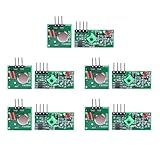
Five complete 433.92 MHz sets with superheterodyne receivers, which is the best combination of quantity and front-end quality in this group.
Best for: Arduino and ESP32 builders who need spare modules Skip it if: you want a finished switch you can wire to a lamp
Five sets is the number that changes how you work. Bare RF modules die from reversed polarity, static and over-enthusiastic soldering, and a single-set kit turns each mistake into a week of waiting. Here you build, break one, and reach for the next.
The published figures back the pick up. D-FLIFE lists a 2.2V to 5V input range, which means the same module drops into a 3.3V ESP32 rail or a 5V Arduino without a level shifter. The stated operating frequency is 433.92 MHz with roughly ±150kHz of bandwidth. The listing claims ASK and OOK modulation support and receiver sensitivity of -108dBm, plus dynamic range greater than 60dB from an integrated chip with a low-noise front end, mixer, filters and synthesiser.
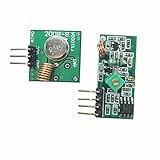
Antennas are included, which the pack photo shows as coiled wire whips. That matters because a bare module with no antenna is a desk-range device.
The trade-off against the QIACHIP options is real: you get radios, not a system. There is no relay, no learning button, no channel logic. Everything past the data pin is your firmware. It's also the fourth-cheapest of the six, so you pay a little for the quantity.
Pros:
- Five complete sets, so spares cost nothing extra
- 2.2V–5V input suits 3.3V and 5V boards
- Superheterodyne receiver design per the listing
- -108dBm sensitivity claim, the only one published here
- Antennas supplied with the modules
Cons:
- No decoding or relay logic, firmware does all the work
- Only one seller lists it
- No dimensions or weight published
- Warranty listed only as a bare figure, with no terms
2. QIACHIP DC 12V 1CH 433Mhz RF Wireless Relay Remote Control — Most versatile
A one-channel 12V relay with a matching remote, so you can switch a real load without writing a line of code.

Best for: switching a 12V light or motor with no code Skip it if: your project runs on 5V logic
This is the pick for people who want the outcome, not the electronics lesson. The receiver carries the relay, so you wire your 12V lamp, motor or gate driver to the contacts and press the fob. QIACHIP calls it a momentary switch configuration in a one-relay set.
The claims are specific. Signal passing through walls, floors and doors, with maximum range quoted at 164ft/50m in the open. Non-directional wireless encoding so multiple units run independently without cross-talk. The company also says the transmitter and receivers can be configured flexibly in quantity and operating mode, and points at light, motor, alarm and door-alarm duty in industrial and security use.
At 3.21 oz for the set, this is the heaviest single item here, which tells you there's a relay and a proper enclosure rather than a bare PCB. Model number is KR1201B_KT08_2_SET.
Two limits. It is the second-most-expensive pick in this set and the priciest of the control-oriented ones, and the 12V requirement rules it out of 5V breadboard work. You're also buying one channel, so a second load means a second kit.
Pros:
- Relay already integrated, no external switching stage
- 164ft/50m open-air range claim
- 3.21 oz assembled set, remote included
- Encoding avoids interference between multiple units
Cons:
- 12V DC only, so no 5V logic projects
- Just one channel per kit
- Second-highest price position in this group
- Only one seller lists it
3. 1Mii 2.4 GHz (1 TX+2 RX) Wireless Audio Transmitter — Best premium
The only audio-grade set here, with 25ms latency claimed and two receivers in the box for a pair of powered speakers.

Best for: sending TV audio to two powered speakers Skip it if: you need to control a switch or read sensor data
Read the box before you buy this one. It moves analogue sound, not control data. If your goal is a wireless doorbell or a sensor link, the other five picks are your list and this one isn't.
For its actual job it is well equipped. One transmitter and two receivers, which 1Mii says allows simultaneous AUX and RCA output to four powered speakers, since each receiver can feed two. Latency is quoted at 25ms from 2.4 GHz wireless, which is the specification that decides whether lip sync bothers you on a TV. Range is claimed at 262 ft (80m) in open space with anti-interference design. The set is plug and play: 1Mii says the transmitter and receivers auto-power on and pair themselves once powered.
A 3.5mm to RCA cable is supplied. Boxed dimensions are 5 x 5 x 16 in, and there's a 1 Year warranty, one of only two published warranty terms in this group. Two sellers list it, the widest availability here.
The catch is cost and scope. It's the most expensive pick here, it's the one buyers choose most often in this set, and it does exactly one thing.
Pros:
- 25ms latency claim keeps TV audio in sync
- Two receivers supplied, up to four speakers
- 262 ft (80m) open-space range claim
- 1 Year warranty published
- 3.5mm to RCA cable in the box
Cons:
- Audio only, no control or data use
- Most expensive pick in this group
- 2.4 GHz shares space with Wi-Fi and Bluetooth
- Boxed at 5 x 5 x 16 in, the bulkiest here
4. QIACHIP RX480E 433MHz RF Transmitter Receiver Module — Best upgrade
Four channels, three switching modes and a 1.1in × 0.47in receiver, which makes it the smartest module to embed in something.

Best for: embedding four channels into a tight enclosure Skip it if: you need more than one kit
This is what you buy when the D-FLIFE modules taught you that raw OOK data is tedious. The RX480E receiver pairs with a TX118SA transmitter and handles the decoding itself using EV1527 learning code across four channels.
Three working modes are listed: momentary, toggle and interlock, all configured with the receiver's learning button rather than solder jumpers. Momentary is a doorbell. Toggle is a light switch. Interlock is the one people miss, and it's for things like forward and reverse on a motor, where only one output may be live at a time. Setting that with a button instead of code is genuinely useful.
Size is the other argument. QIACHIP publishes the receiver at 1.1in × 0.47in and the transmitter at 0.74in × 0.74in, with packed dimensions of 0.39 x 1.1 x 0.71 in. That fits inside a light fitting. Compatibility is stated for Arduino, ESP32 and Raspberry Pi, and the receiver uses a superheterodyne design that QIACHIP credits with strong anti-interference.
The obvious limit is count: one kit. It's the second-cheapest here, so buying two is manageable, but the D-FLIFE box arrives with five.
Pros:
- Four channels with EV1527 learning code
- Momentary, toggle and interlock modes via button
- Receiver just 1.1in × 0.47in
- Second-cheapest of the six
- Stated Arduino, ESP32 and Raspberry Pi support
Cons:
- Only one set per kit, no spares
- No antenna specified in the listing
- No warranty term published
- Only one seller lists it
5. HiLetgo 315Mhz RF Transmitter and Receiver Module link kit — Best budget pick
The cheapest way into RF at all, at 315 MHz and 18 g for the pair.

Best for: a first one-way link on a breadboard Skip it if: you need 433 MHz compatibility
Start here if you have never sent a byte over the air and you'd rather not risk much on the attempt. This is a two-piece link kit: one transmitter, one receiver, listed for Arduino, ARM, MCU and Raspberry Pi work.
The published figures are physical rather than electrical. Weight is 18 g for the pair, dimensions 0.75 x 0.75 x 0.55 in, colour green, model 3-01-0082. It's the cheapest of the six by price position.
The frequency is the whole story. At 315 MHz this kit is a closed world within this lineup: it cannot talk to the D-FLIFE, hiBCTR or either QIACHIP kit, all of which sit at 433 MHz. That isn't a fault, and 315 MHz is a legitimate band with less traffic than 433 MHz in many places. But if you later add a QIACHIP relay, your HiLetgo transmitter is a paperweight, so buy this knowing you're picking a lane.
Note too that this listing publishes no feature bullets at all. No modulation type, no sensitivity figure, no voltage range, no receiver architecture. Compared with D-FLIFE's -108dBm and 2.2V–5V claims, you're buying with less information.
Pros:
- Cheapest pick in this comparison
- 18 g and 0.75 x 0.75 x 0.55 in, breadboard friendly
- Listed for Arduino, ARM, MCU and Raspberry Pi
- 315 MHz band is less congested than 433 MHz
Cons:
- Incompatible with every 433 MHz pick here
- No published voltage, sensitivity or modulation data
- Two pieces only, so no spares
- Only one seller lists it
6. hiBCTR 5-Pack 433MHz RF Link Kit — Best minimal setup
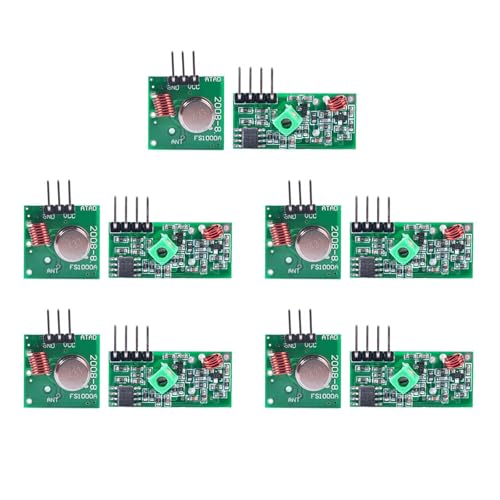
Five 433 MHz pairs with a stated 3.5V–12V supply range, which is the widest voltage tolerance in this group.
Best for: wiring five nodes at 3.5V to 12V Skip it if: you want a published warranty term
Two picks here ship five sets, and this is the cheaper of the two. If your project is a handful of scattered sensor nodes reporting to one hub, quantity beats polish.
The voltage claim is the standout. hiBCTR lists support across 3.5V to 12V DC for the modulation unit, which is broader than the 2.2V–5V range D-FLIFE publishes and means you can run a transmitter straight off a 9V battery or a 12V rail without a regulator. The pulse induction module is described as running on 5V DC at 4mA quiescent current, a figure worth having if you're budgeting a coin cell. Integration is stated as direct, through standard VCC, GND and DATA pins into common prototyping headers and microcontroller boards.
Where it falls short is documentation. The listing describes "paired logic nodes" and "optimized signal elements" without giving a sensitivity figure, a modulation type, a range number or the receiver architecture. There are no dimensions and no weight. The warranty field carries the brand name rather than a term.
This is the slowest seller of the six. Against the D-FLIFE kit, you save a little and lose the published radio specifications.
Pros:
- Five sets, the joint-highest count here
- 3.5V–12V DC supply range stated
- 4mA quiescent current on the 5V module
- Standard VCC/GND/DATA pinout
- Third-cheapest of the six
Cons:
- No sensitivity, modulation or range figures published
- No dimensions or weight listed
- No usable warranty term in the listing
- Slowest seller in this group
Does a 433 MHz kit reach the range on the box?
Two picks here publish a distance. QIACHIP quotes 164ft/50m for the 12V relay set. 1Mii quotes 262 ft (80m) for its 2.4 GHz audio kit. Both figures carry the same qualifier: open space, no obstacle.
Read that qualifier as the actual specification. Every RF range number is measured with clear line of sight, matched antennas and a fresh supply. Your hallway is not that.
Things that shorten a real link:
- No antenna. A bare module with an empty antenna pad loses most of its reach. D-FLIFE supplies antennas; several of these kits don't mention one.
- A weak or noisy supply. Transmit power tracks supply voltage. A module fed 3.5V from a sagging battery won't match the same module on a clean 12V rail.
- Metal. An enclosure, a wall stud, a fridge. Metal near the antenna is worse than distance.
- Band traffic. 433 MHz is shared with weather stations, car fobs and gate remotes. 2.4 GHz is shared with every Wi-Fi router in the building.
- Receiver architecture. Superheterodyne front ends, listed for both QIACHIP kits and the D-FLIFE modules, reject nearby interference better than simpler designs.
Practical approach: assume a third to a half of the quoted figure through a normal building, then confirm before you seal anything in a wall. That's another argument for the five-set kits, since testing two positions at once beats moving one module around.
What the listings for an RF transmitter and receiver leave out
The gaps in these listings are consistent, and they're worth knowing before you order.
Antennas. Only D-FLIFE explicitly states antennas are included. On the others you may get a bare solder pad, in which case add a length of wire cut to a quarter wavelength.
Pin headers. No listing here confirms whether headers arrive fitted or loose. Budget for a soldering iron on the bare-module kits.
Warranty. Only the 1Mii set publishes a real term, at 1 Year. D-FLIFE lists a bare figure with no unit. QIACHIP and HiLetgo publish nothing. hiBCTR's warranty field just repeats the brand name.
Data rate. Not one of these six states a maximum bits per second. For OOK modules that number is usually modest, and it's what limits how much you can send per burst.
Code libraries. The RX480E lists Arduino, ESP32 and Raspberry Pi compatibility, and HiLetgo names Arduino, ARM, MCU and Raspberry Pi. Neither promises example code.
Physical size. The two 5-packs publish no dimensions at all. If your enclosure is tight, the QIACHIP RX480E is the only pick with confirmed measurements: 1.1in × 0.47in for the receiver, 0.74in × 0.74in for the transmitter.
Bare modules or a relay board: which should you buy?
This is the fork that decides most purchases, so here's the direct comparison between the two top picks.
The D-FLIFE kit gives you radios. Data in one pin, data out the other, at 433.92 MHz across a 2.2V to 5V supply. Whatever you want the signal to mean, you define in software. Five sets means five nodes or one node plus four spares. Total flexibility, and you supply the brains.
The QIACHIP 12V relay set gives you a working switch. Press the fob, the relay closes, your 12V load runs. No microcontroller, no library, no debugging. It weighs 3.21 oz assembled, quotes 164ft/50m in the open, and costs more than the D-FLIFE kit.
The cutoff is whether you own a microcontroller and want to program it. If yes, buy modules. If no, buy the relay.
Sitting between them is the QIACHIP RX480E. Four EV1527 channels with momentary, toggle and interlock modes chosen by button, but no relay on board, so you still wire your own switching stage. That's the middle path: decoding handled, power stage yours.
The verdict
The D-FLIFE 5pcs 433mhz Wireless RF Transmitter and Receiver is the best rf transmitter and receiver for the widest range of projects, and the reasoning is straightforward. It is the only kit in this group that combines quantity with published radio specifications: five complete sets, 433.92 MHz with ±150kHz bandwidth, a 2.2V to 5V input that suits both 3.3V and 5V boards, plus stated ASK/OOK support and -108dBm receiver sensitivity from a superheterodyne front end. Antennas come with it. When one module dies, another is already on your bench.
Two conditions flip that. First, if you don't want to write code, the QIACHIP DC 12V 1CH relay set is the correct answer instead, because the receiver already contains the switching hardware and pairs with its own remote. Second, if what you actually want is TV sound in another room, the 1Mii 2.4 GHz set with 25ms claimed latency and two receivers is the only pick here that does audio at all, and the other five cannot be made to do it.
The QIACHIP RX480E's exact advantage over the winner is the decoding layer: four EV1527 channels with three switching modes set by a learning button, in a receiver measuring 1.1in × 0.47in. Buy it when firmware time costs more than the module.
FAQ
Is a cheap RF transmitter and receiver kit worth buying?
A cheap RF transmitter and receiver kit is worth buying when you're learning or prototyping, because these modules are easy to destroy with reversed polarity or heat. The HiLetgo 315 MHz pair is the least costly entry here. The catch is documentation: it publishes no voltage range, sensitivity figure or modulation type, so you're guessing at limits the D-FLIFE listing states outright.
What does more money buy in this category?
More money buys integration, not better radios. The cheapest picks are bare modules that need your microcontroller and code. Mid-range gets you quantity, five sets from D-FLIFE or hiBCTR. The higher positions here buy finished systems: a 12V relay and remote from QIACHIP, or the 1Mii set with two receivers, an RCA cable and a 1 Year warranty.
Will a 315 MHz transmitter work with a 433 MHz receiver?
A 315 MHz transmitter will not work with a 433 MHz receiver, at any distance. The bands are separate and the receiver's filters reject signals outside its own frequency. Five picks here run at 433 MHz and only the HiLetgo kit uses 315 MHz, so decide the band first. Mixing brands within one band is usually fine; mixing bands never is.
D-FLIFE or QIACHIP RX480E: which should I pick?
Choose D-FLIFE or QIACHIP RX480E based on where you want the decoding to happen. D-FLIFE ships five raw 433.92 MHz sets and your firmware interprets the data, with 2.2V–5V input and -108dBm sensitivity published. The RX480E gives one set with four EV1527 channels and momentary, toggle and interlock modes set by button, in a 1.1in × 0.47in receiver.
What is the most common mistake buyers make here?
The most common mistake buyers make is ignoring the antenna. A bare module with an empty antenna pad may reach only a metre or two, which reads as a faulty unit. D-FLIFE includes antennas; other kits here don't confirm one. Solder a quarter-wavelength wire before you conclude anything is broken, and test range before sealing hardware into a wall.
Start by answering one question: are you writing code or not? If you are, order the D-FLIFE 5-pack and put four modules in a drawer as spares, because the first one you kill will cost you an afternoon otherwise. If you're not writing code, the QIACHIP 12V relay set does the job the day it arrives. And if you came here wanting TV audio in the kitchen, buy the 1Mii kit and ignore everything else on this page. The winner earns its place by being the only pick that publishes its voltage range, its sensitivity and its bandwidth, then hands you five of them.