Best Cheap Soldering Iron for Real Repair Work

Seven soldering kits compared on published wattage, heat-up claims, weight and what actually comes in the box, with a named winner and the conditions that flip it.

By Dexter GillUpdated 17 min read
On this page
- Best cheap soldering iron at a glance
- How I cut this field down to seven
- What actually decides a best cheap soldering iron
- 1. Q-MING Soldering Iron Kit — Best overall
- 2. Q-MING Soldering Iron Kit — Best lightweight
- 3. Liouhoum Soldering Iron Kit — Most versatile
- 4. MEAKEST 60W Adjustable Temperature Soldering Iron Kit — Best for families
- 5. MEAKEST Soldering Iron Premium Kit — Best upgrade
- 6. Plusivo Soldering Iron Kit — Best budget pick
- 7. WEP 926LED V3 Soldering Station 130W MAX — Best premium
- Pencil iron or soldering station: which should you buy?
- What comes in the box, and what you'll still need
- Which mistakes ruin a cheap iron fastest?
- The verdict
- FAQ
The best cheap soldering iron is the Q-MING 80W LCD kit, because 80 watts plus a claimed 20-second heat-up and a digital readout is the combination that stops beginners cooking pads. If you want the lightest pen for fine board work, the Q-MING 60W 10-in-1 weighs just 1.76 oz. Here's the misconception worth clearing up first: most buyers shop these kits on wattage alone. Wattage tells you how fast the tip recovers, not how accurately it holds a set temperature, and it says nothing about tip quality. Two irons here share the same 60W figure and behave nothing alike.
Best cheap soldering iron at a glance
| Pick | Power | Heat-up claim | Price |
|---|---|---|---|
Best overall Q-MING Soldering Iron Kit |
80 watts | 20 sec claim | Check Price |
Best lightweight Q-MING 60W 10-in-1 Kit |
60 watts | 15 sec claim | Check Price |
Most versatile Liouhoum Soldering Iron Kit |
80 watts | 10 sec claim | Check Price |
Best for families MEAKEST 60W 9-in-1 Kit |
60 watts | not stated | Check Price |
Best upgrade MEAKEST 12-in-1 Premium Kit |
60 watts | "heats faster" claim | Check Price |
Best budget pick Plusivo 5-in-1 Soldering Kit |
60 watts | "quickly" claim | Check Price |
Best premium WEP 926LED V3 Station |
130W max | not stated | Check Price |


How I cut this field down to seven
Three things got listings thrown out before I compared anything else.
The first was no temperature control. A fixed-heat iron is the classic cheap soldering iron mistake. It runs hot, it lifts pads, and it teaches bad habits. Every pick here adjusts, and five of the seven publish a range.
The second was a bare iron with no consumables. Solder wire and flux are not optional. Six of these seven arrive with wire, paste and a stand, so the box is a working setup rather than a shopping list.
The third was nichrome heating. Ceramic cores hold temperature better and recover faster, and four listings here name ceramic explicitly: both Q-MING kits, the Liouhoum, and the Plusivo.
What survived splits cleanly into two shapes. Six are pencil irons with the control built into the handle. One, the WEP 926LED V3, is a full station with a separate base, and it sits in a different Amazon category as a result.
- Adjustable temperature: all seven
- Published temperature range: five of seven
- Digital display: three of seven
- Ceramic core named in the listing: four of seven
- Published warranty term: two of seven
What actually decides a best cheap soldering iron
Wattage is the number every listing shouts, so it's the number buyers use. It is the wrong one to lead with.
Wattage is a measure of thermal reserve. It tells you how quickly the tip claws back heat after you touch it to a big ground plane. It says nothing about how accurately the iron holds 350°C once it's there, and nothing at all about the tip. A best cheap soldering iron with 80 watts and a wandering thermostat will frustrate you more than a stable 60W pen.
Three things matter more, in this order.
- Temperature stability and readout. Knowing the tip is at 350°C beats guessing. The Q-MING 80W, the Liouhoum and the WEP station all display a real number.
- Tip selection. Five interchangeable tips cover fine board work, wire and larger joints. Four picks here bundle five tips.
- Heat-up time. It changes whether you use the tool. The Liouhoum claims 10 seconds, the Q-MING 60W claims 15, the Q-MING 80W claims 20.
One note on the search term itself. Amazon's results for a best cheap soldering iron do not filter by cost, and the seven kits here span the full range of this set, from the Plusivo at the bottom to the WEP station at the top. Cheap is your judgment call at the link, not a specification I can verify. What I can do is tell you which pick delivers the most published capability at each position in this lineup.
1. Q-MING Soldering Iron Kit — Best overall
80 watts with an LCD readout and seven pieces in the box, which is the most complete beginner setup here.
Best for: a first-time solderer who wants a temperature readout Skip it if: you need the lightest possible pen
Two things separate this from the rest of the set. It's one of only two 80-watt irons here, and it pairs that power with an LCD screen. Q-MING says the display shows temperature status directly, which removes the guesswork of a numbered dial. The listing also claims a 20-second heat-up from the ceramic heater.
The count of 7 covers the iron, five tips, a stand, sponge, solder wire and flux paste. That's a complete first session with nothing extra to buy. Five tip shapes matter more than beginners expect. A conical tip that works on a header pin is useless on a battery tab.
Q-MING calls out four ventilation holes near the tip for heat dissipation, which is a comfort feature on long sessions rather than a performance one. The model is 80W-BLUE.
Where it gives ground: it publishes no warranty term, and the Liouhoum's 24-month replacement is the strongest coverage in this group. It also claims 20 seconds to temperature against the Liouhoum's 10. If sub-second startup mattered, this wouldn't be first. Reserve power plus a readout matters more.
Pros:
- 80 watts, tied for the most power among the pencil irons
- LCD temperature display, one of only three here
- Seven pieces including five tips and flux paste
- Ceramic heater with a 20-second heat-up claim
- Ventilation holes for tip-area cooling
Cons:
- No published warranty term, unlike the Liouhoum
- Weight is not listed, so pen balance is unknown
- Slower claimed heat-up than two other picks
- No desoldering pump in the bundle
2. Q-MING Soldering Iron Kit — Best lightweight
At 1.76 oz this is the lightest iron in the group by a wide margin, with a published 392°F to 842°F range.

Best for: fine board work and long sessions Skip it if: you want a digital temperature display
Weight is the spec nobody compares and everybody feels. This pen lists at 1.76 oz, against 3.17 oz for the MEAKEST 9-in-1 and 4.41 oz for the Liouhoum. Over an hour of small joints, that gap shows up in your wrist.
The temperature range is printed: 392°F to 842°F, or 200°C to 450°C, with a thermostatic setting. Q-MING claims the ceramic heating core reaches target temperature in 15 seconds, which is the second-fastest claim here. The 10-in-1 bundle covers the iron, stand, sponge, five interchangeable tips, 0.6mm solder wire and no-clean rosin flux paste. That 0.6mm figure is the only solder gauge published in the set, and thin wire is what you want for small pads.
It's also the one buyers choose most often across this whole lineup, though it sits at the upper end of this set on price.
The trade-off is the display. Temperature is set by dial, not shown on a screen, so you're trusting the markings rather than reading a number. At 60 watts it also has less thermal reserve than the two 80W picks when you hit a heavy joint.
Pros:
- 1.76 oz, the lightest pen here
- Published range of 392°F to 842°F
- 15-second heat-up claim from a ceramic core
- 0.6mm solder wire, the only stated gauge in this set
- The fastest-moving pick of the seven
Cons:
- Dial control, no digital readout
- 60 watts against two 80W alternatives
- Priced near the top of this lineup
- No warranty term published
3. Liouhoum Soldering Iron Kit — Most versatile
Auto-sleep, temperature memory, an LCD screen and a 24-month replacement warranty make this the most feature-dense pen in the group.

Best for: occasional users who forget to unplug things Skip it if: you want the biggest accessory bundle
This is the pen with the most going on. Liouhoum lists a 24-month replacement warranty, and only one other pick in this set publishes any coverage at all. For a tool you'll use in bursts over years, that's meaningful.
The claimed 10-second heat-up from the premium ceramic core is the fastest figure here. Two functions stand out beyond that. Auto-sleep drops the temperature after five minutes on the stand, which Liouhoum says extends heating core life. Temperature memory means it returns to your last setting instead of a default. Combine those with the LCD display and this is the pen that behaves most like a station.
At 80 watts and 4.41 oz it's the heaviest pencil iron here, in a slim 0.83 x 7.87 x 0.83 in barrel. Model 936H, count of 9.
The catch is that it's more iron than kit. The MEAKEST 12-in-1 bundles more pieces, including a desoldering pump this doesn't have. It's also the heaviest pen, which cuts against long fine-detail sessions where the 1.76 oz Q-MING wins.
Pros:
- 24-month replacement warranty, the longest term here
- 10-second heat-up claim, fastest in the set
- Auto-sleep after 5 minutes plus temperature memory
- 80 watts with an LCD readout
- Slim 0.83 in barrel diameter
Cons:
- 4.41 oz, heaviest of the six pencil irons
- Nine pieces, fewer than the 12-in-1 MEAKEST
- No desoldering pump included
- Temperature range not published in the listing
4. MEAKEST 60W Adjustable Temperature Soldering Iron Kit — Best for families
An on/off switch on the handle and a silicone heat guard make this the safest-feeling pen here for a shared household tool.
Best for: a shared household or classroom iron Skip it if: you want a published warranty term
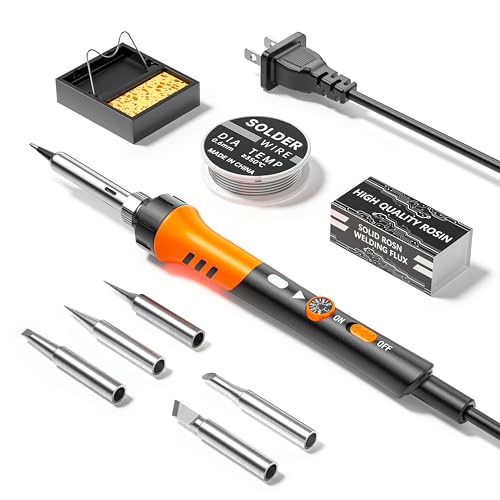
The switch is the point. MEAKEST puts a power switch on the handle, so the iron goes cold without anyone hunting for the plug. On a tool that gets passed between a teenager building a guitar pedal and a parent fixing a lamp cord, that's the difference between a habit and a hazard.
The second safety piece is the high-temperature silicone protective cover over the grip, which sits between your fingers and the hot barrel. The temperature range is published at 200°C to 450°C.
Physically it splits the difference: 3.17 oz in a 0.98 x 8.66 x 0.87 in body, lighter than the Liouhoum, heavier than the Q-MING 60W. The 9-in-1 count includes five tip shapes, which MEAKEST lists for guitars, watches, wires, mobile devices and computer hardware. Roughly mid-range for this set on price.
Two gaps. No heat-up time is published, so you can't compare it against the 10 and 15-second claims elsewhere. And no warranty term appears in the listing, which is a real omission next to the Liouhoum's 24 months on a tool aimed at less careful hands.
Pros:
- On/off switch on the handle for safe idling
- Silicone high-temperature grip guard
- Published 200°C to 450°C range
- Five tip shapes for mixed household jobs
- 3.17 oz, mid-weight and easy to control
Cons:
- No published warranty term
- No heat-up time stated for comparison
- No digital readout, unlike three other picks
- No desoldering pump in the 9-in-1 bundle
5. MEAKEST Soldering Iron Premium Kit — Best upgrade
Twelve pieces including a desoldering pump and larger consumable quantities, which is the most complete pencil-iron bundle here.

Best for: someone who wants desoldering gear included Skip it if: wattage is your priority
Removing solder is half the job on any repair, and this is the only pencil-iron kit in the set that ships a desoldering pump. The count of 12 also covers tips, solder wire and paste, and MEAKEST says it increased the wire and paste quantities specifically because customers ran out.
That last point is worth more than it sounds. Cheap kits often include a token metre of solder that disappears in one afternoon, turning a complete kit into a bare iron.
Electrically it matches the other MEAKEST: 110V, 60W, adjustable 200°C to 450°C, with an on/off key on the handle and the same silicone protective cover. Body dimensions are identical at 0.98 x 8.66 x 0.87 in, and the shipped weight is 1.26 lb because of everything packed around it.
The honest problem is the price position. This sits at the premium end of the lineup and still gives you 60 watts, no digital display and no published warranty. You're paying for accessories, not capability. If the pump and the extra consumables don't interest you, the Q-MING 80W gives you more iron for less.
Pros:
- Twelve pieces, the largest pencil-iron bundle here
- Only pencil kit including a desoldering pump
- Increased solder wire and paste quantities
- On/off key and silicone grip guard
- Published 200°C to 450°C adjustment range
Cons:
- Premium price position for 60 watts
- No digital temperature display
- No published warranty term
- No heat-up time stated in the listing
6. Plusivo Soldering Iron Kit — Best budget pick
The cheapest of the seven, and the only one backed by a 30-day money-back replacement plus lifetime customer support.

Best for: one-off repairs on a strict budget Skip it if: you want five tips and a desoldering pump
If you need to fix one speaker wire and put the tool in a drawer, start here. This is the cheapest of the seven and it still covers the essentials: a 60W adjustable iron with a ceramic heating element, solder wire, a stand with cleaning sponge and the accessories to begin immediately.
Plusivo's support terms are the most specific in the set. The listing states a 30-day money-back or replacement window for factory defects plus lifetime customer support. That's a different kind of coverage from Liouhoum's 24-month replacement, but it's a stated commitment where four other picks say nothing.
The handle gets an anti-slip heat-resistant grip and four ventilation holes for dissipation, the same approach as the Q-MING 80W. Shipped weight is 5.29 oz.
Being honest about what 5-in-1 means: this is the leanest bundle here. No five-tip set, no desoldering pump, no flux paste beyond the rosin included, and no digital display. No temperature range or heat-up figure is published either, so "heats up quickly" is all you get. It's the entry point, not the value peak.
Pros:
- Cheapest of the seven picks
- 30-day money-back replacement plus lifetime support
- Ceramic heating element with adjustable temperature
- Anti-slip heat-resistant grip with four vent holes
- Complete enough to solder out of the box
Cons:
- 5-in-1 is the smallest bundle in this set
- No five-tip set, unlike four other picks
- No published temperature range or heat-up time
- No digital display and no long warranty term
7. WEP 926LED V3 Soldering Station 130W MAX — Best premium
130W max, a 392°F to 896°F range and an eleven-piece kit, which is more capability than any pencil iron here can offer.

Best for: a fixed bench where the iron lives permanently Skip it if: you need to carry it in a bag
This is the one genuine station in the group, and the specs show why that matters. 130W max is over 60% more than the 80W pencil irons, and the range runs from 392°F to 896°F, a wider window than the 842°F ceiling on both published pencil-iron specs. Temperature comes off a control knob with a digital real-time readout, plus C to F conversion.
The eleven-piece kit includes solder wire, five extra tips, tweezers, a desoldering pump and a tip cleaner. WEP also lists a sleep mode that idles the iron after 10 minutes to reduce tip wear, and 1-year USA technical support with 24-hour assistance.
The holder is built into the station body, which keeps the footprint to 4.45 x 6.3 x 4.84 in.
Two real limits. It weighs 1.98 lb and needs bench space, so it's the wrong tool for a toolbox or a job site. And it's the most expensive pick here, as well as the slowest seller of the seven. If your soldering happens three times a year, the money buys headroom you'll never reach.
Pros:
- 130W max, the highest power in this set
- Widest published range at 392°F to 896°F
- Eleven pieces including tweezers and a solder sucker
- Sleep mode after 10 minutes to extend tip life
- Digital readout with C to F conversion
Cons:
- 1.98 lb with a 4.45 x 6.3 x 4.84 in footprint
- Most expensive pick in this lineup
- Not portable, unlike all six pencil irons
- Overpowered for occasional light repairs
Pencil iron or soldering station: which should you buy?
This is the fork that matters more than brand. Six of these seven are pencil irons and one is a station, and the deciding question is where the tool lives.
A pencil iron puts everything in the handle and plugs straight into the wall. The Liouhoum's barrel is 0.83 in across and 7.87 in long, so it fits any drawer. The Q-MING 60W weighs 1.76 oz. You can carry either to a car, a loft or a friend's kitchen table. Q-MING makes exactly that pitch: portable, plug and use, no station required.
A station separates the control electronics from the iron. The WEP 926LED V3 base measures 4.45 x 6.3 x 4.84 in and the whole thing weighs 1.98 lb, so it claims permanent bench space. What you get for that is 130W max, a range up to 896°F, a knob that's easier to set precisely than a handle button, and a holder that's part of the body rather than a folding wire stand.
The threshold is frequency. Solder more than once a month, at a bench you don't pack away, and the station earns its space. Anything less, and a pencil iron is the better cheap soldering iron because it never becomes clutter.
What comes in the box, and what you'll still need
Kit counts run from 5 to 12 pieces here, and the number alone hides what's actually different.
Here's what the bundles cover across the set:
- Solder wire: every pick includes it. Only Q-MING's 60W kit states the gauge, at 0.6mm.
- Stand and sponge: in all six pencil kits. The WEP builds its holder into the station.
- Five interchangeable tips: both Q-MING kits, both MEAKEST kits and the WEP. Not the Plusivo.
- Flux paste: Q-MING 80W, Q-MING 60W and both MEAKEST kits.
- Desoldering pump: MEAKEST 12-in-1 and the WEP station only.
- Tweezers and tip cleaner: WEP station only.
Two items you'll likely buy separately whichever pick you choose. A brass wool tip cleaner outlasts the wet sponge that ships in these kits and doesn't thermally shock the tip. And a helping-hands clamp, because holding a board, a wire and an iron with two hands does not work.
If you plan on desoldering at all, the pump is the item to prioritise. Only two picks here include one, and buying it after the fact often costs more than the gap between kits.
Which mistakes ruin a cheap iron fastest?
Most dead budget irons weren't defective. They were mistreated in one of four predictable ways.
- Running at maximum all the time. Every adjustable pick here tops out at 450°C or above, and the WEP reaches 896°F. Sitting there cooks the tip plating in weeks. Most electronics work sits far lower.
- Leaving it hot for hours. This is why the sleep functions matter. The Liouhoum drops temperature after 5 minutes on the stand, the WEP after 10 minutes. The MEAKEST kits solve it with a handle switch instead.
- Never tinning the tip. A dry tip oxidises and stops transferring heat, at which point people blame the wattage. Leave a bead of solder on it before you shut down.
- Filing or sanding the tip. It removes the iron plating and ends the tip's life immediately. This is why five-tip kits are worth paying for: you swap instead of scrape.
One more habit that isn't about damage. Set the temperature for the joint, not the iron. A fine header pin and a thick ground plane want different numbers, and the picks with a real display, the Q-MING 80W, the Liouhoum and the WEP, make that adjustment something you can actually see rather than guess.
The verdict
At the entry end of this lineup, the Plusivo is the honest floor. It's the cheapest of the seven, it has a ceramic element and adjustable temperature, and its 30-day replacement plus lifetime support is a real commitment. It's a one-repair tool, and it says so with a 5-in-1 bundle.
The middle is where the best cheap soldering iron actually lives, and the Q-MING 80W owns it. Eighty watts of reserve, an LCD readout, a claimed 20-second heat-up and seven pieces including five tips and flux paste. Nothing else here gives you power and a visible temperature in the same tool at that position. The Liouhoum sits just below it on price and answers with a 24-month replacement warranty, a 10-second heat-up claim, auto-sleep and temperature memory. That warranty is its clearest advantage over the winner, and if coverage decides it for you, buy the Liouhoum without hesitation.
At the premium end, only the WEP 926LED V3 justifies the position with capability rather than accessories. 130W max, 392°F to 896°F, eleven pieces, and a footprint of 4.45 x 6.3 x 4.84 in that commits you to a bench. The two premium pencil kits ask for similar money and still deliver 60 watts.
FAQ
Is a cheap soldering iron worth buying for occasional repairs?
A cheap soldering iron is worth buying for occasional repairs, provided it adjusts temperature. Fixed-heat irons run too hot and lift pads. Every pick here adjusts, and five publish a range. For a few jobs a year, the Plusivo 5-in-1 covers wire, stand, sponge and solder. Frequent bench work is where paying more starts returning something.
What wattage do I need for a best cheap soldering iron?
For a best cheap soldering iron, 60 watts handles most electronics and 80 watts gives you reserve for thick wire and ground planes. The picks here run 60W, 80W and 130W max on the WEP station. Higher wattage recovers heat faster after contact. It does not mean the iron runs hotter, since temperature is set separately.
Q-MING 80W or Liouhoum: which pencil iron should I pick?
Between Q-MING 80W and Liouhoum, both are 80 watts with an LCD display. Q-MING bundles seven pieces including flux paste and claims 20-second heat-up. Liouhoum claims 10 seconds, adds auto-sleep after 5 minutes plus temperature memory, and publishes a 24-month replacement warranty. Choose Liouhoum for the warranty and sleep function, Q-MING for the more complete starter box.
Do these kits include enough tips for different jobs?
These kits include enough tips for varied work in most cases. Four picks ship five interchangeable shapes: both Q-MING kits, both MEAKEST kits, and the WEP station also carries five extras. The Plusivo does not. Tip shape matters because a conical point suited to a header pin transfers too little heat for a battery tab or thick wire.
How hot should the tip run for electronics work?
The tip should run well below maximum for electronics work. Five picks here publish 200°C to 450°C, or 392°F to 842°F, and the WEP station reaches 896°F. Running at the ceiling constantly strips tip plating fast. Set the temperature for the joint size instead, which is easier on the three picks with a digital readout.
Pick your side of the fork first. If the iron will live on a bench and get used regularly, the WEP 926LED V3 and its 130W max is the tool you grow into. If it will live in a drawer, the Q-MING 80W kit is the smarter default, because 80 watts with a readable temperature is the combination that lets a beginner make clean joints on the first evening rather than the tenth. Add brass wool and a helping-hands clamp with whichever you choose. Then start on something cheap and unimportant, because the first three joints of your life are practice, not repair.