Best Workbench for Mechanics in a Tight Garage Bay
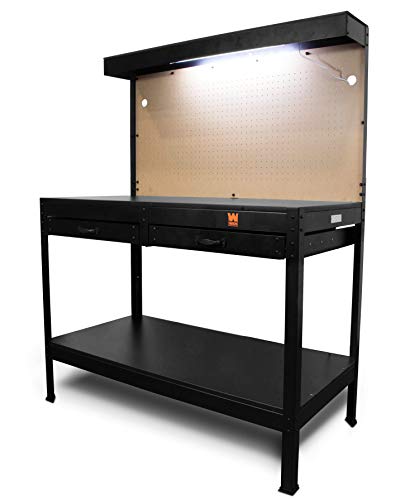
Five workbenches compared on published load ratings, footprint and built-in power. The WEN WB4723T takes the top spot, but two rolling carts beat it if your bay space is already spoken for.

By Dexter GillUpdated 15 min read
On this page
- Best workbench for mechanics at a glance
- How I screened these five workbenches for mechanics
- What actually decides a workbench for mechanics?
- 1. WEN WB4723T 48-Inch Workbench with Power Outlets and Light — Best overall
- 2. IGERI 39" Heavy Duty Work Bench With Drawer and Storage — Best for heavy use
- 3. Pterying Garage Workbench with LED Light Bar — Best for families
- 4. Dehoyi Heavy Duty Adjustable Height Metal Rolling Tool — Most versatile
- 5. WeiSnap Rolling Tool Cart with Phone Stand — Best budget pick
- Fixed bench or rolling cart: which suits your bay?
- How much weight can these tops really hold?
- What the listings do not tell you
- The verdict
- FAQ
The best workbench for mechanics is the WEN WB4723T, because it's the only pick here that publishes a 220-pound top capacity alongside three 13-amp outlets and an overhead light in one 25 by 48-inch footprint. If your garage floor is already full of car, the Dehoyi rolling tool tray is the better buy: it adjusts from 36.2 to 42.9 inches and rolls out of the way.
Short on time? Here's the 30-second shortlist. Take the WEN if you have a wall to give it. Take the IGERI if a vise and a 2,000-pound claimed frame rating matter more than power outlets. Take the Dehoyi if the work happens beside the car, not against the wall.
Best workbench for mechanics at a glance
| Pick | Claimed load | Footprint / height | Price |
|---|---|---|---|
| 220 lb top claim | 25 x 48 in, 62 in tall | Check Price | |
Best for heavy use IGERI 39" Heavy Duty Work Bench With Drawer and Storage |
2,000 lb frame claim | 39.4 x 21.7 in, 35 in top | Check Price |
Best for families Pterying Garage Workbench with LED Light Bar |
600 lb frame claim | Listed as Large, 74.1 lb unit | Check Price |
Most versatile Dehoyi Heavy Duty Adjustable Height Metal Rolling Tool |
No figure published | Adjusts 36.2 to 42.9 in | Check Price |
Best budget pick WeiSnap Rolling Tool Cart with Phone Stand |
No figure published | 39 x 12 x 16.5 in | Check Price |



How I screened these five workbenches for mechanics
I sorted this set by buyer profile first, because "mechanic" covers three very different people and one bench can't serve all of them.
The first profile is the wall-bay owner. You have a stretch of garage wall, you want the bench there permanently, and you want power at the surface so the impact charger and the shop radio stop fighting over one outlet. Two picks publish built-in outlets. Both landed near the top.
The second profile is the vise-and-press user. You bolt things down and lean on them. Frame rigidity and a stated load claim outrank convenience features here, which is why a bench with no outlets still earns a high spot.
The third profile is the beside-the-car mechanic. Your bay is occupied by a vehicle on stands, and a fixed bench simply doesn't fit the way you work. Two rolling carts serve you, and they're the two cheapest picks in the set.
One note on search. Amazon's results for a workbench for mechanics mix true benches with tool carts and craft tables, so the word "mechanic" in a listing title is a marketing choice rather than a specification. I judged each pick on its published figures instead, and I've flagged where those figures are missing.
What actually decides a workbench for mechanics?
Most guides compare tabletop material. Steel top, hardwood top, engineered wood top. That's not what decides it.
Footprint and working height decide it. A garage bay has a fixed amount of floor, and the car takes most of it. The WEN measures 25 by 48 inches and stands 62 inches tall with the light overhead. The IGERI top sits at 35 inches. The Dehoyi swings between 36.2 and 42.9 inches. Those three numbers describe three completely different working postures.
Here's the trick with height. A 35-inch top is comfortable standing and terrible for anything you want to look down into. A 42.9-inch surface is right for detail work at eye level and wrong for pressing a bearing, because you can't get your weight over it. Measure your own hip height before you compare load claims.
The second deciding factor is where the power comes from. Three of these picks have no electrical hardware at all. If your garage has one outlet by the door, the best workbench for mechanics in your case is one that brings sockets to the surface. That narrows five picks to two very fast.
1. WEN WB4723T 48-Inch Workbench with Power Outlets and Light — Best overall
The only pick here that combines a published top capacity, three outlets and an overhead light in one 48-inch package.
Best for: a home mechanic with a dedicated 25-inch-deep wall bay Skip it if: your only free space is under 62 inches of ceiling
What separates the WB4723T inside this group is that it's a complete station rather than a surface. WEN lists three built-in 13-amp power outlets and an overhead fluorescent light, plus a pegboard, two drawers, and upper and lower shelves. No other pick here bundles all four of those.
The published figures give you enough to plan around. The footprint is 25 by 48 inches, the whole thing measures 61.8 x 47.4 x 25 inches, and the unit weighs 88.5 pounds, the heaviest of the five. WEN describes the enamel-coated top as non-marring with a 220-pound capacity.
That 220-pound claim is the honest limit. It's plenty for a cylinder head, a transmission case or a full rolling toolbox drawer's worth of sockets, and it's nowhere near the 2,000-pound number the IGERI listing quotes for its frame. This is also the most expensive pick here, and the height means a low ceiling or a garage door track can rule it out before anything else does.
Pros:
- Three built-in 13-amp outlets, unmatched in this set
- Overhead light included, no separate fixture needed
- Pegboard, two drawers and two shelves in one unit
- 220-lb non-marring top capacity published
Cons:
- Most expensive pick in this group
- 62-inch height rules out low-ceiling and under-shelf spots
- 220-lb top claim well below the IGERI frame figure
- Heaviest unit at 88.5 lb, awkward to reposition alone
2. IGERI 39" Heavy Duty Work Bench With Drawer and Storage — Best for heavy use
The highest published load claim in this set by a wide margin, in the smallest usable footprint.

Best for: vise work and pressing where frame rigidity matters most Skip it if: you need built-in outlets or overhead light
IGERI quotes a 2,000-pound load capacity for the all-steel frame, roughly nine times the number WEN publishes for its top. That's the reason this one sits second. If you're bolting on a vise and leaning into a stubborn hub, frame stiffness is the specification that matters, and this is the pick that leans hardest on it.
The dimensions are 35 x 21.7 x 39.4 inches, with a 39.4 by 21.7-inch work surface and a 35-inch working height. IGERI describes the top as scratch-resistant engineered wood and adds a full steel drawer on smooth-glide slides, a reinforced lower shelf, and adjustable leveling feet for a sloped garage floor.
At 37 pounds it's the lightest of the three fixed benches, which is worth reading carefully next to that 2,000-pound frame claim. A light bench with a huge stated capacity needs to be bolted down or loaded evenly to stay planted. There's no power hardware, no pegboard and no light here, so budget for a strip and a lamp.
Pros:
- 2,000-lb frame load claim, highest published here
- 35-in working height suits standing bench work
- Full steel drawer on heavy-duty glides
- Adjustable leveling feet for uneven garage floors
Cons:
- No outlets, USB ports or light of any kind
- No pegboard, so wall storage is on you
- 21.7-in depth is the shallowest of the fixed benches
- 37-lb unit weight is light for the load figure quoted
3. Pterying Garage Workbench with LED Light Bar — Best for families
A welded-frame bench with USB charging built in, which is the detail that makes it work as a shared surface.

Best for: a shared garage bench used for repairs and school projects Skip it if: you regularly load an engine head onto the top
The Pterying is the other pick with electricity at the surface, and it goes further than the WEN on ports. The listing describes four AC outlets, two USB ports and a power switch on a side panel, plus a 14W LED light bar. That combination is why I'd hand this one to a household where the bench does double duty.
Storage is generous on paper: a pegboard with 12 hooks, two drawers and three-tier shelves. Pterying quotes a 600-pound capacity for the welded A3 alloy steel frame and says the welded construction is more rigid than bolt-together alternatives. Adjustable leveler feet handle a sloped floor. The unit weighs 74.1 pounds.
Two gaps hold it back. The listing gives its size as "Large" with no overall dimensions published, so you can't check it against a tape measure before it arrives. And the 600-pound frame claim, while comfortable for hand tools and parts bins, is a third of the IGERI figure. This also sits in the upper price bracket here, which is a lot to pay when the footprint isn't published.
Pros:
- Four AC outlets and two USB ports on a side panel
- 14W LED light bar included
- Pegboard with 12 hooks plus two drawers and three shelves
- Welded A3 alloy steel frame with leveler feet
Cons:
- No overall dimensions published, only "Large"
- 600-lb frame claim well under the IGERI figure
- Among the priciest picks despite missing size data
- Only one seller lists it
4. Dehoyi Heavy Duty Adjustable Height Metal Rolling Tool — Most versatile
The only pick that changes its own working height, from 36.2 to 42.9 inches.
Best for: brake and suspension work beside the car Skip it if: you want a permanent surface for a bench vise
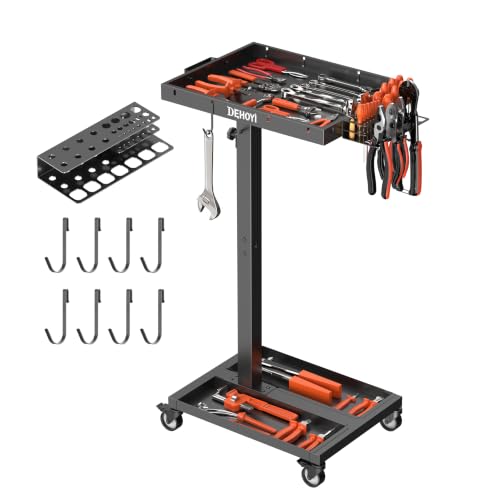
Nothing else here adjusts. Dehoyi lists a height range of 36.2 to 42.9 inches, which covers standing work at a wheel and a lower setting for reaching into an engine bay. That single specification is what earns it the versatility label in this set.
The design is built around movement. Four 360-degree swivel wheels, a double tray so you can grab a socket without straightening up, and a thickened metal plate with an anti-rust powder-coated finish. Dehoyi pitches it directly at mechanics working under vehicles. It's the second-cheapest pick here.
The trade-off is that a rolling tray isn't a bench. There's no published load figure, no dimensions beyond the height range, and no weight given, so you're buying on the description rather than the numbers. A vise wants something bolted to a fixed frame, not a cart on casters. Compared with the fixed benches above, you also lose drawers, a pegboard and any power hardware. Buy it as the thing that works next to the car, not the thing that replaces the bench.
Pros:
- Height adjusts 36.2 to 42.9 in, unique in this set
- Four 360-degree swivel casters for bay-to-bay moves
- Double tray keeps tools reachable from the floor
- Powder-coated anti-rust metal construction
Cons:
- No load capacity figure published anywhere
- No dimensions or weight listed
- No drawers, pegboard, outlets or light
- Casters make it unsuitable for vise or press work
5. WeiSnap Rolling Tool Cart with Phone Stand — Best budget pick
The cheapest way to get a magnetic tool surface rolling next to the car.

Best for: keeping sockets and fasteners magnetically parked at the wheel Skip it if: you want drawers or a rated load figure
This is the cheapest of the five and the most single-minded. WeiSnap describes a powerful magnetic surface that holds metal tools so they don't slide off, an expanded pallet for parts and accessories, and a phone stand for following a repair video while your hands are busy.
Measured at 39 x 12 x 16.5 inches, it's the narrowest thing here by a long way. That 12-inch depth is deliberate: it slips into the gap between a car and a wall where nothing else in this set fits. WeiSnap says assembly takes a few minutes.
The magnetic top is genuinely the right idea for anyone who has lost a caliper bolt into a floor drain. But the compromises are real. No load figure, no weight, no drawers, no shelf, no power. It's also the slowest seller of the five by a wide margin, which is worth knowing when only one seller lists it and you have limited ways to compare. Treat it as an accessory to a bench rather than a bench, and it earns its keep.
Pros:
- Cheapest pick in this group
- Magnetic top holds loose metal fasteners
- 12-in depth fits gaps no other pick here will
- Phone stand for following repair videos
Cons:
- No load capacity, weight or material figures published
- No drawers, shelves or power hardware
- Slowest seller of the five
- 16.5-in profile is too low to work at standing
Fixed bench or rolling cart: which suits your bay?
This is the fork in the road, and it comes before every other comparison. Work through it in order.
- Measure the free wall run in your bay. Under 48 inches and the WEN is out. Under 40 inches and both fixed benches are out.
- Measure your ceiling and any door track. The WEN needs 62 inches of vertical clear space.
- Decide whether you'll bolt a vise down. If yes, you need a fixed bench. Casters and vises don't mix.
- Count your outlets. One outlet in the whole garage points you at the WEN or the Pterying.
- Ask where you actually stand while working. If the answer is "next to the car", the Dehoyi or WeiSnap wins regardless of everything above.
The pattern in this set is clean. The three fixed benches carry storage, published capacities and, in two cases, power. The two rolling picks carry mobility, adjustability and the lowest prices, and give up almost all published specifications in exchange.
Plenty of people end up owning one of each. A fixed bench against the wall for assembly and vise work, plus a cart that lives beside the jack stands. If you're building up from nothing, start with the fixed bench: it's the harder gap to fill later.
How much weight can these tops really hold?
Load claims in this category are not measured to a common standard, so read them carefully rather than ranking them.
Here's what the listings actually say:
- IGERI: 2,000 pounds, described as the all-steel frame capacity
- Pterying: 600 pounds, described as the welded A3 alloy steel frame capacity
- WEN: 220 pounds, described as the table top capacity
- Dehoyi and WeiSnap: no figure published
Notice the wording. The two big numbers describe frames. The WEN number describes the surface you put things on. Those aren't the same measurement, and a frame rating tells you nothing about whether an engineered wood top will dent under a concentrated point load.
Most shoppers miss this and rank the benches by whichever number is biggest. In practice, a 220-pound top rating handles nearly everything a home mechanic puts on a bench. A cylinder head, a stack of rotors, a battery. The place you feel a difference is under shock and leverage: a vise, a press, a stuck fitting you're fighting with a breaker bar. That's where the IGERI frame claim earns its position.
For the two rolling picks, treat load as unknown and keep them for hand tools and small parts.
What the listings do not tell you
Some gaps in this data are worth naming before you buy.
Assembly time and hardware. Pterying mentions labeled, pre-drilled hardware with step-by-step instructions, and WeiSnap says a few minutes. Nobody publishes a realistic figure. An 88.5-pound bench with a light and outlets is not a ten-minute job.
Top thickness. IGERI names engineered wood, WEN names an enamel coating. Neither gives a thickness, and thickness is what determines whether a dropped socket leaves a dimple.
Whether the top can be replaced. A workbench for mechanics eventually gets gouged and stained. None of these listings says whether the surface unbolts.
Drawer dimensions. Three picks mention drawers. None publishes internal measurements, so you can't tell whether a socket rail fits.
Vise mounting. No listing here confirms a pre-drilled vise position or a reinforced corner. If a vise is central to your plan, assume you'll be drilling.
None of these gaps is a reason to avoid the category, but they're the reason I weighted published dimensions and load figures so heavily. A specification a brand commits to in writing is worth more than a paragraph of adjectives.
The verdict
Read this set as three tiers, and pick the tier before you pick the product.
At the entry level, both picks are rolling carts and both give up published specifications for mobility and price. The Dehoyi is the one I'd take, because the 36.2 to 42.9-inch height range makes it useful at three different jobs. The WeiSnap is the cheaper, narrower answer, and its magnetic top and 12-inch depth are the reason to choose it over the Dehoyi.
In the middle sits the IGERI, and it's the pick I'd push hardest on anyone who works with a vise. A 2,000-pound claimed frame rating, a 35-inch working height, a steel drawer and leveling feet, with no power hardware to pay for. That's a straightforward trade.
At the top, the WEN WB4723T wins the whole comparison. Three 13-amp outlets, an overhead light, a pegboard, two drawers, two shelves and a 220-pound top rating in a 25 by 48-inch footprint. Nothing else here does all of that. The Pterying's exact advantage over it is the ports: four AC outlets plus two USB, against the WEN's three outlets and no USB.
The cutoff is your ceiling. Below 62 inches of clear vertical space, the WEN is out and the IGERI takes the top spot.
FAQ
Is a dedicated workbench for mechanics worth it over a folding table?
A dedicated workbench for mechanics is worth it the moment you start applying force. A folding table has no published load rating and nothing to bolt a vise to. The IGERI quotes 2,000 pounds for its steel frame, and the WEN publishes 220 pounds for its top. Those figures exist because the manufacturers expect real loads.
Which is better value, the WEN WB4723T or the IGERI 39-inch bench?
Better value depends on whether you need power. The WEN costs more and includes three 13-amp outlets, an overhead light and a pegboard. The IGERI sits mid-range here with a 2,000-pound frame claim, a 35-inch top and a steel drawer, but nothing electrical. If your garage already has outlets and a light, the IGERI is the sharper buy.
What working height should I look for in a garage workbench?
Working height should match your hip. The IGERI top sits at 35 inches, which suits standing assembly and vise work. The Dehoyi adjusts from 36.2 to 42.9 inches, better for detail tasks at eye level. Measure from the floor to your wrist with your arm relaxed, then compare that number against the published height before you order.
Do any of these picks have built-in power outlets and USB ports?
Built-in power outlets appear on two picks. The WEN WB4723T lists three 13-amp outlets and an overhead fluorescent light. The Pterying adds four AC outlets, two USB ports, a power switch and a 14W LED light bar. The IGERI, Dehoyi and WeiSnap have no electrical hardware at all, so plan on a separate power strip.
What is the most common mistake when buying a workbench for mechanics?
The most common mistake is buying on load capacity alone. Frame ratings and top ratings measure different things, and a 2,000-pound frame figure says nothing about surface dents. The mistake that actually costs money is skipping the tape measure. The WEN needs 62 inches of vertical clearance, which a low garage door track quietly removes.
Start with the tape measure, not the spec sheet. Measure your free wall run, your ceiling clearance and the height from the floor to your relaxed wrist, then hold those three numbers against the picks above. If all three clear, the WEN WB4723T is the right default, because it's the only bench here that solves storage, lighting and power in one delivery instead of three. If any of them fails, drop to the IGERI for fixed work or the Dehoyi for work beside the car, and you'll still be ahead of a folding table with a socket set on it.