Best Wood Filler for Rot, Cracks and Nail Holes

A ranked look at six wood fillers by size, cure behaviour and repair type, from Gorilla's 16 oz tub to Bondo's two-part rot kit and DAP's colour-change budget tube.

By Dexter GillUpdated 15 min read
On this page
- Best wood filler at a glance
- How I ranked six fillers on the specs that matter
- One-part putty or two-part filler: which do you need?
- Best wood filler picks, ranked
- 1. Gorilla All Purpose Wood Filler — Best overall
- 2. 3M Bondo Wood Filler 30 oz — Best premium
- 3. DAP Plastic Wood-X with DryDex Wood Filler — Best budget pick
- 4. Gorilla All Purpose Wood Filler (Tube) — Best upgrade
- 5. Boncart Wood Filler — Best minimal setup
- 6. DAP Plastic Wood All Purpose Latex Wood Filler — Best for pros
- Does a stainable filler ever truly match the wood?
- How much filler does your job actually need?
- When a different pick wins
- The verdict
- FAQ
The best wood filler for most repairs is the Gorilla All Purpose Wood Filler in the 16 oz tub, because it covers cracks, gouges and holes across a whole project without running out and takes stain, paint and sanding. If you're fixing rotted or missing wood rather than a surface flaw, the two-part 3M Bondo Wood Filler is the better buy, with a 1.9 lb filler plus hardener that chemically bonds and is sandable in 15 minutes. Here's how each tier of this category buys you something different.
Best wood filler at a glance
| Pick | Size | Type | Price |
|---|---|---|---|
Best overall Gorilla All Purpose Wood Filler |
16 oz tub | One-part putty | Check Price |
Best premium 3M Bondo Wood Filler 30 oz |
1.9 lb + hardener | Two-part | Check Price |
Best budget pick DAP Plastic Wood-X with DryDex |
5.5 oz | Latex, colour-change | Check Price |
Best upgrade Gorilla All Purpose Wood Filler (Tube) |
6.08 oz tube | One-part putty | Check Price |
Best minimal setup Boncart Wood Filler |
9.87 oz + kit | One-part putty | Check Price |
Best for pros DAP Plastic Wood All Purpose Latex |
6 oz | Latex, white | Check Price |


How I ranked six fillers on the specs that matter
I lined up the published specifications for all six and compared them on the things a repair actually turns on: how much product you get, whether the filler cures on its own or needs a hardener, what colour it dries, and whether the listing claims it takes stain and paint. Volume and cure type did most of the sorting.
Three criteria carried the most weight, in this order:
- Cure type. A one-part putty air-dries. A two-part filler mixes with hardener and bonds chemically. That single split decides which jobs a filler can handle.
- Usable volume. The 16 oz Gorilla tub and the 1.9 lb Bondo filler dwarf the 5.5 oz DAP tube. Volume decides how far one container stretches.
- Finish behaviour. Stainable, paintable and sandable claims decide whether the repair disappears.
Everything else, from tub versus tube to the extras in the box, broke ties. A search for the best wood filler throws up dozens of near-identical tubs, so I leaned on the numbers that separate them rather than the marketing on the label.
One-part putty or two-part filler: which do you need?
One-part putty is the default. You scoop it, press it into the flaw, let it air-dry, then sand. Five of these six work that way, including both Gorilla sizes and both DAP tubes. It's the right choice for nail holes, hairline cracks and shallow gouges.
A two-part filler is a different animal. The 3M Bondo pairs a 1.9 lb filler with a 1 oz cream hardener you mix in before use. Bondo says the formula chemically bonds with the surface to adhere permanently and is sandable in 15 minutes. That chemistry is what lets it rebuild rotted or missing wood, not just cover it.
The trade-off is working time. Once you mix a two-part filler, the clock starts, so you commit to what you mixed. A one-part putty stays workable in the tub between sessions. Match the filler to the damage:
- Surface flaws under 1/4 inch: one-part putty.
- Deep fills, rebuilt edges, rot: two-part filler.
- A mix of both across a project: keep one of each.
Best wood filler picks, ranked
1. Gorilla All Purpose Wood Filler — Best overall
The 16 oz tub gives you enough one-part putty to work through a whole project, and the listing claims it stains, paints and sands.
Best for: someone patching cracks and holes across several projects Skip it if: you're repairing structural rot
What sets this one apart in the set is volume in a form you can dip into repeatedly. At 16 oz, the tub holds far more than the 6.08 oz Gorilla tube or the 5.5 oz DAP, and because it's one-part putty, you use only what you need and reseal the rest. The tub measures 2.9 x 4.1 x 4.1 in and weighs about 1 lb, so it stores on a shelf without hogging space.
Gorilla says the formula is water resistant, spreads to a smooth natural finish, and does not shrink or crack, which matters on both indoor and outdoor repairs. The listing also claims it's paintable, stainable and sandable, and that it anchors nails and screws. Those are the manufacturer's claims, not lab results, but they cover the everyday jobs most people buy filler for.
This is also the one buyers reach for most often across this set. The trade-off: it air-dries, so it won't rebuild rotted wood the way the two-part Bondo does. For surface work, though, it's the most flexible pick here.
Pros:
- Largest usable volume in this set at 16 oz
- Resealable tub for repeated use
- Claimed water resistant, indoor and outdoor
- Paintable, stainable and sandable per the listing
- The pick buyers choose most often here
Cons:
- One-part putty won't rebuild rotted wood
- Air-dry cure is slower than a two-part filler
- Only two sellers list it
- Colour described only as natural, not matched to a species
2. 3M Bondo Wood Filler 30 oz — Best premium
A two-part filler with a 1.9 lb tub and 1 oz hardener that chemically bonds and, per the listing, sands in 15 minutes.

Best for: repairing rotted or missing wood on doors and sills Skip it if: you only have small indoor nail holes to fill
This is the only two-part filler in the group, and that's the whole point. Bondo pairs a 1.9 lb filler with a 1 oz cream hardener you mix before applying. Bondo says the formula chemically bonds with the surface to adhere permanently, makes quick durable repairs to damaged and rotted wood, and is sandable in 15 minutes. That fast cure is a real edge when you're rebuilding an edge and want to shape it the same afternoon.
At 2 lb total and 4.25 x 4.25 x 7 in, it's the heaviest and one of the bulkiest picks here. The colour is light brown, which reads closer to bare softwood than the white DAP latex does. Bondo lists it for most wood-based interior or exterior surfaces.
The trade-offs are real. It's the most expensive pick here, mixing adds a step, and once hardener is in, your working time is limited. For rot and missing chunks, no one-part putty in this set competes.
Pros:
- Two-part chemistry bonds and rebuilds rotted wood
- Sandable in 15 minutes per the listing
- Large 1.9 lb filler volume plus hardener
- Light brown tone closer to bare softwood
- Rated for interior or exterior surfaces
Cons:
- The most expensive pick here
- Mixing adds a step and limits working time
- Heaviest and bulkiest at 2 lb
- Overkill for small nail holes
3. DAP Plastic Wood-X with DryDex Wood Filler — Best budget pick
The cheapest pick here, with a colour-change indicator that goes on pink and dries natural so you know when to sand.

Best for: beginners who want a dry-time signal Skip it if: you need a large-volume tub
This is the cheapest of the six and the one I'd hand a first-timer. DAP's DryDex indicator goes on pink and dries to a natural tone, giving you a clear visual cue that the repair is ready to sand. That removes the guesswork that trips up people new to filler, who tend to sand too soon.
The tube holds 5.5 oz and weighs 5.44 oz, in a compact 2 x 2.5 x 2.5 in package. DAP calls it a thick, knife-grade latex formula that can be molded and sculpted to fill any shape, and says it looks and acts like real wood. It's listed as stainable, paintable, and able to be planed, cut, drilled, screwed and nailed. DAP gives dry times of 3 to 6 hours for fills up to 1/8 inch and 36 hours for depths of 1/4 inch and over.
The trade-off is size. At 5.5 oz it's the smallest here, so it suits touch-ups rather than a house full of trim. For learning the technique cheaply, it's the pick.
Pros:
- The cheapest pick in this set
- Pink-to-natural indicator confirms dry time
- Knife-grade formula moulds into any shape
- Listed as stainable and paintable
- Compact tube stores anywhere
Cons:
- Smallest volume at 5.5 oz
- Deep fills need 36 hours to cure
- Not suited to large projects
- Only two sellers list it
4. Gorilla All Purpose Wood Filler (Tube) — Best upgrade
The same natural-finish Gorilla putty in a 6.08 oz tube, sized for quick touch-ups instead of a full project.
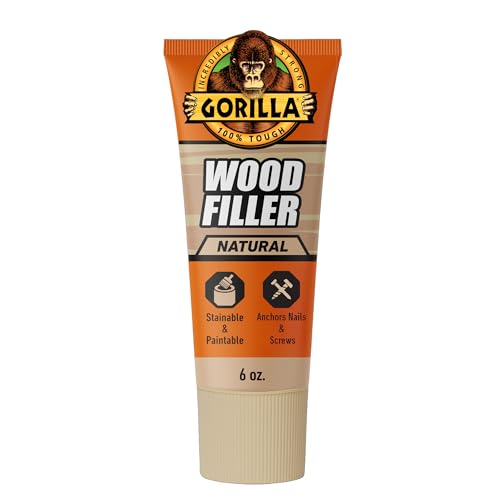
Best for: small touch-ups where a tube beats a tub Skip it if: you have a lot of holes to fill at once
This is the tub's smaller sibling, and the format is the difference. At 6.08 oz in a 6.8 x 1.7 x 2.8 in tube, it's easier to control for spot repairs than dipping a knife into a big tub. You squeeze what you need onto a nail hole or hairline crack and cap it. Less mess, less waste on a small job.
The formula matches the overall winner. Gorilla says it's water resistant, does not shrink or crack, spreads to a smooth natural finish, and works indoors or outdoors. The listing also claims it's paintable, stainable and sandable, and that it anchors nails and screws. Same claims, smaller package.
Because it's the same putty, it carries the same limit: it air-dries and won't rebuild rotted wood. And per ounce, a tube this size won't stretch as far as the 16 oz tub if you have real volume to fill. Buy this when precision on small repairs matters more than quantity. For anything bigger, the tub is the smarter spend.
Pros:
- Squeeze tube gives precise control
- Same water-resistant Gorilla formula
- Claimed paintable, stainable and sandable
- Compact 6.8 x 1.7 x 2.8 in size
- Works indoors or outdoors per the listing
Cons:
- Less volume than the 16 oz tub
- One-part putty won't fix rot
- Costs more per ounce than the tub
- Only two sellers list it
5. Boncart Wood Filler — Best minimal setup
A 9.87 oz white putty that ships with 2 scrapers and 2 sandpapers, so a first-timer has the whole repair covered.

Best for: first-timers who want scrapers and sandpaper in the box Skip it if: you already own scrapers and sanding pads
Boncart's angle is the box. The kit bundles a 9.87 oz putty with 2 scrapers and 2 sandpapers, so someone who owns no tools can start immediately. That middle-of-the-pack volume sits between the DAP tubes and the 16 oz Gorilla tub, enough for a run of furniture repairs.
Boncart says the putty quickly repairs hardwood furniture, nail holes, potholes, dents and cracks, and lists it for cabinets, tables, wood floors and doors. The brand also states the material is non-toxic and formaldehyde-free. Those are the manufacturer's claims, not test results, but the low-odour, safe-material angle appeals if you're working in a small room.
Two things count against it. It's priced toward the top of this set despite being a one-part putty, so you're partly paying for the included tools. And the listing describes the colour only as white, with no stain-match detail, so on bare wood you'll likely paint over it. If you already own scrapers and sanding pads, the included kit adds little. For a true first repair with nothing on hand, it's the easiest start.
Pros:
- Includes 2 scrapers and 2 sandpapers
- Mid-range 9.87 oz volume for the set
- Claimed non-toxic and formaldehyde-free
- Listed for furniture, floors and doors
Cons:
- Priced toward the top for a one-part putty
- White colour, no stain-match detail
- Extras waste money if you own tools
- Only two sellers list it
6. DAP Plastic Wood All Purpose Latex Wood Filler — Best for pros
A 6 oz white latex filler built for trim work that gets painted, with claimed shrink and crack resistance.

Best for: trim carpenters who want white filler under paint Skip it if: you plan to stain the repair
This white latex filler is the one I'd point a trim carpenter toward when the work gets painted. At 6 oz and 7.25 x 2.5 x 2.5 in, it's a working-size tube, and it's the second-cheapest pick here, which matters when you go through filler steadily. DAP lists it for repairing cracks, gouges and holes, and calls it shrink and crack resistant with strong nail and screw anchoring.
The white colour is the tell. Under paint, white filler disappears cleanly, which is why it earns its spot for painted trim, casing and baseboard. On bare or stained wood, white is harder to hide, so the natural-tone DAP DryDex or the Gorilla putty is the smarter choice there.
The catch is the sparse listing. It carries fewer published details than the others, with no stated dry time or stain claim, so you're buying on the DAP name and the shrink-resistance line. For paint-grade production work where colour under primer is irrelevant, that's an easy trade. For a finish you'll stain, look elsewhere in this set.
Pros:
- Second-cheapest pick in this set
- White tone hides cleanly under paint
- Claimed shrink and crack resistant
- Strong nail and screw anchoring per the listing
- Working-size 6 oz tube
Cons:
- White is hard to hide on stained wood
- Fewer published specs than the others
- No stated dry time on the listing
- Only two sellers list it
Does a stainable filler ever truly match the wood?
A stainable filler takes stain, but it rarely matches the surrounding wood perfectly, and it helps to know why before you buy. Filler has no grain. Stain colours wood partly by soaking into the grain structure, so a grain-free patch usually takes stain differently and reads as a slightly off-tone spot up close.
Here's what that means for these picks:
- Gorilla (both sizes) and DAP DryDex are listed as stainable, with a natural tone that starts closer to bare wood.
- DAP white latex and Boncart white are better hidden under paint than under stain.
- Bondo dries light brown, useful on bare softwood but still a filler, not real grain.
The trick most shoppers miss: on a stained finish, tint the filler or touch it up afterward rather than expecting the raw patch to vanish. On a painted finish, colour barely matters, so the white options are fine. Set your expectations to "much less visible," not "invisible."
How much filler does your job actually need?
Volume is the spec people underbuy, then run short mid-project. The containers here range widely, from the 5.5 oz DAP tube to the 16 oz Gorilla tub and the 1.9 lb Bondo filler. Matching volume to the job saves a second trip.
A rough guide, using the sizes in this set:
- A handful of nail holes: the 5.5 oz DAP or the 6.08 oz Gorilla tube is plenty.
- A room of trim or several furniture pieces: step up to the 9.87 oz Boncart or the 16 oz Gorilla tub.
- Rebuilding a rotted sill or door bottom: the 1.9 lb Bondo, because deep fills eat volume fast.
Remember that one-part putty in a resealable tub, like the 16 oz Gorilla, lets you use a little now and more later. A two-part filler like Bondo commits you to whatever you mix, so mix small batches. Buy slightly more than you think you need; leftover putty stores, a half-finished repair does not.
When a different pick wins
The overall winner suits most people, but the right filler changes with the job. These are the flips worth knowing.
- If you're rebuilding rotted or missing wood, the two-part Bondo wins, because its hardener-cured chemistry rebuilds structure that air-dry putty can't.
- If the repair gets painted, the white DAP latex wins on paint-grade trim, since white hides under primer and it's the second-cheapest here.
- If you're new and own no tools, the Boncart kit wins, with 2 scrapers and 2 sandpapers in the box.
- If you only need a spot touch-up, the 6.08 oz Gorilla tube beats the tub on control and mess.
- If budget rules and you want a dry cue, the 5.5 oz DAP DryDex wins as the cheapest, with its pink-to-natural indicator.
Match the filler to the damage and the finish, not to the biggest tub on the shelf.
The verdict
If you want one wood filler for general repairs, buy the Gorilla All Purpose Wood Filler in the 16 oz tub. It's the largest resealable one-part container here, the listing claims water resistance plus stain, paint and sand compatibility, and it's the pick buyers reach for most often across this set. For cracks, gouges and nail holes indoors or out, it does the most for the money.
If you're rebuilding rotted or missing wood, the 3M Bondo is the better buy. Its two-part formula pairs a 1.9 lb filler with a 1 oz hardener, chemically bonds, and per the listing sands in 15 minutes. That's structural repair no air-dry putty in this group can match, and it's the reason to accept the higher price and the mixing step.
The cutoff is the damage type. Surface flaws go to the Gorilla tub; missing or rotted wood goes to the Bondo. If you're learning and want the cheapest way in, the DAP DryDex tube gives you a colour-change dry cue for a fraction of the outlay. Buy the container that matches your job's volume, and keep the leftovers.
FAQ
Is the best wood filler worth paying more for?
The best wood filler is worth more only when the job needs it. For nail holes and hairline cracks, the cheapest DAP DryDex tube does the work fine. Pay up for the two-part Bondo when you're rebuilding rotted or missing wood, since its hardener-cured chemistry rebuilds structure that a one-part putty simply cannot.
Is a two-part wood filler worth the extra step?
A two-part wood filler is worth the extra mixing step for rot and missing chunks. The Bondo combines a 1.9 lb filler with a 1 oz hardener that, per the listing, bonds chemically and sands in 15 minutes. That fast, structural cure earns the hassle. For small surface holes, a one-part putty avoids the step entirely and stays workable in the tub.
What size wood filler should I buy for a room of trim?
The size wood filler you need for a room of trim is a mid-to-large container, not a small tube. The 16 oz Gorilla tub or the 9.87 oz Boncart covers a full trim run with margin. The 5.5 oz DAP and 6.08 oz Gorilla tube suit spot repairs. Buy slightly more than you estimate, since leftover putty stores fine.
Gorilla tub or DAP DryDex: which should I pick?
Between the Gorilla tub and DAP DryDex, pick by volume and experience. The 16 oz Gorilla tub gives you far more product and a resealable format for repeated use across projects. The 5.5 oz DAP DryDex is cheaper and adds a pink-to-natural dry indicator that helps beginners avoid sanding too soon. Volume for one, guidance for the other.
What is the most common wood filler mistake?
The most common wood filler mistake is expecting a stainable patch to match the surrounding wood exactly. Filler has no grain, so it takes stain differently and shows up on stained finishes. Tint or touch up the repair afterward, or use white filler only where paint will cover it. Sanding too soon, before the cure completes, runs a close second.
Start by naming your damage before you name a product: surface flaw or missing wood. That single question routes you to the 16 oz Gorilla tub for everyday cracks and holes, or the two-part Bondo for rot and rebuilds. The Gorilla tub is the right default because it handles the widest range of common repairs, stores between jobs, and stretches further than any tube here. Match the container to your job's volume, keep a small tube around for touch-ups, and you'll rarely need to buy filler twice for the same project.