Best Water Softener for Home With 3-4 Bathrooms

Five whole-house water softeners compared on grain capacity, footprint, warranty and control valve, with a clear winner for 3-4 bathroom homes and picks for tight utility rooms.

By Dexter GillUpdated 15 min read
On this page
- Best water softener for home at a glance
- How I narrowed the field to five
- The specification that actually decides this
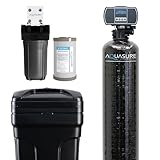
- 1. Aquasure Harmony Series 48 — Best overall
- 2. Aquasure Harmony Series 50 — Best large-capacity
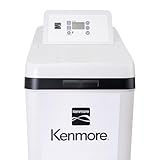
- 3. Kenmore 350 Whole House Water Softener System — Runner-up
- 4. Aquasana SimplySoft Whole House Water Softener — Best premium
- 5. iSpring WCSTB45KG 45 — Best budget pick
- What grain capacity means for your home
- Softener vs. conditioner: what you are really buying
- Installation, bypass valves and salt refills
- What the listings do not tell you
- The verdict
- FAQ
The best water softener for home use in a 3-4 bathroom household is the Aquasure Harmony Series 48,000 Grains, a 62 x 10 x 10 in cabinet with a digital metered control head and a 48,000-grain resin bed sized for whole-house treatment. If your utility space is shorter than 62 inches or you want a stronger published warranty, the Kenmore 350 at 47.8 x 19.8 x 16.5 in with a 10-year tank warranty is the better fit.
Best water softener for home at a glance
| Pick | Grain capacity | Footprint | Price |
|---|---|---|---|
Best overall Aquasure Harmony Series 48 |
48,000 grains | 62 x 10 x 10 in | Check Price |
Best large-capacity Aquasure Harmony Series 50 |
50,000 grains + pre-filter | 48 x 11 x 11 in | Check Price |
Runner-up Kenmore 350 |
32,000 grains | 47.8 x 19.8 x 16.5 in | Check Price |
Best premium Aquasana SimplySoft |
40,000 grains | 43 x 30 x 16 in | Check Price |
Best budget pick iSpring WCSTB45KG |
45,000 grains | 49 x 12.5 x 10 in | Check Price |


How I narrowed the field to five
Water softeners are not accessories. They plumb into your main line, they weigh over 75 lb when dry, and the wrong one turns a Saturday installation into a Sunday phone call to a plumber. So the screening was strict.
I started with whole-house ion-exchange units in the Water Softeners category, sized for a typical single-family home rather than an apartment or an RV. Anything without a published grain capacity was cut, because grain capacity is how you size a softener against your hardness and household usage. Anything without a stated tank footprint was cut too, because a softener that does not fit through your utility door is a return.
What survived:
- Five whole-house units ranging from 32,000 to 50,000 grains.
- Every one with a metered or automatic control valve, based on manufacturer claims.
- Two with published warranties, three without.
- A price spread wide enough to fit both first-time buyers and larger households.
The best water softener for home use in this set is the one whose capacity, footprint and control head line up with the way your household actually uses water. That is what the picks below are ranked on.
The specification that actually decides this
Most guides to picking the best water softener for home use compare grain capacity as if bigger is always better. It is not. The specification that decides this is grain capacity relative to your household's daily water use and your incoming hardness. A 50,000-grain unit regenerating twice a week wastes salt and water in a two-person home. A 32,000-grain unit regenerating every 36 hours in a four-bathroom home shortens its own resin life.
Here is the trick. Multiply the people in your home by 75 (a common per-person gallon estimate) and multiply again by your hardness in grains per gallon. That figure tells you how many grains you need to treat between regenerations. Then you pick a unit sized to regenerate roughly every 5 to 7 days.
Against that yardstick, the Aquasure Harmony 48 lands in the sweet spot for a 3-4 bathroom home with moderate hardness. The Kenmore 350 at 32,000 grains is honest about its 1-4 person target. The Aquasure Harmony 50 with its pre-filter is aimed at higher demand or dirtier incoming water. This is where the listings actually tell you something useful, if you read them.
1. Aquasure Harmony Series 48 — Best overall
The 48,000-grain resin bed and 62-inch cabinet make this the right default for a 3-4 bathroom home on municipal water.
Best for: a 3-4 bathroom home on municipal water with moderate to high hardness Skip it if: your utility space is under 62 inches tall
Within this set, the Harmony 48 is the pick whose stated household range matches the capacity on the label. Aquasure says the Harmony Series is designed for 3-4 bathrooms, and the 48,000-grain resin bed with a digital metered control head backs that up. The 62 x 10 x 10 in cabinet is tall and narrow, which is helpful in a slim utility closet but requires you to measure ceiling clearance before ordering.
The control head is where the case gets stronger. Aquasure claims a fully programmable backlit digital display with customisable auto-flush intervals based on incoming hardness, and a metered valve that only regenerates when the resin has actually processed its rated grains. That is more efficient than a timer-only valve on the older Kenmore 350.
The trade-off is footprint and weight. At 120 lb dry it is the heaviest published weight in this set, and it needs two adults and a hand truck to move. Also, no warranty figure is published on the listing, unlike the Kenmore.
Pros:
- 48,000-grain capacity sized for 3-4 bathrooms
- Digital metered control head with programmable auto-flush
- Corrosion-resistant fiberglass-lined polyethylene tank
- Includes a bypass valve for maintenance
- Prefilled with premium-grade resin
Cons:
- 62-inch height rules out shorter utility closets
- Heaviest listed weight in this set at 120 lb
- No published warranty on the listing
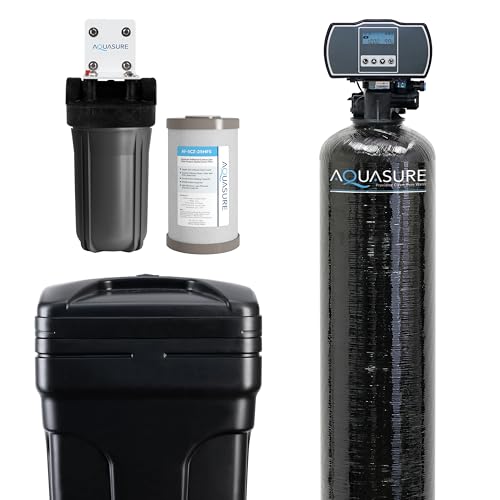
2. Aquasure Harmony Series 50 — Best large-capacity
The 50,000-grain bed plus a Sediment/GAC/Zinc pre-filter makes this the pick for higher demand or dirtier incoming water.
Best for: high-demand homes wanting longer intervals between regenerations and pre-filtration Skip it if: you do not need chlorine and sediment reduction upstream
The Harmony 50 gains 2,000 grains of capacity over the Harmony 48 and, more importantly, a triple-purpose pre-filter that Aquasure says removes 99% of chlorine, VOCs, PFAs, sediment and rust before the softening stage. That is a real functional difference in this set. Every other pick softens only; this one softens with an upstream carbon and zinc stage.
The cabinet is 48 x 11 x 11 in, which is 14 inches shorter than the Harmony 48 but slightly wider. So the paradox: the higher-capacity Aquasure is easier to fit under a low ceiling than the smaller one. Aquasure also states stainless steel construction on the 50 versus fiberglass-lined polyethylene on the 48, which is a materials upgrade.
The trade-off is price position. This is the second-most expensive pick here, and the pre-filter media eventually needs replacing, which is an ongoing cost that a plain softener like the Kenmore does not have. It also lists no warranty and no weight, which is thin documentation for a premium-priced unit.
Pros:
- Highest grain capacity in this set at 50,000
- Triple-purpose pre-filter for chlorine, VOCs and sediment
- Stainless steel construction per the listing
- Automatic digital metered control valve
- Shorter cabinet than the Harmony 48
Cons:
- Second-most expensive pick here
- Pre-filter media adds an ongoing replacement cost
- No published warranty or weight on the listing
3. Kenmore 350 Whole House Water Softener System — Runner-up
The strongest published warranty in this set, on a compact 32,000-grain unit sized for 1-4 people.

Best for: a 1-4 person household that needs the strongest published warranty here Skip it if: you have four bathrooms running at once
The Kenmore 350 is the only pick in this roundup with a fully itemised warranty on the listing: one year full, three years on the control board, ten years on the tank. That is meaningful with a product that sits on your main line for a decade. Neither Aquasure listing publishes a warranty figure, and the Aquasana does not either.
Capacity is where you have to be honest with yourself. At 32,000 grains it is the smallest bed here, and Kenmore states it is designed for 1-4 people. If your household is at the upper end of that, or your hardness is high, you will regenerate more often than owners of the Harmony 48. Kenmore's IntelliSoft claim is that the valve learns your usage pattern and only regenerates when needed, which mitigates the smaller bed on paper.
The cabinet is 47.8 x 19.8 x 16.5 in, so it is short but wider than any Aquasure here. Good for a low-ceilinged closet, awkward if the closet is narrow. Weight is 80 lb, mid-pack.
Pros:
- Full warranty schedule published: 1 year full, 3 years electronics, 10 years tank
- IntelliSoft valve regenerates based on learned usage
- 3/4-inch high-flow valve per the listing
- Compact 47.8-inch height fits shorter closets
- Built-in sediment shield claimed by Kenmore
Cons:
- Smallest capacity here at 32,000 grains
- Widest footprint of the picks at 19.8 inches
- Undersized if you have four bathrooms in simultaneous use
4. Aquasana SimplySoft Whole House Water Softener — Best premium
The shortest cabinet in this set at 43 inches, aimed at homes where headroom is the constraint.

Best for: a shorter utility closet where a 43-inch tall unit fits and a taller one does not Skip it if: you want a metered digital control head and detailed spec sheet
The SimplySoft is the shortest published cabinet in this set at 43 inches, roughly 19 inches shorter than the Harmony 48 and 5 inches shorter than the Kenmore. If your softener has to fit under a shelf, a stair or a low basement ceiling, that headroom is the reason to consider this pick. It is also the only softener here in blue rather than black or grey, if aesthetics in a visible utility space matter to you.
Aquasana positions the 40,000-grain unit for either city or well water and states it uses ion exchange, the same underlying process as the Aquasure and Kenmore picks. The listing is thinner on control valve detail than the Aquasure units. There is no mention of a metered digital control head, no stated warranty, no listed weight.
The trade-off is exactly that thinness. This is the most expensive pick in the set, and it has the fewest published specifications. You are paying for the brand and the short cabinet, and you accept a shorter spec sheet in return.
Pros:
- Shortest cabinet here at 43 inches
- Rated for city or well water per the listing
- 40,000-grain capacity, mid-pack in this set
- Distinctive blue finish
Cons:
- Most expensive pick in this set
- No published warranty, weight or control-valve detail
- Slowest seller of the five
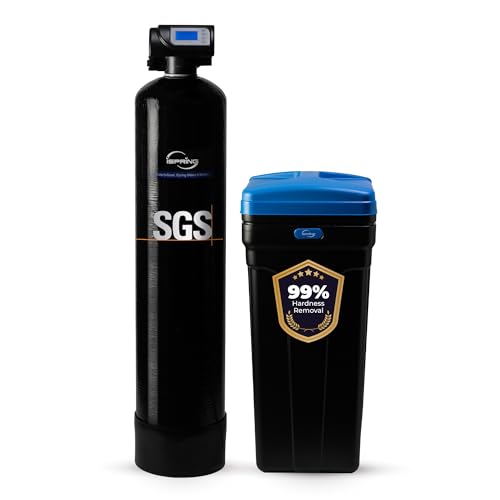
5. iSpring WCSTB45KG 45 — Best budget pick
The cheapest of the five, with 45,000 grains and iSpring's claim of third-party testing on the resin.
Best for: a first-time softener buyer who wants published third-party testing on the resin Skip it if: you want a warranty longer than one year
The iSpring WCSTB45KG is the cheapest of the five and, unusually for the entry position, not the smallest. At 45,000 grains it sits above the Kenmore and the Aquasana in capacity, below only the two Aquasure units. iSpring says the resin has been third-party tested to reduce 99% of hardness minerals, which is the kind of claim you can at least look up when you receive the unit.
Physical dimensions are 49 x 12.5 x 10 in and dry weight is 75.6 lb, which makes it the lightest pick here and the easiest to manoeuvre alone. The listing mentions a programmable automatic control valve that calculates regeneration based on quality and usage, similar in principle to the Aquasure and Kenmore metered valves.
The trade-offs are honest. The warranty is 1 year limited, shortest published in this set, and it is the slowest seller among the Aquasure and Kenmore units on this list. Two sellers list it rather than one, which is a minor difference but worth noting for stock reasons. For a first softener where budget is the constraint, it is a defensible entry point.
Pros:
- Cheapest of the five picks
- 45,000-grain capacity, above the Kenmore and Aquasana
- Lightest published weight at 75.6 lb
- Third-party testing claimed on the resin
- Separate brine tank included
Cons:
- Shortest published warranty at 1 year limited
- Listing detail thinner than the Aquasure units
- Two sellers stock it, which can affect availability
What grain capacity means for your home
Grain capacity is not a marketing number. It is the total amount of hardness a softener can remove between regenerations, measured in grains of calcium carbonate. Bigger tanks hold more resin, more resin holds more hardness, and higher-capacity units regenerate less often.
The picks in this roundup span 32,000 to 50,000 grains. Here is how to think about that range:
- 32,000 grains (Kenmore 350). Designed for 1-4 people. A two-person home with moderate hardness will regenerate every 5-7 days.
- 40,000 to 45,000 grains (Aquasana, iSpring). Comfortable for 3-4 people with moderate hardness, or a smaller home with harder water.
- 48,000 to 50,000 grains (Aquasure Harmony 48 and 50). Sized by Aquasure for 3-4 bathrooms, meaning higher fixture counts and heavier peak use.
Regeneration frequency matters because every cycle uses salt and rinses water down the drain. An oversized softener in a small home wastes both. An undersized softener in a big home either regenerates too often or delivers hard water at the end of a peak-use day.
Here is what most shoppers miss. Grain capacity should be matched to hardness first, household size second. A four-person home on 5 grain-per-gallon water uses fewer grains per day than a two-person home on 25 grain-per-gallon well water.
Softener vs. conditioner: what you are really buying
Every pick in this roundup is an ion-exchange softener. They use resin beads and salt-based regeneration to actually remove calcium and magnesium from your water. That is different from a salt-free "conditioner," which alters how minerals behave without removing them. Both categories market themselves as solving hard water. Only ion exchange actually softens it.
If your goal is scale prevention on appliances and pipes without slippery-feel soft water, a conditioner may suit you. If your goal is genuine soft water at every tap, with reduced soap scum, better lather and protection for your water heater, an ion-exchange softener is what you want. All five picks here fall in that second camp.
The practical consequences of choosing ion exchange:
- You need a drain line for regeneration wastewater.
- You need a source of salt or potassium chloride pellets, added periodically to the brine tank.
- You add sodium (or potassium) to your softened water in exchange for the removed hardness minerals.
- You need a bypass valve for maintenance, which all five picks include or reference.
None of that is a reason not to buy an ion-exchange softener. It just means you should know what you are committing to before the pallet arrives at the door.
Installation, bypass valves and salt refills
Installation is where a softener project either goes smoothly or turns into a plumber call. Every pick here connects to your main cold water line before it branches to the water heater, and every pick needs a nearby drain line for regeneration wastewater and a 120V outlet for the control head.
What to plan before you order:
- Clearance: measure the height, width and depth of the space, and add 6 inches around the cabinet for service access.
- Plumbing tie-ins: confirm your main line is accessible and that you have room for a bypass loop.
- Drain: identify a floor drain, standpipe or utility sink within reach of the discharge tubing.
- Salt storage: the brine tank needs periodic refills, and the salt bags are heavy.
The bypass valve on each of these units lets you route water around the softener for maintenance, resin replacement or extended vacations. Aquasure specifically calls out a durable bypass valve on both Harmony models. Kenmore highlights a 3/4-inch high-flow valve. That size matters: a valve with a smaller inner diameter will bottleneck peak flow to multiple bathrooms at once.
Skip this project as a DIY if your main line is copper or galvanised steel with no unions nearby, and hire it out. Otherwise, most homeowners with basic plumbing tools can handle a PEX or CPVC tie-in in an afternoon.
What the listings do not tell you
There are three things none of these listings tell you clearly, and all three matter.
First, flow rate at peak demand. A softener that keeps up with one shower will not necessarily keep up with two showers plus a dishwasher. Only Kenmore mentions valve size (3/4 inch) as a proxy for flow. If your household has simultaneous morning fixtures, ask the seller about service flow rate before ordering.
Second, resin type. All five picks state ion-exchange resin, and Aquasure calls its material "premium-grade," but grain rating tells you capacity, not resin quality. Higher cross-linked resins last longer against chlorine, which matters on municipal water without a carbon pre-filter. The Aquasure Harmony 50 addresses this with its GAC pre-stage; the others do not.
Third, salt consumption per regeneration. Metered valves regenerate less often than timer valves, but no listing here publishes salt usage per cycle. Budget a bag or two per month as a rough working figure and adjust based on your first three months of use.
The verdict
The best water softener for home use in this roundup is the Aquasure Harmony Series 48,000 Grains. Its 48,000-grain resin bed matches the 3-4 bathroom household range Aquasure states, its digital metered control head only regenerates when it needs to, and its 62 x 10 x 10 in cabinet is narrow enough to slot into a slim utility closet. It is the second-cheapest of the five, which is unusual for the pick that carries the strongest fit between capacity and stated household use.
Two conditions flip the recommendation. If your utility space is shorter than 62 inches, the Aquasana SimplySoft at 43 inches tall is the pick that actually fits, and you accept a thinner spec sheet in return. If your household is on the smaller side and warranty coverage is more important than capacity headroom, the Kenmore 350 with its 10-year tank and 3-year electronics warranty is the safer buy, at a cost of grain capacity.
The Aquasure Harmony Series 50 is the right choice only if you specifically want the triple-purpose pre-filter for chlorine and sediment. The iSpring WCSTB45KG is the entry point where 45,000 grains for the lowest price outweighs a one-year warranty.
FAQ
What size water softener for home with 3-4 bathrooms?
What size water softener for home use with 3-4 bathrooms depends on hardness, but manufacturers in this set point to 48,000-50,000 grains as the target. Aquasure states the Harmony 48 and Harmony 50 are designed for 3-4 bathrooms specifically. A 32,000-grain unit like the Kenmore 350 is undersized for that fixture count and would regenerate too frequently.
Is a whole-house water softener worth it?
Is a whole-house water softener worth it if you have hard water? Yes, if scale is damaging your water heater, dishwasher and fixtures, or if soap scum and dry skin are daily annoyances. Every pick here is ion-exchange and physically removes calcium and magnesium. If your hardness is under 3 grains per gallon, a softener is optional; above 7 grains per gallon, the payback on appliance lifespan is real.
What is the difference between the Aquasure Harmony 48 and 50?
The difference between the Aquasure Harmony 48 and 50 is capacity, construction and pre-filtration. The 48 holds 48,000 grains in a 62-inch fiberglass-lined polyethylene cabinet. The 50 holds 50,000 grains in a 48-inch stainless steel cabinet and adds a Sediment/GAC/Zinc pre-filter that Aquasure says removes chlorine, VOCs and sediment upstream of the softening stage.
Do these softeners work on well water?
Do these softeners work on well water? Aquasana specifically states SimplySoft is rated for city or well water, and Kenmore claims the 350 reduces clear water iron. Well water often carries iron, manganese and sediment that foul softener resin, so the Aquasure Harmony 50 with its pre-filter is the strongest choice here for problem well supplies. Test your well water first.
How often does a water softener regenerate?
How often does a water softener regenerate depends on capacity, hardness and household use. A metered control head, which all five picks here claim in some form, only regenerates when the resin has processed its rated grains. For a 3-4 bathroom home with a 48,000-grain unit and moderate hardness, expect every 5-7 days. Undersized units regenerate more often and use more salt.
Sizing a softener is fundamentally about matching grain capacity to how your household actually uses water, not to how large the tank looks in the product photo. Start with your hardness reading and your household size, then pick the cabinet that fits your utility space. The Aquasure Harmony 48 is the default for a 3-4 bathroom home because its 48,000-grain bed, digital metered valve and narrow 10-inch footprint line up with the way most busy households run. Measure your ceiling height before you order, plan your drain and salt refills, and the rest of the project is straightforward.