Best Water Filter: DREO Countertop RO Leads
A working shortlist of five countertop water filters, ranked by what the listings actually publish, with a clear winner and the profiles that flip the pick.

By Dexter GillUpdated 15 min read
On this page
- Best water filter at a glance
- How I cut the field down to five
- What actually decides a water filter
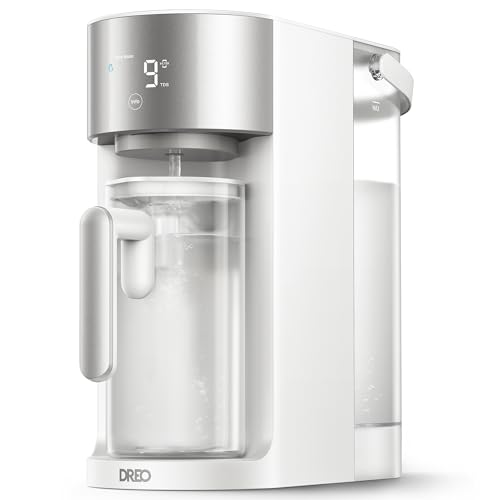
- 1. DREO Reverse Osmosis Water Filter Countertop — Best overall
- 2. Big Berkey 2.25 Gal Gravity Water Filter System — Best premium
- 3. Brita X-Large 27 Cup Water Dispenser — Best upgrade
- 4. Brita XL 27 Cup Water Filter Pitcher — Best minimal setup
- 5. Waterdrop PT-07B Water Filter Pitcher — Best budget pick
- Reverse osmosis, gravity or pitcher: which suits you?
- How much counter space will each pick eat?
- What the listings do not tell you
- The verdict
- FAQ
The best water filter for most kitchens is the DREO Countertop RO, a 9.46 lb reverse osmosis unit with a 3:1 pure-to-drain ratio, live TDS readout and no plumbing to cut. If you want stainless steel and zero electricity, the Big Berkey 2.25 Gal gravity system is the better buy. Both are the most expensive picks in this set, and both earn it in ways the pitcher options cannot match.
Getting a water filter wrong usually shows up the same way: a pitcher that filters slower than the household drinks, or a system that promises more than the label supports and leaves the buyer arguing with a spec sheet. The five picks below cover that gap honestly, from a 10-cup pitcher to a 2.25 gallon steel tower, and each is tied to a buyer profile you can check against your own kitchen before you click a Check Price link.
Best water filter at a glance
| Pick | Type | Capacity | Price |
|---|---|---|---|
Best overall DREO Reverse Osmosis Water Filter Countertop |
Countertop RO | 3L pitcher | Check Price |
Best premium Big Berkey 2.25 Gal Gravity Water Filter System |
Gravity, stainless | 2.25 gal | Check Price |
Best upgrade Brita X-Large 27 Cup Water Dispenser |
Fridge dispenser | 27 cups | Check Price |
Best minimal setup Brita XL 27 Cup Water Filter Pitcher |
Dispenser, Plus filter | 27 cups | Check Price |
Best budget pick Waterdrop PT-07B Water Filter Pitcher |
Pitcher, NSF 42/372 | 10 cups | Check Price |



How I cut the field down to five
Three filters got cut before this list took shape. Some listings promise "advanced filtration" with no NSF/ANSI reference and no contaminant list on the page. Those went first. Others published a capacity in cups but no dimensions, which is a problem the moment you try to fit one in a fridge door. Those went second. The last cut was for anything without a stated model number, because a filter without a model number has no matching replacement cartridge you can be sure about.
The five that survived each publish enough spec detail to compare like for like: capacity, dimensions, weight where relevant, and either a certification reference or a manufacturer figure I can quote as their claim rather than mine. Two of the five carry a written warranty. Three do not. That gap matters when the winner is a piece of electronics you leave running, which is why I weighted the DREO's design carefully against the Big Berkey's steel-and-gravity simplicity.
What actually decides a water filter
Most guides compare filter media: carbon versus resin, ion exchange versus reverse osmosis. That is not what decides it for a real household. What decides it is throughput matched to daily demand, and where the unit lives when it is not being used.
A 10-cup pitcher that sits on a counter is fine for one person. Two adults and a kid drain it before lunch, and the filter cannot keep up with refills. A 27-cup dispenser solves throughput, but only if it fits your fridge shelf or your countertop clearance under the wall cabinets. A countertop RO unit solves throughput and contaminant reduction in the same box, but it needs a power outlet within cord reach.
- One person, small kitchen: a 10-cup pitcher covers a day easily.
- Two to four people, taste and odour focus: a 27-cup dispenser refills less often than a pitcher.
- Two to four people, contaminant focus: countertop RO or gravity.
- Off-grid, remote cabin, or a household that distrusts electronics: gravity, every time.
Match the pick to that answer first. Then, and only then, look at filter chemistry.
1. DREO Reverse Osmosis Water Filter Countertop — Best overall
A countertop RO unit that skips the under-sink plumbing and still gives you a live TDS number every time you pour.
Best for: a household that wants aggressive filtration without drilling into the sink Skip it if: you have no outlet near the counter
The DREO is the only pick here that runs on electricity, and that is what buys the rest of its case. Reverse osmosis is a slow process, and the auto-fill sensor plus 3L pitcher is how DREO manages that: the unit tops itself up when the pitcher goes back on the base. DREO says the 7-in-1 setup filters 99.9% of possible contaminants including PFOA, PFOS, chlorine and fluoride, and that the pure-to-drain ratio is 3:1, which is efficient for household RO. Treat those as the manufacturer's figures and read them alongside the live TDS display, which lets you check raw versus filtered water each time.
At 9.46 lb and 13.4 x 14.5 x 6.73 in, this is a real counter presence. The slim 6.73 in depth is genuinely helpful under standard cabinets, but you need a clear 14.5 in of width and a socket the cord will reach. Against the Big Berkey it trades stainless steel and gravity for a power cord and a display, and against the Brita dispensers it trades sheer volume for far more thorough filtration. It is the best water filter in this set because it collapses the three variables that matter, throughput, contaminant reduction and installation, into a single box.
Pros:
- 3:1 pure-to-drain ratio, efficient for household RO
- Live TDS readout on raw and filtered water
- Auto-fill sensor keeps the 3L pitcher topped up
- Self-cleaning cycle on internal tubes
- No under-sink plumbing needed
Cons:
- Needs a mains outlet within cord reach
- The heaviest countertop unit here at 9.46 lb
- One of two premium-priced picks in this set
- Only two sellers list it, so availability is thinner
2. Big Berkey 2.25 Gal Gravity Water Filter System — Best premium
A stainless steel gravity system that runs on nothing but the water sitting in its top chamber.

Best for: off-grid use or households that want steel over plastic Skip it if: you live in California or Iowa
The Big Berkey occupies a different lane. It is polished AISI 304 stainless steel, 2.25 gal in capacity, and it needs neither electricity nor plumbing. You prime the two Black Berkey elements, sit them in the upper chamber, and pour tap water in. Gravity does the rest. That is genuinely useful in a cabin, a workshop or a household that treats a running countertop appliance as a liability.
Berkey publishes a proper warranty structure: six months on the system, and a two-year prorated warranty on the Black Berkey elements calculated in six-month intervals. Read the shipping caveat carefully, because the listing states this system is not available to ship to California or Iowa, and that is a legal, not a stock, restriction. Against the DREO, this pick trades the live TDS number and RO-grade filtration for durability and independence from a socket. Against the Brita picks, it trades price position and speed for a build quality none of them attempts. It is the highest price position in this set, and the material choice is where that money goes.
Pros:
- Polished AISI 304 stainless steel body
- 2.25 gal upper chamber, largest here
- No electricity, no plumbing, nothing to short
- Two Black Berkey elements included
- Six-month system warranty, plus prorated element warranty
Cons:
- Not available to ship to California or Iowa
- Slowest fill of any pick in this set
- The most expensive pick in the set
- No contaminant readout, so you trust the elements blind
3. Brita X-Large 27 Cup Water Dispenser — Best upgrade
The obvious step up from a pitcher when a pitcher runs dry before lunch.

Best for: families who empty a pitcher in a morning Skip it if: your fridge shelf is under 11 inches deep
At 27 cups, this Brita holds nearly three times what the Waterdrop pitcher does, and it is the pick to reach for when throughput is the real problem. Brita says the standard filter cuts chlorine taste and odour and reduces copper, mercury and other impurities. It also carries the same sticker replacement indicator on the lid, which sounds trivial and is not: the failure mode of a household dispenser is a filter no one remembers to change.
Weight is 3 lb, dimensions are 10.5 x 18 x 5.67 in. That 18 in horizontal footprint is what to check first. It fits on most countertops and is fridge-friendly, but only if your fridge has an 11 in deep shelf you are willing to give over to it. The precision-pour spigot beats tipping a pitcher one-handed while you hold a glass in the other, which is the main practical difference between this and the Brita XL pitcher below. Against the DREO it is far cheaper here and vastly simpler, but it does not touch RO-grade contaminants. Against the Big Berkey it wins on price position and fridge-fit and loses on materials and capacity.
Pros:
- 27 cup capacity, three times a 10-cup pitcher
- Precision-pour spigot, no tipping
- Fridge-friendly footprint at 5.67 in depth
- Sticker filter replacement indicator
- One of two entry-priced picks here
Cons:
- Standard filter only, not the higher-density Plus
- The 18 in dimension eats fridge shelf real estate
- No warranty published on the listing
- BPA-free plastic body, not steel
4. Brita XL 27 Cup Water Filter Pitcher — Best minimal setup
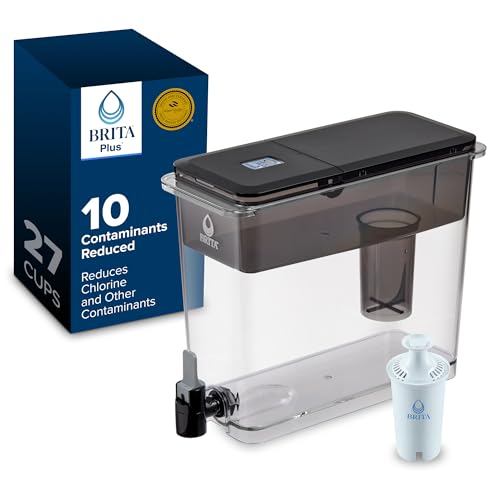
A 27-cup dispenser using the higher-density Brita Plus filter, for renters who cannot install anything.
Best for: renters who want more than a standard filter without any hardware Skip it if: you resent replacing a filter every two months
This model shares the 27 cup UltraMax body with the pick above but ships with the BritaPlus filter instead of the standard one. Brita says the Plus filter traps twice as many contaminants as the standard filter, including chlorine, mercury, cadmium, copper and zinc, and that it is WQA certified to NSF/ANSI standards. The listing gives a filter life of 40 gallons or roughly two months. That is your ongoing cost, and it is worth knowing before you buy.
Dimensions are 5.63 x 11.2 x 14.6 in, so the footprint is very close to the standard dispenser but stood a little more upright. Weight is not published on the listing, and that is genuinely the only meaningful gap in the spec sheet: everything else you need to make a decision is there. Against the standard 27-cup dispenser this pick trades a lower price position for a stronger filter and a shorter change interval. Against the DREO, it does not attempt RO-grade filtration and does not need a power outlet. It is the sensible middle of this list.
Pros:
- BritaPlus filter, Brita's higher-density option
- WQA certified to NSF/ANSI standards
- 27 cup capacity in an upright body
- No installation, no plumbing
- Standard mid price position in this set
Cons:
- Filter change every 40 gallons or two months
- No weight figure published on the listing
- No warranty published on the listing
- Still a plastic-bodied dispenser
5. Waterdrop PT-07B Water Filter Pitcher — Best budget pick
A 10-cup pitcher with a published NSF certification and a 30-day money-back window.

Best for: one or two people in an apartment Skip it if: you want certified contaminant reduction beyond taste and odour
The Waterdrop is the cheapest of the five and the smallest. Capacity is 10 cups, weight is 2.65 lb, and the footprint at 10.6 x 11.4 x 4.53 in slides sideways into most fridge doors. Waterdrop says the pitcher has passed NSF/ANSI 42 and 372 certifications, which cover aesthetic effects like chlorine taste and odour and material safety respectively. Those are real certifications and worth having, but they are not the same as NSF/ANSI 53, which covers health-related contaminants. Know which one you need before you buy.
The listing gives a filter lifespan of up to 200 gallons or three months, so replacement costs work out favourably against the 40-gallon Brita Plus. Waterdrop also publishes the strongest warranty terms here: a 30 day return window and a 90 day free replacement window from date of purchase. That is a stronger safety net than three of the four picks above offer. Against the Brita dispensers, this pick loses on capacity and throughput. Against the DREO and Berkey, it does not compete on contaminant reduction. What it does is give a small household a working pitcher for the lowest price position in the set, without hiding what it is.
Pros:
- NSF/ANSI 42 and 372 certifications published
- 200 gallon or three month filter lifespan
- 30 day return, 90 day replacement warranty
- Hands-free lid design
- The cheapest pick in this set
Cons:
- 10 cup capacity strains for two-plus people
- NSF 53 is not claimed, only 42 and 372
- No contaminant readout of any kind
- Sales rank sits mid-pack, not top of category
Reverse osmosis, gravity or pitcher: which suits you?
Three of the five picks are pitcher-style; one is gravity, one is reverse osmosis. The category matters more than the brand, so decide the category first.
- Reverse osmosis pushes water through a membrane that stops most dissolved solids. The DREO is the RO option here. Choose it if you care about PFAS and fluoride, and if you have both counter space and a socket.
- Gravity relies on the weight of water alone. The Big Berkey is the gravity option. Choose it if you want a steel body, no electricity, and a system that keeps working in a power cut.
- Pitcher and dispenser filters use activated carbon and, in the Brita Plus case, higher-density media. Choose these if the main problem is taste, odour and common tap-water impurities, and if you want the simplest possible setup.
Filter chemistry follows category. Read the certification. NSF/ANSI 42 is taste and odour. NSF/ANSI 53 is health-related contaminants. NSF/ANSI 58 is reverse osmosis specifically. Waterdrop publishes 42 and 372. Brita's Plus filter is WQA certified to NSF/ANSI standards. DREO publishes a contaminant list rather than a specific NSF certification on the listing, which is why the TDS readout is useful: you can watch the filtration working on your own tap water.
How much counter space will each pick eat?
Countertop clearance under wall cabinets is usually 15 to 18 in. Fridge shelves are usually 10 to 12 in deep. Check yours against the picks:
- DREO: 13.4 x 14.5 x 6.73 in, 9.46 lb. Fits under 15 in cabinets. Counter only, not fridge.
- Big Berkey: 7.58 x 3.35 x 3.35 in (as listed), 2.25 gal capacity. Counter only.
- Brita 27 Cup Dispenser: 10.5 x 18 x 5.67 in. Counter or a deep fridge shelf.
- Brita XL Pitcher: 5.63 x 11.2 x 14.6 in. Counter or fridge door.
- Waterdrop PT-07B: 10.6 x 11.4 x 4.53 in. Fits fridge doors.
Take a tape measure to the space you actually have. A dispenser that lives on the counter because it will not fit in the fridge quickly becomes a dispenser you resent. The DREO's slim 6.73 in depth is the single most useful spec figure in this set for anyone with a shallow counter.
What the listings do not tell you
Two things are worth knowing that no listing prints in bold.
Filter replacement is the ongoing cost, and it varies by more than the price of the pitcher. The Brita Plus filter is rated at 40 gallons or two months. The Waterdrop filter is rated at 200 gallons or three months. That is a five-times gap in gallons and a fifty percent gap in time. Over a year, replacement cost dwarfs the price gap between the pitcher-class picks. Check the replacement filter price before you commit to the pitcher price.
Second, warranty is not standard. The Waterdrop publishes a 30-day return and 90-day replacement window. The Big Berkey publishes a six-month system warranty plus a two-year prorated element warranty. The two Brita picks and the DREO publish no explicit warranty on the listing text. That is not automatically a red flag, because retailer and manufacturer policies fill the gap, but if a written warranty matters to you, the Berkey and the Waterdrop are the two picks that supply one on paper.
The verdict
The best water filter for most kitchens is the DREO Reverse Osmosis Water Filter Countertop. It is the only pick here that combines aggressive filtration, live TDS feedback, hands-free auto-fill and a footprint that fits under standard cabinets. Two conditions flip that call. If you have no accessible mains outlet, or you distrust running electronics on a countertop, the Big Berkey 2.25 Gal gravity system is the right pick and worth the highest price position in the set. If your problem is not contaminant reduction but throughput for a family who empties pitchers before lunch, the Brita X-Large 27 Cup Dispenser is a much cheaper and completely appropriate answer.
The runner-up here is the Big Berkey and its exact advantage is material and independence: polished AISI 304 stainless steel, zero electricity, and a written warranty on both the system and the elements. If you want a filter to outlive its own décor, that is the pick. The DREO wins the top spot because it does more work per square inch of counter than anything else in the set.
FAQ
Is a water filter worth it for city tap water?
A water filter is worth it for city tap water when your goal is taste, odour and residual chlorine reduction, and where any of the pitcher picks handle that easily. It becomes more clearly worth it if your utility report flags lead pipes or elevated disinfection byproducts, in which case an NSF/ANSI 53 or 58 rated system is the right level, not a basic pitcher.
DREO countertop RO or Big Berkey: which should I buy?
DREO countertop RO or Big Berkey depends on two things: your outlet situation and your feeling about electronics. DREO gives you a 3:1 pure-to-drain ratio, live TDS readout and auto-fill, but needs a socket. Big Berkey gives you 2.25 gal of stainless-steel gravity filtration and a six-month warranty, but no readout. Pick the DREO for a wired kitchen, the Berkey for a cabin or a power cut.
How often will I need to change the filter?
How often you need to change the filter depends on the model. Brita's Plus filter is rated at 40 gallons or two months. Waterdrop's PT-07B filter is rated at 200 gallons or three months. Berkey's Black Berkey elements carry a two-year prorated warranty. DREO uses a live filter-life indicator to time replacement. Match the schedule to how much water your household actually pours.
Do these filters reduce PFAS and fluoride?
Do these filters reduce PFAS and fluoride depends on the technology. DREO says its 7-in-1 RO system filters 99.9% of possible contaminants including PFOA, PFOS, chlorine and fluoride, which is the strongest claim in this set. Standard carbon pitchers, including the Brita and Waterdrop picks here, do not typically claim fluoride removal. If PFAS is your reason for buying, reverse osmosis is the category to shop.
What is the biggest mistake people make choosing a water filter?
The biggest mistake people make choosing a water filter is comparing filter media before comparing throughput. A 10-cup pitcher for a four-person household runs empty by mid-morning, and no filter chemistry fixes that. Size the capacity to your daily draw first, check the physical fit against your fridge shelf or cabinet clearance second, and only then argue about carbon versus reverse osmosis versus gravity.
Water filtration is a long-term relationship with a replacement filter, not a one-off purchase, so the right first move is to open your utility's most recent water report and read what is actually in your tap water. That takes ten minutes and it tells you whether you need NSF/ANSI 42 for taste, 53 for health contaminants, or 58 for reverse osmosis. The DREO earns the top spot here because it does the most work in the least counter space and gives you a live number to check that work against, which is exactly what a household filter should do in a kitchen you use every day.