Best Water-Based Wood Stain for Indoor Furniture

Six water-based stains compared on the numbers that actually matter: container size, published coverage, dry time and whether the formula seals as well as colours. Varathane's quart leads, but three smaller picks beat it on specific jobs.

By Dexter GillUpdated 17 min read
On this page
- Best water-based wood stain at a glance
- How I matched six stains to six kinds of project
- Why container size decides the best water-based wood stain
- 1. Varathane Dark Walnut Wood Stain — Best overall
- 2. Varathane Total Control Dark Walnut Gel Stain — Runner-up
- 3. COATEZ Water Based Wood Stain and Sealer in One — Best for families
- 4. DWIL Water Based Wood Stain — Best for beginners
- 5. SENVEN Wood Stain, Walnut Wood Stain — Best for heavy use
- 6. Vividye Wood Stain, Water Based — Best budget pick
- How much wood will one container actually cover?
- Gel, liquid or stain-and-sealer: which should you buy?
- What the listings do not tell you about colour
- The verdict
- FAQ
The best water-based wood stain here is the Varathane Dark Walnut Wood Stain, because 1 quart is the only container in this group big enough to finish a dresser, a door and a set of shelves from a single batch. If your project is vertical, the Varathane Total Control Dark Walnut Gel Stain is the better buy: the listing describes a thick, no-drip formula and claims coverage up to 250 square feet per quart. Most people compare colour names first. Colour names are the least reliable thing on any of these labels.
Best water-based wood stain at a glance
| Pick | Container size | Claimed coverage | Price |
|---|---|---|---|
Best overall Varathane Dark Walnut Wood Stain |
1 quart | 1-coat colour claim | Check Price |
| Half pint | 250 sq ft per quart claim | Check Price | |
Best for families COATEZ Water Based Wood Stain and Sealer in One |
10.50 oz | Stain plus sealer claim | Check Price |
Best for beginners DWIL Water Based Wood Stain |
8.5 oz | 1-coat matte claim | Check Price |
Best for heavy use SENVEN Wood Stain, Walnut Wood Stain |
3.5 fl oz | Single-application claim | Check Price |
Best budget pick Vividye Wood Stain, Water Based |
250 ml | 90–120 sq ft per coat claim | Check Price |


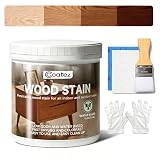

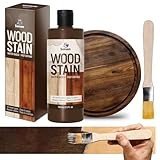

How I matched six stains to six kinds of project
I did not rank these by which formula sounds most advanced. I sorted them by the buyer standing in front of the project.
Six profiles came out of the published data, and each pick maps to one:
- The furniture refinisher with a dresser or a cabinet run. Needs one container large enough that colour stays consistent across every panel. That is the quart Varathane.
- The door and trim painter working on vertical wood where thin stain runs. That is the gel.
- The first-timer who owns no finish and does not want to buy a topcoat separately. That is the COATEZ stain-and-sealer.
- The learner practising the wipe-on, wipe-off rhythm on something small before touching the good piece. That is DWIL.
- The tester who wants to try a colour on scrap before committing. That is the 3.5 fl oz SENVEN.
- The one-project buyer on the tightest budget. That is Vividye.
What I cut: anything where the container size was unstated, and anything where I could not compare the size figure against the others. Every pick here publishes either a volume or a weight, which is the minimum needed to judge whether it will finish your job.
One thing to be clear about upfront. The listings in this group are all water-based, but "best" in a category this varied depends entirely on which of those six people you are. There is no formula here that is simultaneously right for a full kitchen and right for a picture frame.
Why container size decides the best water-based wood stain
Here's the trick with stain: the failure mode is almost never the colour you chose. It's running out.
A water-based wood stain dries fast. That's the whole selling point, and Varathane's gel listing claims 1 hour on wood. Fast drying means you cannot walk away, drive to a store, buy a second container and come back to a wet edge. You get a hard lap line where the old stain flashed off and the new stain went on. Sanding that out means starting the panel again.
Look at the spread in this set. The Varathane quart is one container. The SENVEN is 3.5 fl oz. That is not a small difference in convenience, it is a different category of project. The 3.5 fl oz bottle measures 4.7 x 1.6 x 1.6 in, roughly the footprint of a spice jar.
The specification most guides lead with is dry time, and every pick here claims to be fast. That makes it useless as a tiebreaker. Vividye's listing describes a 30-minute recoat and an 8 to 12 hour final dry. DWIL says wait 5 to 10 minutes before wiping. Varathane's gel says 1 hour. These are all in the same broad range, and none of them will decide your purchase.
So work backwards. Measure the wood. Read the coverage claim. Then buy the size above it, not the size that just barely fits.
1. Varathane Dark Walnut Wood Stain — Best overall
The only quart in this group, which makes it the only pick that can finish a large piece without a mid-job colour break.
Best for: a full furniture or cabinet job that needs one consistent colour batch Skip it if: you only need to touch up a single shelf
Size is the whole argument. At 1 quart and 2.4 lb, this holds more stain than the other five picks combined, and it ships in a 4.88 x 4.25 x 4.25 in can you can dip a brush straight into. That matters more than any formula claim. When you stain a six-drawer dresser, every drawer front has to come out of the same liquid.
Varathane says the formula creates rich, even colour in one coat on most surfaces, and that additional coats build to a darker shade. It also describes a semi-transparent finish that cleans up with soap and water, plus lower odour and lower VOC content than traditional oil-based stains. Those are the manufacturer's claims, but the semi-transparent description does tell you something useful: grain will show through, so this is a colouring product, not a cover-up.
It's the only pick in this set with a warranty listed at all. It is also the most expensive here, and by a wide margin the largest quantity, so a small job leaves you storing most of a can. Dark Walnut is the only colour on this listing, so if you want a lighter oak tone you're shopping elsewhere in the range.
Pros:
- 1 quart, the largest container in this set
- Only pick here with a published warranty
- Semi-transparent finish keeps grain visible
- Low-odour, low-VOC formula per the listing
- Soap-and-water cleanup
Cons:
- The most expensive pick here
- Far too much stain for a single small project
- Only Dark Walnut on this listing
- Just two sellers stock it
2. Varathane Total Control Dark Walnut Gel Stain — Runner-up
A thick gel body is what stops stain running down a door, and this is the only gel in the group.

Best for: vertical surfaces like doors, trim and banisters Skip it if: the project is a floor, deck or siding
Everything about this pick is aimed at wood you cannot lay flat. Varathane describes a thick, no-drip formula that applies smoothly on horizontal and vertical surfaces, and lists wood, metal and fiberglass among them. The listing names doors, trim and banisters directly. It also claims coverage up to 250 square feet per quart and a 1-hour dry time on wood.
It sells faster than anything else in this set by a clear margin, which is worth knowing when you're weighing an unfamiliar formula against a familiar liquid one. The container is a half pint measuring 2.97 x 2.88 x 2.88 in, so it's a genuine project size rather than a sample.
Two limits. The listing explicitly does not recommend it for floors, decks or siding, which rules out the biggest outdoor jobs. And gel behaves differently from liquid stain: it sits on the surface more and penetrates less, so grain definition can read differently than you expect from the same colour name.
Against the quart, you're trading volume for control. If your project is one door, that trade is worth making. If it's a whole staircase, buy the bigger can.
Pros:
- Thick no-drip body suits vertical wood
- Claimed 250 sq ft per quart coverage
- Claimed 1-hour dry time on wood
- Sells faster than the rest of this set
- Rated for interior and exterior projects
Cons:
- Not recommended for floors, decks or siding
- Half pint runs out fast on large pieces
- No weight or warranty published
- Gel finish shows grain differently to liquid stain
3. COATEZ Water Based Wood Stain and Sealer in One — Best for families
The only pick here that claims to colour and seal in the same product, which removes a whole shopping trip.
Best for: a first-timer who does not want to buy a separate topcoat Skip it if: you already own a finish you trust
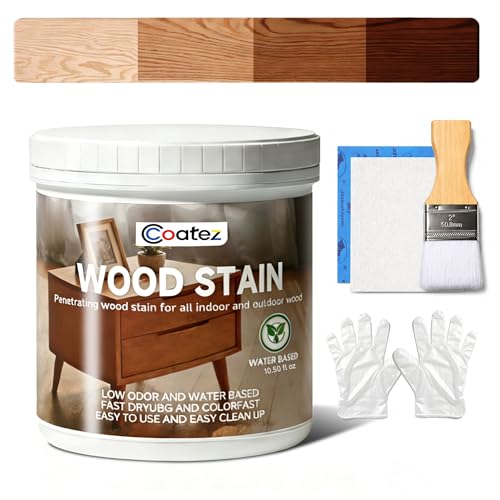
Stain alone does not protect wood. It colours it. Every other pick in this group leaves you needing a topcoat, and COATEZ is the only one whose listing says the primer and top coat are combined so separate steps are not required. For someone staining a bedside table on a Saturday, that's one product instead of three.
The container holds 10.50 fl oz at 0.66 lb, in a 2.7 x 10 x 2 in bottle, and the listing says a water-based brush is included. COATEZ also claims ultra-low VOCs with no harsh fumes and describes it as safe for indoor use in kitchens and bedrooms, plus outdoor decks and fences. The listing further claims protection against heavy rain, frost and UV, and resistance to warping, rotting and discolouration. Those are broad claims from the manufacturer, and outdoor durability is exactly the kind of thing you cannot verify from a label.
The catch: it's the slowest seller in this group by a wide gap, so there's less accumulated shopper familiarity behind it than the Varathane pair. It's also priced near the top of this set despite holding less than half the volume of the quart. Brown Walnut is the listed colour, and no warranty is published.
Pros:
- Combines stain and sealer, per the listing
- Brush included with the bottle
- 10.50 fl oz, second-largest container here
- Rated for indoor and outdoor use
Cons:
- Slowest seller of the six
- Priced high for the quantity supplied
- No warranty published
- Big outdoor protection claims are unverifiable from the label
4. DWIL Water Based Wood Stain — Best for beginners
The clearest published technique instructions in this set, which is what a first attempt actually needs.

Best for: learning the wipe-on, wipe-off technique on a small piece Skip it if: you need more than a couple of square yards covered
Most stain failures are technique failures, and DWIL's listing spells the technique out: apply with a clean cloth or brush along the grain, wait 5 to 10 minutes, then wipe off the excess. It adds that a longer wait gives deeper colour. That single instruction is the whole skill, and having it printed on the listing means you're not guessing.
The bottle holds 8.5 oz at 0.53 lb, in a 7.87 x 2.36 x 2.36 in shape that's easy to hold while you work. The listed colour is Teak. DWIL claims one coat gives a natural matte finish, describes the formula as highly concentrated with even colour penetration, and says it's low odour, non-toxic and safe around pets. Cleanup is described as effortless.
A matte one-coat claim is worth pausing on. Matte hides brush marks better than a satin sheen, which forgives a shaky first attempt. But at 8.5 oz, this is a practice-piece and small-furniture size, not a cabinet-run size.
Against the quart Varathane, you lose volume and the published warranty. You gain a container you'll actually finish, and instructions that tell you what to do at minute five.
Pros:
- Specific 5–10 minute wipe-off timing published
- Claimed matte one-coat finish hides brush marks
- Light at 0.53 lb, easy to hold while working
- Described as non-toxic and pet-safe
Cons:
- 8.5 oz limits it to small pieces
- Mid-range price for a modest quantity
- Only Teak on this listing
- No warranty or coverage figure published
5. SENVEN Wood Stain, Walnut Wood Stain — Best for heavy use
At 3.5 fl oz this is the sample size of the group, which makes it the cheap way to test a colour before you commit a whole piece.
Best for: repeat small jobs and colour testing before committing Skip it if: you have a whole cabinet run to stain
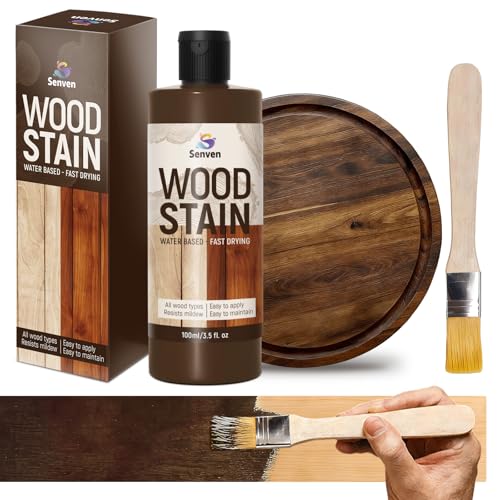
Every experienced finisher tests on scrap first, because the same stain reads differently on pine than on oak. The problem is that testing usually means opening a full can. This is 3.5 fl oz in a 4.7 x 1.6 x 1.6 in bottle, and it's the second-cheapest pick here. That combination is what makes it useful: buy it, brush it on offcuts from the actual piece, and see the real colour before you spend on volume.
SENVEN describes a semi-transparent finish that highlights natural grain, claims rich even colour from a single application, and says the formula is ultra-low in VOCs, free from harsh fumes and safe for families and pets. The listed colour is Walnut. It also claims even colour distribution across indoor and outdoor wooden surfaces.
Once your test passes, you'll want more of it, and there's the weakness. The listing gives no coverage figure, no weight and no warranty, so you cannot calculate how many bottles a real project needs. Buying four of these to do a door is a worse deal than buying one larger container. Treat it as a trial size and it earns its place. Treat it as your main supply and you'll be reordering.
Pros:
- Smallest container here, ideal for colour tests
- Second-cheapest pick in this set
- Semi-transparent finish keeps grain visible
- Described as ultra-low VOC and pet-safe
Cons:
- 3.5 fl oz covers very little wood
- No published coverage, weight or warranty
- Buying multiples costs more than one bigger can
- Only Walnut on this listing
6. Vividye Wood Stain, Water Based — Best budget pick
The cheapest of the six, and the only one that publishes a square-foot coverage range you can plan against.

Best for: one small golden oak project on a tight budget Skip it if: you want dark walnut tones
Cheapest and most transparent about coverage is a good combination. Vividye's listing claims a 250 ml bottle covers approximately 90 to 120 sq ft with a single coat, which is the only figure in this group specific enough to check against a tape measure before you buy. Compare that with the four picks that publish no coverage number at all.
The listed colour is Golden Oak, and it's the only pick here in that lighter family. Every other bottle in this set is a walnut or teak tone. If you're after warm honey rather than deep brown, this is your only option in the group. The bottle measures 0.8 x 2.3 x 3 in, so it's genuinely small despite the coverage claim.
Vividye publishes a four-step process: sand smooth, shake and apply with brush or cloth, wipe off excess and recoat after 30 minutes for deeper colour, then let dry 8 to 12 hours. That final 8 to 12 hour figure is the longest full-cure window stated in this set, so plan an overnight gap before handling.
The trade-offs are real. No weight, no warranty, and the slowest full dry here. It's also the second-slowest seller of the six, so fewer shoppers have worked through it than the Varathane pair.
Pros:
- Cheapest pick in this set
- Publishes a 90–120 sq ft coverage range
- Only Golden Oak option among the six
- Clear four-step application instructions
Cons:
- 8–12 hour dry time, the longest stated here
- No warranty or weight published
- Second-slowest seller of the six
- Small 250 ml bottle limits project size
How much wood will one container actually cover?
Only two picks here give you a number, and they give it two different ways.
- Vividye claims 90 to 120 sq ft per 250 ml bottle with one coat.
- Varathane's gel claims up to 250 sq ft per quart, which is a per-quart rate rather than a per-container figure. The container itself is a half pint.
- Varathane's quart, DWIL, SENVEN and COATEZ publish no coverage figure at all.
That gap is why size matters more than any claim. Where the number is missing, container volume is the only planning tool you have.
Rough project scale, for context: a small side table is a few square feet of visible surface. A standard interior door, both faces and edges, is a couple of dozen. A run of kitchen cabinet doors and drawer fronts climbs into the high dozens fast, because you stain both sides.
Two habits that save reorders. First, always add a second coat to your estimate, even if the listing claims one coat works, because darkening is the most common reason people recoat. Second, buy for the whole project plus scrap, not the whole project exactly. Test pieces consume stain too, and the batch you test with should be the batch you finish with.
Gel, liquid or stain-and-sealer: which should you buy?
Three formulas sit in this group, and they solve different problems.
Liquid stain is the default. Varathane's quart, DWIL, SENVEN and Vividye all work this way: flood the surface, wait, wipe off the excess. It penetrates well and keeps grain visible, and it's the easiest to blend on a flat panel. It also runs downhill, which is a problem on doors.
Gel stain is thicker. Varathane's Total Control listing describes a no-drip formula that works on vertical surfaces and on materials beyond wood, including metal and fiberglass. You get control at the cost of penetration, and the listing rules out floors, decks and siding.
Stain plus sealer is one product doing two jobs. COATEZ claims combined primer and top coat, which means no separate finish purchase. Convenient, but you give up the ability to choose your own topcoat sheen.
Quick decision path:
- Flat furniture, large job: liquid, biggest container you can justify.
- Doors, trim, banisters, railings: gel.
- No topcoat in the cupboard and no wish to buy one: stain and sealer.
- Testing a colour: the smallest bottle you can find.
What the listings do not tell you about colour
Here's what a colour name on a bottle does not tell you: what the stain will look like on your wood.
"Dark Walnut" appears on both Varathane picks in this set, one liquid and one gel. Those are different formulas with different penetration behaviour, so the same name does not guarantee the same result on the same board. "Walnut", "Brown Walnut", "Teak" and "Golden Oak" all appear across the other four picks, and none of those names is standardised between brands.
Three variables the label cannot account for:
- The species you're staining. Pine, oak, maple and birch absorb at wildly different rates. Softwood drinks stain and goes darker.
- How you sanded. Finer grit closes the grain and lightens the result. Coarser grit opens it and darkens it.
- How long before you wipe. DWIL says 5 to 10 minutes and that longer means deeper. That's a user-controlled variable, not a fixed property of the colour.
Which is why the 3.5 fl oz SENVEN and the 250 ml Vividye earn their spots for something other than value. They're the affordable way to see the real colour on your real wood before you buy volume. Sand a scrap the same way you'll sand the piece, stain it, and let it dry fully. Two picks here publish full-dry guidance, and Vividye's 8 to 12 hours is the longest stated: wet stain always looks darker than cured stain.
The verdict
The best water-based wood stain in this group is the Varathane Dark Walnut Wood Stain, on the strength of one number. It is a 1 quart can at 2.4 lb, and nothing else here comes close. On a real furniture or cabinet project, running out mid-panel is the failure that ruins the work, and volume is the only insurance against it. It's also the only pick in this set with a warranty published on the listing.
Two conditions flip that. First, if your wood is vertical, the Varathane Total Control Dark Walnut Gel Stain wins outright, because it's the only gel here and the listing specifically claims a no-drip body for doors, trim and banisters. Thin liquid stain on a stile leaves runs you'll be sanding out. Second, if you own no topcoat and don't intend to buy one, COATEZ is the pick, because it's the only listing in this set claiming stain and sealer in a single product.
The gel's exact advantage over the quart is control, not colour. Both are Dark Walnut. One stays where you brush it on a vertical surface, the other flows. Match the formula to the orientation of the wood and this decision gets simple.
FAQ
Is a water-based wood stain worth it over an oil-based one?
A water-based wood stain is worth it mainly for the cleanup and the air quality. Varathane's listing describes lower odour and lower VOC content than traditional oil-based stains, with soap-and-water tool cleaning. Every pick in this set claims low odour and low toxicity. The trade-off is speed: fast drying leaves less time to blend an edge, so work in smaller sections than you would with oil.
Which offers better value, the quart Varathane or the cheaper small bottles?
Better value depends on the size of your project. The quart Varathane is the most expensive pick here, but it holds more than the other five containers combined, so per unit of stain it's efficient on a large job. Vividye is the cheapest and claims 90 to 120 sq ft per bottle. On a single side table, the small bottle wins. On a dresser, it doesn't.
How much surface will one container cover?
One container covers whatever the listing states, and only two of these state it. Vividye claims 90 to 120 sq ft per 250 ml with one coat. Varathane's gel claims up to 250 sq ft per quart, though the container sold is a half pint. The quart Varathane, DWIL, SENVEN and COATEZ publish no coverage figure, so use container volume as your guide instead.
Varathane gel or Varathane liquid: which should I pick for a door?
For a door, pick the gel. Varathane's Total Control listing describes a thick, no-drip formula that applies smoothly on vertical surfaces and names doors, trim and banisters directly, with a claimed 1-hour dry time on wood. The liquid quart is the better choice for flat panels and larger volumes. Both are Dark Walnut, so the decision is about body, not colour.
What is the biggest mistake people make with wood stain?
The biggest mistake is skipping the test piece. Colour names are not standardised, and the same stain looks different on pine than on oak, different after 120 grit than after 220, and different after five minutes than after ten. Sand a scrap the way you'll sand the real wood, stain it, and let it dry fully. Vividye's listing suggests 8 to 12 hours for a full dry.
Measure your wood before you open a browser tab, then work down from there. If the total surface is more than a couple of pieces of furniture, buy the quart Varathane Dark Walnut and stop worrying about running out halfway through the third drawer front. That's the practical case for it, and it's stronger than any formula claim on any of these labels. If the wood in question is standing upright, the gel is the answer instead. And whichever you choose, order one small bottle of something in the target colour family first, brush it on an offcut, and let it cure overnight before you commit the real piece.