Best Telescoping Ladder for Professionals

A working comparison of six telescoping ladders across height, load rating and stability hardware, with clear picks by job profile and honest trade-offs.

By Dexter GillUpdated 16 min read
On this page
- Best telescoping ladder for professionals at a glance
- Who this guide is really for
- How I screened six telescoping ladders
- 1. SocTone Telescoping Ladder — Best overall
- 2. SINMEIRUN Telescoping Ladder — Most versatile
- 3. UC UP CLIMBER Telescoping Ladder — Best upgrade
- 4. SEEKNEW Telescoping Ladder — Best premium
- 5. LEVELEVE Telescoping A Frame Ladder — Best minimal setup
- 6. HQJUN Telescoping Ladders — Best budget pick
- What actually decides a telescoping ladder purchase
- How do certifications like ANSI and EN 131 compare?
- What do the listings not tell you about pro use?
- Which pick fits which job?
- The verdict
- FAQ
The best telescoping ladder for professionals is the SocTone Telescoping Ladder, a 12.5 ft aluminium extension weighing 22.3 lb with twin triangular stabilisers the maker says cut sway from 30° down to 10°. For two-storey reach, the SEEKNEW 27.6 FT Pro is the better buy at 52.9 lb and an EN 131 certification. Here is the honest catch: Amazon's search treats "professionals" loosely, so treat the modifier as a filter you apply yourself using the specs below.
Best telescoping ladder for professionals at a glance
| Pick | Extended height | Weight | Price |
|---|---|---|---|
Best overall SocTone Telescoping Ladder |
12.5 ft | 22.3 lb | Check Price |
Most versatile SINMEIRUN Telescoping Ladder |
14.5 ft | 26 lb | Check Price |
Best upgrade UC UP CLIMBER Telescoping Ladder |
12.5 ft | 23.1 lb | Check Price |
Best premium SEEKNEW Telescoping Ladder |
27.6 ft | 52.9 lb | Check Price |
Best minimal setup LEVELEVE Telescoping A Frame Ladder |
20 ft | not listed | Check Price |
Best budget pick HQJUN Telescoping Ladders |
12.5 ft | 24.9 lb | Check Price |


Who this guide is really for
"Professionals" covers a wide range on Amazon, and the search results reflect that. A roofer, a HVAC technician, a sign fitter and a general handyman need different ladders. This roundup keeps the best telescoping ladder for professionals grounded in what the listings actually disclose: extended height, weight, load rating, and the presence or absence of a recognised safety standard.
If you climb a ladder for a living every day, your first question is not price. It is whether the ladder is rated to a documented duty class, and whether the listing tells you which one. In this set, two of the six carry a named standard: the SINMEIRUN cites ANSI A14.2 Type IA at 330 lb, and the SEEKNEW cites EN 131. That matters more than colour, model number or the marketing sentence at the top of the page.
If you only climb occasionally, weight and folded length matter more than certification. A 12.5 ft ladder that collapses to 32.7 in fits behind a driver's seat. A 27.6 ft one does not. The picks below are matched to those different jobs, not to a single "pro" ideal that does not exist.
How I screened six telescoping ladders
I compared the published specifications side by side across all six listings in this set, then cut anything I could not verify. Height, weight, folded length, load capacity, model number and stated certification came straight from specs[] and the feature bullets. Manufacturer safety claims stayed labelled as claims, because that is what they are on a product page.
Three screens shaped the picks:
- Extended height, because a ladder that will not reach your work is not your ladder. This set ranges from 12.5 ft to 27.6 ft.
- Weight, because you carry it before you climb it. The lightest here is 22.3 lb; the heaviest is 52.9 lb.
- Documented rating, because a stated ANSI or EN class is more useful than a "heavy duty" bullet.
What I did not use: prices, star numbers, reviewer counts, or any figure I could not read off the listing. Where a listing left a field blank, I said so instead of guessing. The LEVELEVE, for instance, publishes dimensions and size but no weight, and its feature bullet describes a 20 ft maximum height even though the size line reads 20FT. That inconsistency is called out in its own section, not smoothed over.
1. SocTone Telescoping Ladder — Best overall
A 12.5 ft aluminium telescoping ladder at 22.3 lb, with two triangular stabilisers the maker says cut sway from 30° to 10°.
Best for: trades doing indoor and light exterior work up to a single-storey eave Skip it if: you need to reach a second-storey gutter
Inside this set, the SocTone wins on the ratio of reach to carry weight. It extends to 12.5 ft, weighs 22.3 lb, and collapses to a folded frame with dimensions of 149.6 x 19 x 4.99 in on the size line. It is the lightest ladder here, edging the UC UP CLIMBER by 0.8 lb and the HQJUN by 2.6 lb, both of which reach the same 12.5 ft. That gap matters when you fold the ladder onto a shoulder five times a day.
SocTone claims a wobble reduction from 30° down to 10° with the added triangle stabilisers, which is a bigger deviation than most working ladders should ever see. Read the claim as what it is: the maker's own before-and-after, not an independent measurement. The listing does not cite ANSI or EN certification, so if a jobsite requires documented class rating, the SINMEIRUN or the SEEKNEW is the safer paperwork.
Pros:
- Lightest in the set at 22.3 lb
- Twin triangular stabilisers reduce lateral sway (claim)
- Reaches 12.5 ft for single-storey work
- Aluminium alloy frame, rust-resistant per the listing
- Named model number ZL0113 for warranty tracking
Cons:
- No stated ANSI or EN certification in the listing
- No published load rating figure
- Only one seller lists it, so backup stock is thin
2. SINMEIRUN Telescoping Ladder — Most versatile
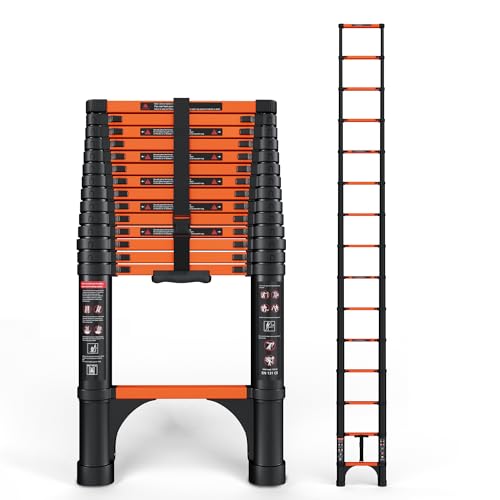
A 14.5 ft aluminium ladder rated ANSI A14.2 Type IA at 330 lb, with 11.8 in step spacing.
Best for: a jobbing handyman who wants one ladder in the van for mixed work Skip it if: you prize the lightest possible carry weight
The SINMEIRUN is the only ladder in this set that cites an ANSI classification. The listing states ANSI A14.2 with a Type IA heavy-duty rating supporting 330 lb, which is the standard American duty class for industrial use. That single piece of paperwork sets it apart from the SocTone and the UC UP CLIMBER, both of which stay in general-purpose marketing language.
It reaches 14.5 ft, extending two full feet past the 12.5 ft ladders here, and weighs 26 lb. Step spacing is called out at 11.8 in, which is worth checking against your own stride: closer spacing is easier on long climbs, wider spacing gets you up faster. Folded, it collapses to a 37 in body, so it will fit most car boots.
The trade-off is weight. Every extra foot of ladder is more aluminium to carry, and at 26 lb it is 3.7 lb heavier than the SocTone. If you climb once and stay up there, the two feet of extra reach is worth it. If you climb and descend all day, that weight tells.
Pros:
- ANSI A14.2 Type IA rating stated in the listing
- 330 lb load capacity
- 14.5 ft reach, longest of the sub-30-lb group
- 37 in folded length fits most boots
- Reinforced nylon fibre in the plastic components (claim)
Cons:
- Heavier than every 12.5 ft option here
- Orange finish is harder to keep looking clean
- No stated warranty terms
3. UC UP CLIMBER Telescoping Ladder — Best upgrade
A 12.5 ft telescoping ladder rated to 330 lb, with the second-lowest price position in the set.

Best for: a homeowner stepping up from a step stool without paying premium money Skip it if: you need documented ANSI or EN 131 certification
The UC UP CLIMBER matches the SocTone's 12.5 ft reach and adds a stated 330 lb load capacity. It weighs 23.1 lb, which is 0.8 lb heavier than the SocTone and 1.8 lb lighter than the HQJUN. It is the second-cheapest of the six, sitting just above the HQJUN in price position and delivering more in return: a specified load, anti-slip bottom caps and a named model number, DLT706B.
One quirk worth flagging. The first feature bullet says "high-strength stainless steel" while the "Adjustable Height" bullet describes a retractable aluminium-style extension. Telescoping ladders in this class are typically aluminium, and the dimensions and weight fit an aluminium build. Read the material line as ambiguous, and if the material actually matters for a corrosive worksite, ask the seller before buying.
Against the SocTone, this pick concedes 0.8 lb of carry weight and a stated 30°-to-10° stability figure, but gains a published 330 lb capacity. Against the SINMEIRUN, it loses the ANSI paperwork and two feet of reach.
Pros:
- 330 lb stated load capacity
- 12.5 ft reach at 23.1 lb
- Anti-slip bottom caps for stability
- The second-cheapest of the six
- Anti-slip bottom caps and named model DLT706B
Cons:
- Material description is inconsistent between bullets
- No cited safety standard
- No published warranty terms
4. SEEKNEW Telescoping Ladder — Best premium
A 27.6 ft EN 131 telescoping ladder at 52.9 lb, with integrated wheels and triangular stabilisers.

Best for: roofers, sign fitters and window cleaners working two-storey elevations Skip it if: you cannot lift 52.9 lb into a van single-handed
The SEEKNEW is here for one reason: reach. At 27.6 ft it more than doubles the extended height of the SocTone and clears the SINMEIRUN by 13.1 ft. For a professional who needs to get to a two-storey gutter, a chimney flashing or a shopfront fascia, no other pick in this set does the job. It cites EN 131, which is the European ladder standard, and describes an aircraft-grade aluminium alloy frame.
Weight is the price of admission. It comes in at 52.9 lb, more than twice the SocTone, and folds to 48.8 in, which is longer than the SINMEIRUN's 37 in body. Integrated wheels and a carry strap help you drag it rather than shoulder it, and the maker cites a reinforced support bracket alongside the triangular stabiliser design.
The one thing to watch is not the ladder but the technique. A 27.6 ft telescoping ladder at full extension flexes more than a two-section extension ladder of the same reach. SEEKNEW's own bullet warns to respect that. Take the note seriously.
Pros:
- 27.6 ft extended height, longest in the set
- EN 131 cited in the listing
- Integrated wheels for ground transport
- Triangular stabilisers and reinforced bracket (claim)
- Named model SST27.6FT-GL-BK
Cons:
- 52.9 lb, heaviest by a wide margin
- 48.8 in folded length is bulky in most vans
- The most expensive pick here
- Only one seller lists it
5. LEVELEVE Telescoping A Frame Ladder — Best minimal setup
A multi-position ladder that converts into step, A-frame, telescopic, right-angle and staircase configurations.

Best for: stair landings and uneven ground where an A-frame configuration earns its keep Skip it if: you want a single-purpose straight extension and nothing else
The LEVELEVE is the only ladder in this set that converts. The listing describes a 5-in-1 configuration: step ladder, A-frame, telescopic, right-angle and a staircase mode with offset legs. That last mode is why this pick exists. If your work takes you into stairwells, half-landings or garden ground that steps down, a straight telescoping ladder cannot sit level and this one can.
Height is where the listing is muddled. The size line reads 20FT, the marketing bullet describes a 20 ft maximum, and the product title reads 22FT. Treat the reach as approximately 20 ft and confirm with the seller if the exact number matters. Weight is not published on the listing at all, which is a real gap given the LEVELEVE feature bullet mentions 38 pounds. Since that figure is not in the specifications section, I do not carry it into the table.
Against the SEEKNEW, you give up 7 ft of straight reach and gain the ability to stand safely on a staircase. That is a specific trade you either need or you do not.
Pros:
- Five configurations from one ladder
- W-shaped non-slip step design (claim)
- 2mm-wall industrial aluminium tubing (claim)
- Stabiliser bar and integrated wheels
- Works on stairs where a straight ladder cannot
Cons:
- Height figures disagree between size line and title
- No published weight in the specifications section
- No cited ANSI or EN standard
- The second-most expensive pick here
6. HQJUN Telescoping Ladders — Best budget pick
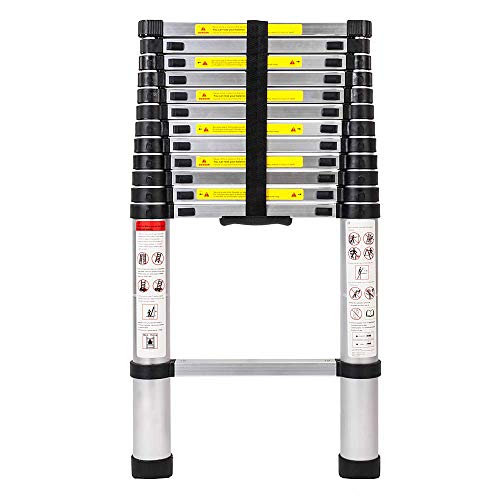
A 12.5 ft EN 131 telescoping ladder, the cheapest of the six, with a stabiliser bar and anti-slip rubber sleeves.
Best for: occasional site use as a backup ladder kept in the truck Skip it if: this is the ladder you climb every day
The HQJUN is the cheapest of the six and the slowest seller of the set. Both of those facts follow the same reason: it is a plain-vanilla 12.5 ft aluminium telescoping ladder with a stabiliser bar and no standout hardware. It cites EN 131 in the product title, which puts it in company with the SEEKNEW on paperwork, and it folds to a 32.7 in body, the shortest stow length in this set by a clear margin. That matters if you carry the ladder inside a hatchback rather than a van.
The compromises are legible. At 24.9 lb it is heavier than every other 12.5 ft option here. The feature bullets are thin, essentially five short lines. There is no published load rating in the specifications table, only the EN 131 reference in the title. The listing gives you a working ladder at the lowest entry point in this set, and asks you to accept less documentation in return.
Pros:
- The cheapest of the six
- 32.7 in folded body, shortest in the set
- EN 131 referenced in the title
- Stabiliser bar and anti-slip rubber sleeves
- 12.5 ft reach at the lowest price position
Cons:
- Heaviest of the 12.5 ft group at 24.9 lb
- Thin feature detail on the listing
- No published load rating in the spec table
- The slowest seller of the six
What actually decides a telescoping ladder purchase
Most guides on telescoping ladders lead with reach. Reach matters, but it is not the deciding specification for a professional. The deciding specification is the pair of numbers you weigh together: stated load rating and stated safety standard. A "heavy duty" bullet with no class attached is marketing. A stated ANSI Type IA or EN 131 line is a claim the maker has tied itself to.
In this set, only two ladders publish a named standard on the listing: the SINMEIRUN cites ANSI A14.2 Type IA at 330 lb, and the SEEKNEW cites EN 131. The HQJUN references EN 131 in the title but not in the specifications table. The SocTone, the UC UP CLIMBER and the LEVELEVE make general safety and stability claims without naming a standard. For occasional use that is fine. For daily use it is a paperwork gap.
The second thing that decides the purchase is folded length. Every telescoping ladder here extends to a similar body cross-section around 19 in wide. What varies is the stowed height:
- HQJUN: 32.7 in
- SINMEIRUN: 37 in
- SEEKNEW: 48.8 in
If it lives in a car, the HQJUN and the SINMEIRUN are the practical options. If it lives in a van, all six fit.
How do certifications like ANSI and EN 131 compare?
How do certifications like ANSI and EN 131 compare in this set? Two are actually cited on the listings. The SINMEIRUN names ANSI A14.2 Type IA at 330 lb, an American standard for industrial-duty ladders. The SEEKNEW names EN 131, a European standard that covers ladder construction, marking and testing. The HQJUN also references EN 131 in its product title but not in the specifications section, which is a weaker citation.
None of these is a guarantee on its own. A cited standard tells you the manufacturer has publicly staked its listing on meeting the class, and that is easier to challenge if the ladder fails than a bullet that says "heavy duty" without qualification. For a professional user, prefer a listing where the standard sits inside the specification block, not just the marketing copy. If your employer or client requires proof, ask the seller for the test documentation before you buy.
What do the listings not tell you about pro use?
What do the listings not tell you? Three things, mostly.
First, duty cycle. None of these product pages tells you how many climb cycles the ladder is rated for before the locking mechanism should be inspected. Telescoping ladders lock section by section, and those locks wear. On a daily-use ladder, inspect them monthly.
Second, repair and spare parts. All six listings show only one or two sellers each, and none publishes a spare-parts programme. If a rung lock fails after two years, you are almost certainly replacing the ladder, not fixing it. That changes the cost calculation for a professional.
Third, warranty terms. Not one of the six listings publishes explicit warranty language in the specifications shown. Amazon's own return window is your default protection. If you need a longer warranty for professional use, look outside this set to a trade-supply channel.
Which pick fits which job?
Read this list as if/then flips, not as a hierarchy.
- If you work single-storey interiors — bulb changes, ceiling fans, HVAC vents, cabinet installs — the SocTone at 22.3 lb is the ladder you want in your hand.
- If you need one van ladder for mixed work — light exterior plus interior — the SINMEIRUN gives you 14.5 ft reach and the ANSI paperwork for 27.5% more carry weight.
- If you work two-storey exteriors — gutters, roof edges, sign fixings — the SEEKNEW at 27.6 ft is the only pick here that reaches.
- If your work involves stairs or terraced ground, the LEVELEVE is the only convertible in the set.
- If price rules and you climb rarely, the HQJUN gets you working at 12.5 ft.
- If you want a stated load rating without paying up, the UC UP CLIMBER publishes 330 lb at the second-lowest price position.
The verdict
If you climb every day and the ladder lives in one place, the SocTone Telescoping Ladder is the right default. At 12.5 ft and 22.3 lb, with its twin triangular stabiliser design, it does the work most professionals actually do, and it is the lightest ladder here by a clear margin. That combination of low carry weight and single-storey reach fits the daily rhythm of interior tradework, service calls and residential maintenance.
If your work runs above one storey — roofs, second-floor gutters, shopfront signage — the SEEKNEW 27.6 FT Pro is the better buy despite its 52.9 lb weight and its price position at the top of this set. It is also the only pick with EN 131 named on the listing. Nothing else in the set reaches beyond 20 ft.
The cutoff between the two is a single question: does your ladder need to reach past a single-storey eave, yes or no? Below that line the SocTone wins on weight, portability and simplicity. Above it, the SEEKNEW is the only real answer, and the trade-off in carry weight is the cost of doing the job safely. Everything else in this roundup is a middle ground designed to fit somewhere between those two points.
FAQ
Is a telescoping ladder worth it for daily professional use?
Is a telescoping ladder worth it for daily professional use? For most tradework at single-storey height, yes. The gain is stow length and carry weight rather than any climbing advantage. The SocTone at 22.3 lb and the HQJUN at a 32.7 in folded body illustrate what a telescoping design gets you. If your daily work is roof or two-storey, choose one with a cited standard, like the SEEKNEW EN 131 or the SINMEIRUN ANSI A14.2.
How does the SocTone compare to the SINMEIRUN?
How does the SocTone compare to the SINMEIRUN? The SocTone reaches 12.5 ft at 22.3 lb and cites no external standard, relying on its stabiliser design. The SINMEIRUN reaches 14.5 ft at 26 lb and cites ANSI A14.2 Type IA at 330 lb. You gain two feet of reach and a stated duty class with the SINMEIRUN, and give up 3.7 lb of carry weight. Pick the SocTone for lightness, the SINMEIRUN for paperwork.
What load capacity should professionals look for?
What load capacity should professionals look for on a telescoping ladder? A stated 330 lb rating covers a worker plus tools and materials with a working margin, and it corresponds to ANSI Type IA industrial duty. Two picks here cite that figure: the SINMEIRUN and the UC UP CLIMBER. The SEEKNEW cites EN 131 rather than an ANSI class. If load capacity is not stated at all on the listing, treat that as a gap and ask the seller directly.
Can any of these ladders reach a second-storey gutter?
Can any of these ladders reach a second-storey gutter safely? Only the SEEKNEW, at 27.6 ft extended, is designed for that height range in this set. The LEVELEVE reaches roughly 20 ft depending on which line of the listing you read, which sits at the edge of two-storey work. The other four ladders top out at 12.5 or 14.5 ft, which is single-storey or interior reach. Match the ladder to the job, not the other way around.
What is the most common mistake buying telescoping ladders?
What is the most common mistake buying telescoping ladders? Choosing on reach alone and ignoring folded length and stated standard. A 27.6 ft ladder that will not fit in your van is not your ladder. A ladder with no cited class is fine for occasional use and a gap for daily use. Look at all three — extended height, folded length and cited standard — before you compare prices. The picks above sort into those buckets deliberately.
Once you know which of the six buckets you are in — single-storey daily, mixed van work, two-storey exteriors, staircases, occasional backup, or lowest entry point — the choice is almost mechanical. The SocTone handles the largest share of professional day-to-day work because most of that work is single-storey and interior. For anything else, pair the specification you cannot compromise on with the pick that publishes it: ANSI on the SINMEIRUN, EN 131 on the SEEKNEW, convertible geometry on the LEVELEVE. Buy the ladder that fits the job you actually do most days, not the one that fits the job you do twice a year.