Best Stain for Cedar Decking: Ready Seal Wins

A ranked comparison of six exterior wood stains suitable for cedar decking, with the deciding criterion named early and the trade-offs spelled out.

By Dexter GillUpdated 17 min read
On this page
- Best stain for cedar decking at a glance
- The misconception that ruins cedar decks
- How I narrowed 40 listings to six
- 1. Ready Seal Exterior Wood Stain & Sealer — Best overall
- 2. SaverSystems #1 Deck Premium Semi-Transparent Wood Stain — Best upgrade
- 3. SaverSystems #1 Deck Premium Wood Fence Stain — Best minimal setup
- 4. JOBOSI Advanced Wood Stain & Sealer — Best budget pick
- 5. Armstrong-Clark Oil-Based Wood Stain for Decks — Best for pros
- 6. Wood Defender 200 Series Stain and Seal — Runner-up
- Oil-based versus water-friendly: which suits cedar?
- How much stain does a cedar deck actually need?
- What the listings do not tell you
- When should you skip these and hire out?
- The verdict
- FAQ
The best stain for cedar decking is Ready Seal Exterior Wood Stain & Sealer in Natural Cedar, sold in a 5 Gallon pail, because its penetrating formula forgives lap marks, tolerates damp or hot wood, and needs no back-brushing on a horizontal surface. If you want to reset cedar that has already silvered, SaverSystems #1 Deck Premium Semi-Transparent in Gray is the better buy. Both are semi-transparent, oil-forward finishes that let the grain show, which is what most cedar owners actually want.
Best stain for cedar decking at a glance
| Pick | Finish type | Size | Price |
|---|---|---|---|
Best overall Ready Seal Exterior Wood Stain & Sealer |
Penetrating oil, semi-transparent | 5 Gallon | Check Price |
Best upgrade SaverSystems #1 Deck Premium Semi-Transparent |
Semi-transparent, flat finish | 1 Gallon | Check Price |
Best minimal setup SaverSystems #1 Deck Premium Fence Stain |
Semi-transparent sealer | 1 Gallon | Check Price |
Best budget pick JOBOSI Advanced Wood Stain & Sealer |
Water-friendly, penetrating | 8 oz | Check Price |
Best for pros Armstrong-Clark Oil-Based Wood Stain |
Penetrating oil, semi-transparent | 1 Gallon | Check Price |
| Oil-based, transparent | 1 Gallon | Check Price |




The misconception that ruins cedar decks
Most guides on the best stain for cedar decking start with pigment depth or color range. That is not what decides the outcome. What decides it is how the stain sits in the wood.
Cedar is a soft, resinous wood with open pores. A film-forming finish sits on top, and on a horizontal deck it eventually cracks, lifts and peels, because foot traffic and standing water attack the film from every angle. A penetrating oil soaks in, dries below the surface, and wears by fading rather than peeling. When it is time to recoat, you clean and reapply. No sanding, no stripping.
Five of the six picks here are penetrating or semi-transparent oil-forward formulas. That is not a coincidence. It is the shape of the category once you cut the film-formers out.
The second decision is color. Cedar starts warm and reddish, then silvers under UV. Warm-toned stains ("Natural Cedar", "Cedar Tone") try to hold or restore the original hue. A gray stain, like the SaverSystems #1 Deck Premium in Gray, accepts the silvered look and locks it in. Both are legitimate, and choosing between them decides half your shortlist.
How I narrowed 40 listings to six
I worked from the listing data and disqualified in three passes rather than scoring on features.
- Cut on finish type. Anything explicitly film-forming, glossy or paint-adjacent came off the list. Cedar decks reward penetrating oils and semi-transparent sealers because they wear predictably and recoat without stripping.
- Cut on category fit. Products flagged only for interior use, floors, or furniture came off. Every survivor names decks or exterior wood in the listing.
- Cut on evidence. Listings without a stated size, color and finish description were dropped. If you cannot see what the can holds and how it dries, you cannot judge it.
What survived was six oil-forward stains in warm cedar tones or gray, sold in sizes from 8 oz to 5 Gallon, at prices spread across entry, mid and premium positions. The winner had to be the one that reduced the number of ways a first-time application could go wrong. The runners-up had to earn their place against it on a specific axis: color range, cure speed, price, or professional pedigree.
1. Ready Seal Exterior Wood Stain & Sealer — Best overall
Ready Seal's 5 Gallon Natural Cedar pail is the safest bet for a first cedar-deck refinish because the formula is built to hide the mistakes a beginner makes.
Best for: a first-time DIYer refinishing a weathered cedar deck Skip it if: you want a film-forming, glossy finish
Ready Seal is the only pick in this set sold in a 5 Gallon size, which matters because cedar decks are thirsty and a single-gallon can rarely finishes a full deck in one session. The listing describes a "Goof Proof" formula that requires no back-brushing, no wet-line application, and no lap-mark management, and says it can be applied in direct sunlight and can withstand rain within minutes. Those are the manufacturer's claims, but they map to what a penetrating oil is supposed to do: soak in fast, self-level, and stop being sensitive to weather once it has bitten the wood.
The color is Natural Cedar, which reads as a warm honey tone that suits fresh or lightly weathered cedar rather than heavily silvered boards. Model 512, dimensions 13.8 x 12 x 12 in. It is the slowest-drying-looking of the set on paper but the fastest to become weather-safe. The trade-off against the others in this set: it is the most expensive pick here, and the pail is heavy to move around a deck.
Pros:
- Only 5 Gallon size in this set, right-sized for a full deck
- No back-brushing or wet-line management claimed
- Rain-tolerant shortly after application per the listing
- Recoats without sanding or stripping
- Warm Natural Cedar tone suits fresh or lightly aged boards
Cons:
- The most expensive pick here
- Warm tone will not correct heavily silvered wood
- 5 Gallon pail is bulky to store if you only need part of it
2. SaverSystems #1 Deck Premium Semi-Transparent Wood Stain — Best upgrade
The Gray version of #1 Deck Premium is the pick when your cedar has already silvered and you want to stop fighting the sun.

Best for: cedar that has silvered and needs a gray-toned reset Skip it if: you want to keep the warm cedar hue
This is the second-cheapest pick in the set and the only one here that leans into gray. The listing says it dries to a flat, natural-looking finish and is available in five semi-transparent deck colors, so the Gray you see in the product image is one of five. It also says it works on damp wood, which trims the wait between cleaning and staining down to "visibly dry". On a real deck that saves half a day per side, which is how weekend refinishes actually get finished.
What earns it "Best upgrade" is not price, since it sits in the entry price position here. It earns the label by giving cedar owners the second legitimate answer to the color question. If you have accepted the silver, you do not want a warm honey stain lifting the boards back to a color the wood no longer wants to be. The trade-off against Ready Seal: no 5 Gallon option in this listing, so a large deck needs multiple cans, and the listing carries fewer application-condition claims.
Pros:
- Flat, semi-transparent finish lets the grain show
- Gray option addresses silvered cedar directly
- Damp-wood application shortens the refinish cycle
- Sits at the entry end of this set on price
- Same family as the Cedar-tone sibling for matched color across a property
Cons:
- Sold only in 1 Gallon in this listing
- Fewer published specifications than the winner
- Gray will not suit fresh cedar boards
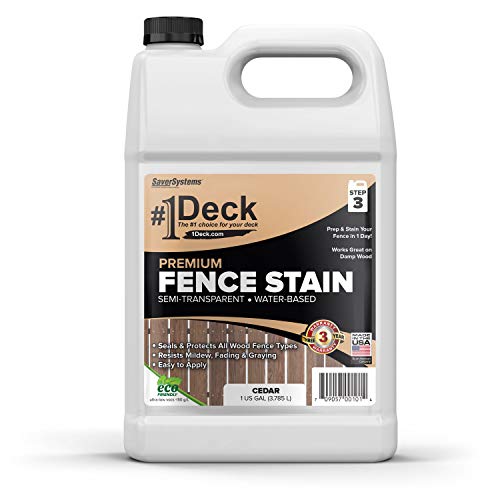
3. SaverSystems #1 Deck Premium Wood Fence Stain — Best minimal setup
The Cedar version of the same #1 Deck Premium family is the pick when your prep window is short and your deck is small.
Best for: a small cedar deck you want to stain the day after cleaning Skip it if: your deck is bigger than one gallon can cover in a coat
Same manufacturer, same "works on damp wood" claim, warm Cedar color instead of Gray. The 1 Gallon can weighs 8.88 lb, which is the only weight figure published in this set, and that is a useful proxy for the oil load: this is a thick, resin-forward can, not a thinned sealer. Model 300634, two sellers list it against the Gray version's one, which reads as a slightly more established SKU in the family.
The reason this earns "Best minimal setup" over the winner is the wait time. Ready Seal handles heat and rain, but the SaverSystems damp-wood claim is what lets you power-wash Saturday morning and stain Saturday afternoon. On a small deck, that turns a two-weekend job into a one-day job. The trade-off is size: at 1 Gallon and a coverage rate that depends on how thirsty the boards are, this is not the pick for a large surface. Buy two cans or step up to the Ready Seal pail.
Pros:
- Damp-wood application collapses the prep-to-stain wait
- Warm Cedar tone matches fresh or lightly aged boards
- 8.88 lb can suggests a resin-forward oil blend
- Semi-transparent, flat finish preserves grain visibility
- Sibling colors available for matched fences and decks
Cons:
- 1 Gallon only, so scaling up means more cans
- Two sellers listed, less availability than the winner
- No warranty stated in the listing
4. JOBOSI Advanced Wood Stain & Sealer — Best budget pick
JOBOSI's 8 oz can is the cheapest way to test a color on your own cedar before committing to a full deck.

Best for: cedar railings, planters, or a sample patch before committing Skip it if: you need to cover a full deck in one go
This is the cheapest of the six and by far the smallest, an 8 oz can with dimensions of 3.54 x 4.13 x 3.54 in. The listing describes a water-friendly, low-odor, quick-drying formula that claims to resist fading, peeling and cracking for 3-5 years, and it lists decks, fences, wall panels and outdoor furniture. Four sellers list it, the widest offer count in this set.
The honest use case is not "stain your deck with this". At 8 oz per can, that is not the job. The honest use case is the one every experienced refinisher wishes they had done: paint a two-board test patch in an out-of-the-way corner, let it cure, look at the color in morning light and evening light, then decide whether to buy 5 Gallon of a warm tone or 1 Gallon of a gray. It is also a fair pick for a set of railings, a bench, or a couple of planter boxes where a full pail is overkill. The trade-off against every other pick here: it is a water-friendly formula in a set otherwise dominated by penetrating oils, and the long-life claim is the manufacturer's.
Pros:
- Cheapest pick in the set
- 8 oz size right for test patches and small pieces
- Low odor, easy soap-and-water cleanup per the listing
- Four sellers listed, the widest availability here
- Natural Cedar color matches the warm-tone strategy
Cons:
- 8 oz will not cover a full deck
- Water-friendly formula sits outside the oil-based mainstream of this set
- Long-life claim is the manufacturer's, not independently framed
5. Armstrong-Clark Oil-Based Wood Stain for Decks — Best for pros
Armstrong-Clark is the pick when you know how penetrating oil stains behave and want a professional-grade result on cedar.

Best for: a homeowner comfortable with penetrating oil stains and thin coats Skip it if: you want the fastest, most forgiving application
The listing describes conditioning oils that penetrate the wood while drying oils lock in protection, and names cedar, redwood, pine and pressure-treated wood as intended substrates. The finish is Cedar Semi-Transparent, sold in 1 Gallon at dimensions of 9 x 7 x 7 in, and Armstrong-Clark says maintenance coats typically need cleaning and reapplication without sanding, stripping or media blasting. Two sellers list it.
This sits in the premium price position, second only to the Ready Seal pail. The reason to reach for it over the winner is not price; it is application philosophy. Ready Seal is engineered to be forgiving. Armstrong-Clark is engineered to reward technique: thin, even coats on properly prepped wood produce the finish the brand is known for. Overapply it and you get shiny spots that need wiping. If you have stained decks before and want the tightest color-retention story in this set, this is the pick. The trade-off: no wet-line-free claim as explicit as Ready Seal's, and no 5 Gallon size in this listing.
Pros:
- Named for cedar, redwood, pine and pressure-treated wood in the listing
- Penetrating oil with separate conditioning and drying oil functions
- Recoats without sanding, stripping or blasting
- Semi-transparent finish preserves grain
- Applicable in direct sun and warm temperatures per the listing
Cons:
- Premium price position without the winner's forgiveness
- 1 Gallon only in this listing
- Rewards technique, so a rushed application shows
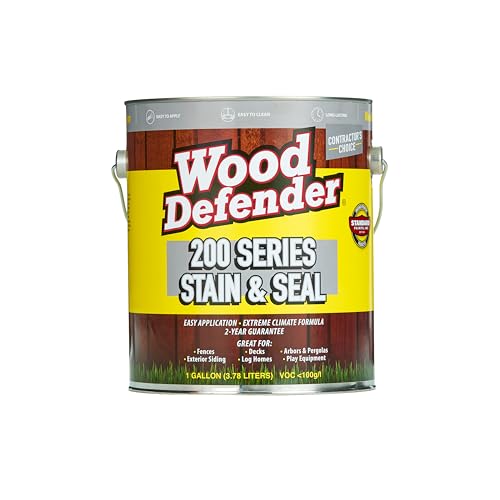
6. Wood Defender 200 Series Stain and Seal — Runner-up
Wood Defender 200 Series is the pick when the deciding factor is getting back on the deck fast.
Best for: a weekend refinish where you need to walk on the deck within two days Skip it if: you want the most established track record in this set
Wood Defender 200 Series is a 1 Gallon oil-based stain and seal in Cedar Tone, model 200, with two sellers listed. The headline claim on the listing is a 24 to 48 hour cure window, weather permitting, which is the tightest published cure claim in this set. Coverage is stated at approximately 125 to 225 sq. ft. per gallon depending on the wood and the application, one of the few pieces of coverage math any listing in the set volunteers.
The reason this lands at runner-up rather than higher is that the listing leans on multi-purpose language, calling it one product for fences and decks. That is useful if you want matching color across vertical and horizontal surfaces on the same property, and it is exactly the case where Wood Defender wins on the cure clock. The trade-off against the winner: fewer application-condition claims, no 5 Gallon size, and a mid-range price position that does not undercut the entry-tier options.
Pros:
- 24 to 48 hour cure claim, the tightest here
- Published coverage estimate of 125 to 225 sq. ft. per gallon
- Cedar Tone color matches fence-line products in the same family
- Oil-based penetrating formula, suits cedar
- DIY-friendly application per the listing
Cons:
- Mid-range price without a large-format option
- Cure time depends on weather, which the listing notes
- Fewer published specifications than the winner
Oil-based versus water-friendly: which suits cedar?
Cedar's chemistry rewards oil-based penetrating stains. The wood is soft and porous, and it exudes natural oils that a compatible finish blends with rather than fights. Five of the six picks here are oil-based or oil-forward: Ready Seal, both SaverSystems cans, Armstrong-Clark and Wood Defender. Only JOBOSI describes a water-friendly formula, and even that listing is careful to call it a stain and sealer rather than a latex or acrylic paint.
The choice is not binary in practice. It plays out along three axes.
- Absorption. Oil stains sink in and dry below the surface. Water-friendly stains sit closer to the surface and rely on binders to hold pigment.
- Recoat behavior. Oil-based penetrating stains typically recoat with a clean-and-reapply cycle, as every oil pick in this set describes. Water-based films are more likely to need sanding as they age.
- Cleanup. Water-friendly cleans up with soap and water per the JOBOSI listing. Oil requires solvent for tool cleanup.
For a deck, absorption and recoat behavior matter more than cleanup, which is why the oil-forward picks dominate this shortlist. Where a water-friendly small can earns its place is exactly the JOBOSI use case: sampling a color, hitting a set of railings, or refinishing a garden bench where cleanup convenience matters more than a decade of wear.
How much stain does a cedar deck actually need?
This is the calculation most first-time buyers get wrong. Cedar drinks stain, and the first coat rarely covers what a smooth pine board would.
- Measure the deck in square feet. Length times width, then add roughly 15 to 20% for railings, spindles and skirt boards if you plan to stain them.
- Use the coverage figure the listing gives. Wood Defender publishes 125 to 225 sq. ft. per gallon. Assume the low end for weathered or newly cleaned cedar and the high end for boards that have already been sealed once.
- Plan for two coats on bare or heavily weathered wood. One coat looks patchy on thirsty cedar. Two coats even out the color and build the sealer film.
A 200 sq. ft. deck with railings can easily need 2 to 3 gallons of a penetrating stain on the first refinish. That is why the 5 Gallon Ready Seal pail lands where it does in this ranking: on a full-size deck, it is a single-purchase job rather than a repeated trip to the store when the second coat runs out. On a small landing or a set of stairs, a single 1 Gallon can from the SaverSystems family covers the project.
What the listings do not tell you
Product listings for stain are optimistic by nature. Three things they will not put on the label matter more than most of what they do.
- Prep decides the outcome more than the stain does. A dirty or greying deck stained without cleaning will look uneven no matter which of these six you buy. Every oil-based pick here expects a clean substrate.
- UV exposure sets the recoat clock. A south-facing deck in full sun will fade faster than a shaded one, regardless of the "3-5 years" language in the JOBOSI listing or the "long-lasting" language elsewhere. Inspect annually and recoat when the water stops beading.
- Board age changes absorption. New cedar rejects stain more than weathered cedar because the mill-glaze on the surface is still intact. A light sanding or a brightener wash improves penetration on fresh boards. Older, silvered boards drink stain in a way that shifts the color darker than the sample chip suggests.
None of the six listings walks a buyer through this, and none of the color chips accounts for it. The JOBOSI 8 oz can exists partly because there is no substitute for a real test patch on your actual wood.
When should you skip these and hire out?
For most cedar decks, a homeowner with a pump sprayer, a stain pad, and a free weekend gets a result that lasts. Some decks are not that job.
- The deck is larger than about 400 sq. ft. and you cannot break the work into two sessions.
- The boards are cupped, split, or showing rot around fastener holes. Stain will not fix structural failure.
- The previous finish was a film-forming paint or solid stain that is now peeling. Stripping that off is a bigger job than staining what remains.
- You are working on a second-story deck where fall protection matters.
For a small, sound cedar deck at ground level, any of the six picks here can produce a finish you are proud of, provided you match the pick to the condition of the wood and your comfort with oil stains. Ready Seal is the safest default. Armstrong-Clark rewards technique. JOBOSI is a sampling tool. SaverSystems is the wet-cedar rescue. Wood Defender is the fast-cure choice.
The verdict
For most cedar decks, most people, most of the time, Ready Seal Exterior Wood Stain & Sealer in Natural Cedar is the best stain for cedar decking. The 5 Gallon size right-sizes a full deck refinish into one purchase. The Goof Proof application language matches how a penetrating oil actually behaves on cedar: it self-levels, it forgives lap marks on a horizontal surface, and it recoats without sanding.
The cutoff is color intent. If your cedar has already gone silver and you have made peace with that, SaverSystems #1 Deck Premium in Gray is the better buy. It preserves the grain, works on damp wood after cleaning, and sits at the entry end of this set on price. Its exact advantage over the winner is not durability or forgiveness; it is that it lets you stop chasing a warm color the wood no longer wants to be.
If your window is short and your deck is small, the Cedar-tone sibling from SaverSystems does the same wet-cedar trick in the traditional color. If you have stained decks before and want the tightest color-retention story here, Armstrong-Clark rewards the technique. The winner is the default. Everything else is a reason to deviate.
FAQ
Is Ready Seal actually worth the premium price?
Ready Seal actually earns the premium price on a full-size deck, because it is the only 5 Gallon option in this set and because its penetrating formula is engineered to hide the mistakes a first-time applicator makes. On a small deck or a set of railings, a 1 Gallon can from SaverSystems or Wood Defender does the job for less, so the value case is size-dependent rather than universal.
What is the best stain color for cedar decking?
The best stain color for cedar decking depends on how weathered your boards already are. Fresh or lightly aged cedar takes warm honey tones like Ready Seal's Natural Cedar, Wood Defender's Cedar Tone, or the SaverSystems Cedar. Cedar that has silvered under UV takes gray tones better, which is why SaverSystems #1 Deck Premium in Gray earns its own place on this shortlist. Neither choice is wrong.
How does Ready Seal compare to Armstrong-Clark on cedar?
Ready Seal compares to Armstrong-Clark as forgiveness against technique. Ready Seal's listing emphasizes no back-brushing, no wet-line application, and tolerance for direct sun and rain shortly after application. Armstrong-Clark's listing emphasizes conditioning and drying oils that reward thin, even coats on prepped wood. For a first refinish, Ready Seal is the safer pick. For a confident applicator chasing color retention, Armstrong-Clark is the better pick.
Can you stain damp cedar decking?
You can stain damp cedar decking if the stain says so, and two picks here explicitly do. Both SaverSystems #1 Deck Premium listings state the product works on damp wood once the surface is visibly dry, which collapses the wait between cleaning and staining. Other picks in this set do not make the same claim, so on a rushed weekend the SaverSystems family is the pick that lets you power-wash in the morning and stain in the afternoon.
How often should you restain a cedar deck?
How often you should restain a cedar deck depends on sun exposure, foot traffic and rainfall. A reasonable rule is annually inspect, recoat when water stops beading on the surface. JOBOSI's listing claims 3-5 years for its formula, and the oil-based picks here all describe recoat cycles without sanding or stripping. Expect a south-facing deck in full sun to need attention sooner than a shaded one, regardless of the product.
Start with the deck you actually have, not the deck the color chip shows. Clean the boards, let them dry to whatever "dry" your chosen stain requires, and paint a test patch in the corner before you open the second can. If you are refinishing a full-size cedar deck for the first time, the Ready Seal 5 Gallon pail is the pick that shortens the list of ways this can go wrong: right size, forgiving formula, and a warm Natural Cedar tone that suits the wood most people actually own. Buy the stain that matches your boards today, not the boards you had five summers ago.