Best Professional Workbench for Mechanics Who Wrench Daily
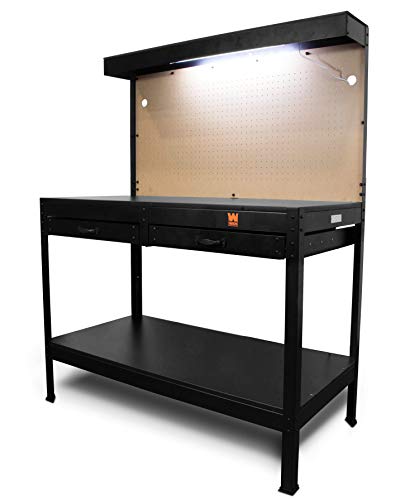
Five workbench setups compared on load rating, power, storage and footprint, with a clear winner for daily wrenching and a runner-up when uneven floors are the problem.

By Dexter GillUpdated 15 min read
On this page
- Best professional workbench for mechanics at a glance
- How I cut the shortlist to five
- What actually decides a mechanic's workbench?
- 1. WEN WB4723T 48-Inch Workbench with Power Outlets and Light — Best overall
- 2. Pterying Garage Workbench with LED Light Bar — Runner-up
- 3. IGERI 39" Heavy Duty Work Bench With Drawer and Storage — Best for pros
- 4. FreekyFit Shop Stool with Backrest — Best for beginners
- 5. WeiSnap Rolling Tool Cart with Phone Stand — Best budget pick
- Load rating vs. top capacity: what's the difference?
- Power on the bench: outlets, USB, and the light overhead
- How much footprint do you really need?
- What the listings do not tell you
- The verdict
- FAQ
The best professional workbench for mechanics is the WEN WB4723T, a 48-inch steel unit with a 220-pound enamel top, three 13-amp outlets and an overhead fluorescent light built in. If your floor is uneven or you want USB charging beside the AC outlets, the Pterying Garage Workbench with LED Light Bar is the smarter buy, trading a smaller published top rating for adjustable leveler feet and a wider power strip.
Best professional workbench for mechanics at a glance
| Pick | Load or top rating | Footprint | Price |
|---|---|---|---|
Best overall WEN WB4723T 48-Inch Workbench |
220 lb top (manufacturer) |
61.8 x 47.4 x 25 in | Check Price |
Runner-up Pterying Garage Workbench |
600 lb frame (manufacturer) |
Not listed | Check Price |
Best for pros IGERI 39" Heavy Duty Work Bench |
2000 lb frame (manufacturer) |
35 x 21.7 x 39.4 in | Check Price |
Best for beginners FreekyFit Shop Stool with Backrest |
300 lb seat (manufacturer) |
41.7 x 16.9 x 16.9 in | Check Price |
Best budget pick WeiSnap Rolling Tool Cart |
Not listed | 39 x 12 x 16.5 in | Check Price |


How I cut the shortlist to five
Three criteria decided this set, weighted in this order: published load capacity, integrated power, and enclosed storage. Load came first because a mechanic's workbench either holds a vise under torque or it does not. Everything else follows from that.
Integrated power came second. A bench without outlets forces an extension cord across the floor, which is the number one tripping hazard in a home bay. Storage came third: drawers and pegboard beat open shelves for a workshop that sees oil and swarf.
Here is what got cut on each rule:
- Benches with no published load figure, of any kind. If the listing does not commit to a number, neither should you.
- Benches sold as tabletops only, without legs. A slab is not a bench for a mechanic.
- Benches with no storage and no outlets, priced above the entry tier. Nothing survived that combination.
What remained was three full workbenches, one rolling helper cart, and one shop stool. I kept the stool and the cart in the set on purpose, because a professional bench setup is rarely just a bench.
What actually decides a mechanic's workbench?
Most guides in this category compare tabletop thickness. That is not what decides it. Whether the frame is welded steel or bolted steel decides it, because a bolted frame racks under a vise handle after a few months of wrenching and a welded frame does not.
Two of the three full benches in this set publish that detail. IGERI describes an all-steel frame under a 2,000-pound load rating. Pterying names a welded A3 alloy steel frame with a 600-pound capacity and explicitly says the welded build is more rigid than bolt-together alternatives. WEN publishes a 220-pound top capacity but does not commit to a frame construction in the listing details supplied here.
The trap is reading the biggest number and stopping. IGERI's 2,000-pound figure is a frame rating, not the working surface number you would use to plan a press job. Pterying's 600-pound figure is described as frame capacity for engine parts and heavy tools. WEN's 220 pounds is specifically the top surface. Three numbers, three meanings, and only one of them tells you what the bench will hold when you set a small block on it.
1. WEN WB4723T 48-Inch Workbench with Power Outlets and Light — Best overall
The only pick here that combines a stated top-surface rating, three built-in outlets and an overhead light in one unit.
Best for: a full-time home mechanic who wants power, light and storage in one 48-inch unit Skip it if: your bay is under four feet wide or you need to roll the bench between jobs
The WB4723T commits to numbers where the rest of the set stays vague. The enamel-coated top is rated for 220 pounds and described as non-marring, which matters when you set a hot manifold on it. WEN publishes a full footprint: 61.8 by 47.4 by 25 inches, standing 62 inches tall on a 25 by 48-inch floor plan, at 88.5 pounds shipped. That's a real dimension list, not a size class.
The power story is where it wins outright. Three built-in 13-amp outlets and an overhead fluorescent light are integrated into the frame, so an impact driver charger and a bench grinder both plug into the bench rather than the wall. Storage runs to two drawers, an upper and lower shelf, and a pegboard. WEN describes the unit as suited to mechanics in its own listing copy, which is one of the few places in this set where the modifier is addressed directly.
The trade-off is size. This is the biggest footprint in the set, and the top rating of 220 pounds is honest but modest next to IGERI's 2,000-pound frame claim. You buy this bench for the integrated power and light, not for holding an engine block.
Pros:
- Three built-in 13-amp outlets on the bench
- Overhead fluorescent light integrated in the frame
- 220-lb non-marring enamel top with published rating
- Two drawers, two shelves and a pegboard in one unit
- Full published dimensions and shipping weight
Cons:
- The largest footprint in the set at 47.4 in wide
- The most expensive pick here
- Top capacity of 220 lb is lower than the frame claims on rivals
- No published frame construction detail in the listing supplied
2. Pterying Garage Workbench with LED Light Bar — Runner-up
The only pick here with USB ports on the bench and adjustable leveler feet for uneven concrete.

Best for: a garage with uneven concrete and a need for USB charging at the bench Skip it if: you want a published top-surface rating rather than a whole-bench figure
Pterying claims a 600-pound capacity on a welded A3 alloy steel frame, and the listing is explicit that welded is stiffer than bolt-together, which is the correct point to make. Weight comes in at 74.1 pounds, lighter than the WEN despite the higher frame number, which tells you the top is thinner and the frame is doing the work.
Two features push it into second place. The side panel carries four AC outlets, two USB ports and a power switch, so a phone, a headlamp battery and a corded drill all charge at the bench without a splitter. The 14W LED light bar sits above the work surface and, per the manufacturer, reduces eye strain. Storage matches the WEN: pegboard with 12 hooks, two drawers, three shelves.
The reason it's the runner-up rather than the winner is the number Pterying does not publish. There is no stated top-surface capacity here, only a whole-frame 600 pounds. For most bench work that is fine, but if you plan to press bearings or bolt down a heavy vise, the WEN's clearer top rating matters. Full external dimensions are also not listed in the data supplied.
Pros:
- Welded A3 alloy steel frame per manufacturer
- Four AC outlets plus two USB ports on side panel
- 14W integrated LED light bar
- Adjustable leveler feet for uneven floors
- Pegboard with 12 hooks, two drawers, three-tier shelves
Cons:
- No published top-surface load rating, only frame
- Full external dimensions not listed
- Size given only as "Large" rather than a figure
- Premium price position with fewer specifications published than the winner
3. IGERI 39" Heavy Duty Work Bench With Drawer and Storage — Best for pros
The highest published frame rating in the set at 2,000 pounds, in the smallest footprint of the three full benches.

Best for: a pro who bolts a vise to the bench and loads it hard in a tight bay Skip it if: you need built-in outlets or overhead light in the unit itself
If your ceiling is fluorescent-lit and you already have a shop outlet within arm's reach, IGERI answers a different question than the other two benches. The all-steel frame is rated by the manufacturer at 2,000 pounds, which is roughly three times Pterying's frame figure and nine times the WEN's top figure. The top is described as scratch-resistant engineered wood with a 39.4-inch by 21.7-inch surface at a 35-inch working height, on a 35 by 21.7 by 39.4-inch footprint.
Shipping weight is 37 pounds, which sounds light for a 2,000-pound rating and reflects the compact size, not a claim about ruggedness. The full-steel drawer runs on heavy-duty smooth-glide slides per the listing, with a reinforced lower shelf and adjustable leveling feet under the frame.
The pro case is honest but narrow. This is the pick when you already own bench-side power and lighting and want raw structural capacity in a bay that cannot spare a 48-inch wall. What it does not have is anything in the outlet or lighting column: no strip, no light bar, no USB. The compact footprint is a feature and a limit at once.
Pros:
- 2,000 lb frame capacity per manufacturer, the highest here
- All-steel frame construction stated
- Smallest full-bench footprint at 35 x 21.7 in
- 35-inch working height on a scratch-resistant top
- Full steel drawer on smooth-glide slides
Cons:
- No integrated outlets, USB or light
- No pegboard, unlike the WEN and Pterying
- Top capacity itself is not published, only frame
- Narrower 21.7-inch depth than the WEN
4. FreekyFit Shop Stool with Backrest — Best for beginners
A padded, height-adjustable stool rated at 300 pounds, for beginners who don't yet own a bench-side seat.

Best for: a beginner setting up a bay who needs a seat before a second bench Skip it if: you're shopping for the actual work surface, not somewhere to sit at it
The FreekyFit is not a workbench, and I've kept it here because a professional bench setup for a mechanic almost always includes a stool for detail work, wiring, and diagnostics with a laptop. Height adjusts from 24.49 to 30 inches on a pneumatic mechanism, and the seat swivels 360 degrees, rated at 300 pounds. It weighs 14.7 pounds on a 41.7 by 16.9 by 16.9-inch shipped footprint.
Two details matter here. The backrest is 6.69 inches tall and 12.6 inches long per the manufacturer, which is short by office-chair standards but the point of it is lumbar support during a two-hour rebuild, not a full recline. The other detail is a one-year manufacturer warranty. It is the only pick in this set with a published warranty in the data supplied, and beginners setting up a first bay should note that.
The reason it's the beginner pick and not the pro pick is the range of use. A pro already owns a stool. A beginner buying their first bench often forgets one, then works standing for a month, then buys one anyway. Buy it with the bench.
Pros:
- 300 lb capacity per manufacturer
- Height adjustable from 24.49 to 30 in
- 360-degree swivel PVC seat with padded backrest
- One-year manufacturer warranty, the only one in the set
- Two sellers list it, more than the other picks
Cons:
- It's a stool, not a bench
- The category path is Roller Seats, not Workbenches
- Backrest is short at 6.69 in
- No wheel-lock detail published in the listing
5. WeiSnap Rolling Tool Cart with Phone Stand — Best budget pick
A rolling helper cart with a magnetic top and a phone stand, for shops that already have a main bench.

Best for: a mobile helper cart to roll tools next to a lift or a stationary bench Skip it if: you plan to mount a vise or press parts on top of it
The WeiSnap is the cheapest of the five and the only wheeled unit in the set. Its 39 by 12 by 16.5-inch shipped footprint is narrower than any of the full benches, and the design is built around rolling tools to the job rather than hosting the job. The magnetic tool holder on top keeps sockets and drivers from sliding off when you push it, which is the single most useful feature on a shop cart under a certain price.
The phone stand is a real touch, not filler. Watching a torque-spec video while both hands are on a fastener is exactly what a mechanic needs a phone stand for, and clamping a phone to a tool chest with a magnetic mount is fiddlier than the listing here.
Where it falls short is everything a stationary bench does. There's no published load rating in the data supplied. There's no vise-mounting story. The size field is missing beyond the shipped dimensions, and the sales rank of 144,289 makes it the slowest seller here. Buy it as a second unit, not as the bench.
Pros:
- The cheapest of the five
- Magnetic top surface for metal tools
- Integrated phone stand for tutorials
- Compact 39 x 12 in rolling footprint
- Manufacturer describes fast assembly in minutes
Cons:
- No published load capacity in the listing data
- No published weight
- Not a stationary bench for vise or press work
- The slowest seller of the five
Load rating vs. top capacity: what's the difference?
This is the specification most likely to mislead a first-time buyer, so it earns its own section.
Frame capacity is what the whole bench can hold if the load is distributed across the top and legs, and it is usually the biggest number a manufacturer publishes. IGERI's 2,000 pounds is a frame figure. Pterying's 600 pounds is a frame figure.
Top capacity is what the work surface itself will bear before it deflects or dents. The WEN publishes 220 pounds specifically for the top. Both numbers are useful, but they answer different questions.
A quick rule for reading the specs:
- If you plan to press bearings, drive a vise handle, or set an engine part on the surface, top capacity is the number you want.
- If you plan to stand on the bench or store a full toolbox on the lower shelf, frame capacity is the relevant figure.
- If the listing only publishes one of the two, assume the other is lower than the number you see.
The WEN wins the winner slot partly because it commits to the specific top figure. The others may well hold more on the surface, but the listings do not commit to it, so you cannot plan around it.
Power on the bench: outlets, USB, and the light overhead
Three of the five picks in this set carry integrated power in some form, and it's the feature most worth paying up for in a home bay.
The WEN puts three 13-amp outlets on the bench with an overhead fluorescent tube. That's enough for a battery charger, a corded drill and a bench grinder without a power strip.
The Pterying has four AC outlets plus two USB ports plus a switch on the side panel, and a 14W LED bar overhead. The USB ports are the differentiator; a modern mechanic charges a phone, a Bluetooth OBD reader and a headlamp on USB.
The IGERI has neither. It's the stripped-down pro option that assumes the shop already has wall power and shop lighting. Between the two premium picks, the outlet and USB count is the tiebreaker in a bay without existing wall outlets nearby.
How much footprint do you really need?
The three full benches occupy noticeably different floor plans:
- WEN WB4723T: 47.4 in wide, 25 in deep, 62 in tall
- Pterying: dimensions not listed beyond "Large"
- IGERI: 39.4 in wide, 21.7 in deep, 35 in tall
The WEN is a wall-anchor bench. It needs four feet of wall to itself, and it gives you the room to lay out a disassembled carburetor with the tools next to it. The IGERI is a corner bench. It fits where the WEN cannot, but you'll work on smaller pieces at a time. Pterying sits between the two in intent, but the missing dimensions in the listing mean you should measure your bay and ask the seller before you order.
Ceiling height matters for the WEN. At 62 inches tall with an overhead light on top, it needs headroom above the frame for the light to clear the ceiling in a low basement bay.
What the listings do not tell you
Three things are missing from every listing in this set, and you should plan for each before you order.
Assembly time. Pterying says pre-drilled and step-by-step, WeiSnap says a few minutes, WEN and IGERI don't commit. Assume a half-day for the full benches and clear the floor.
Vise mounting. None of the three benches publishes pre-drilled vise-mount holes or a recommended vise size. If you own a five-inch bench vise already, measure the base plate against the top before ordering, because drilling a factory top yourself will void whatever warranty is in place.
Delivery format. These ship flat-packed. The 88.5-pound WEN in particular is a two-person carry in the box.
The verdict
The WEN WB4723T is the best professional workbench for mechanics in this set, and it wins because it commits to numbers where the rest hedge: a 220-pound top rating, three 13-amp outlets, an overhead light, two drawers, two shelves and a pegboard, on a fully published 61.8 by 47.4 by 25-inch footprint. If you have four feet of wall and a full-time home bay, this is the default.
Two conditions flip that. If your garage floor is uneven or you need USB charging beside AC outlets, the Pterying Garage Workbench with LED Light Bar is the better buy: adjustable leveler feet, four outlets, two USB ports and a 14W LED bar, on a welded A3 alloy steel frame. If your bay is tight and you already own bench-side power and light, the IGERI's 2,000-pound frame claim in a 39.4-inch wide footprint is the smart pro answer.
The FreekyFit stool and the WeiSnap cart are complements, not substitutes. Buy them alongside the main bench, not instead of it.
FAQ
What is the best professional workbench for mechanics on a limited wall?
The best professional workbench for mechanics with limited wall space is the IGERI 39" Heavy Duty Work Bench, at 39.4 inches wide and 21.7 inches deep. It publishes a 2,000-pound frame rating on an all-steel frame, which is the highest number in this set, in the smallest full-bench footprint. Pair it with a wall-mounted power strip, since it has no integrated outlets.
Is a workbench with built-in outlets worth it?
A workbench with built-in outlets is worth it in any home bay where the nearest wall receptacle is more than an arm's reach from the work surface. The WEN carries three 13-amp outlets and the Pterying carries four AC plus two USB ports. Both eliminate an extension cord run across the floor, which is the most common tripping hazard in a working garage.
WEN WB4723T vs Pterying: which should I buy?
WEN WB4723T vs Pterying comes down to what your floor is like. The WEN publishes a 220-pound top rating, three outlets, an overhead fluorescent light and a full 61.8 by 47.4 by 25-inch footprint. The Pterying counters with adjustable leveler feet, four AC outlets, two USB ports and a welded A3 alloy steel frame at 600 pounds. Uneven concrete or a phone that lives on the bench? Pterying.
Does the FreekyFit stool count as a workbench?
The FreekyFit stool does not count as a workbench, and its category path is Roller Seats rather than Workbenches. It's included here as a companion buy for beginners setting up a first bay. The 300-pound seat adjusts from 24.49 to 30 inches, swivels 360 degrees, and carries a one-year manufacturer warranty, which is the only warranty published across all five picks.
What's the biggest mistake buying a mechanic's workbench?
The biggest mistake buying a mechanic's workbench is reading the largest capacity number and assuming it applies to the top surface. IGERI's 2,000 pounds is a frame rating. Pterying's 600 pounds is a frame rating. Only the WEN publishes a specific top-surface figure at 220 pounds. If you plan to press parts or torque a vise, top capacity is the number to compare.
Start by measuring the wall where the bench will live before you click through to any of these listings. Four feet of clear wall unlocks the WEN and its integrated outlets and light. Three feet or less pushes you toward the IGERI, which trades the power strip for a 2,000-pound frame claim in a smaller footprint. If the floor slopes, Pterying's leveler feet earn their premium. Order the FreekyFit stool with whichever bench you pick, because you'll want it by week two. The WeiSnap cart is the last piece, once the stationary side of the bay is finished.