Best Professional Ladder for Well-Equipped Job Sites

Six ladders compared on the specs that decide a job site pick: load rating, reach, weight, and whether the frame conducts electricity. The Louisville FS1506 leads, with a Little Giant Velocity for crews that need one ladder to do everything.

By Dexter GillUpdated 15 min read
On this page
- Best professional ladder for professionals at a glance
- How I screened these six ladders
- What actually decides a professional ladder?
- 1. Louisville Ladder 6-Foot Fiberglass Step Ladder — Best overall
- 2. Little Giant Velocity — Best premium
- 3. Louisville Ladder 16-foot Fiberglass Extension Ladder — Best for pros
- 4. SINMEIRUN Telescoping Ladder — Runner-up
- 5. UC UP CLIMBER Telescoping Ladder — Best budget pick
- 6. Little Giant MightyLite 6 ft Fiberglass Stepladder — Best for beginners
- Fiberglass or aluminum: which frame should you buy?
- Does the professional label mean anything here?
- When a different ladder wins
- The verdict
- FAQ
The best professional ladder for professionals is the Louisville Ladder 6-Foot Fiberglass Step Ladder, a 20 lb Type IA rig with a 300-pound load rating and a non-conductive fiberglass frame. If you need one ladder that shifts between A-frame, extension and wall shapes, the Little Giant Velocity reaches 26 ft and locks into four positions instead. A bad pick fails in one of two ways: it buckles under load, or it conducts a current you never see coming. Both are avoidable if you read the rating before the price.
Best professional ladder for professionals at a glance
| Pick | Type / Reach | Load rating | Price |
|---|---|---|---|
Best overall Louisville 6-ft Fiberglass Step Ladder |
Step, 6 ft | 300 lb, Type IA | Check Price |
Best premium Little Giant Velocity |
Multi-position, 26 ft reach | Not listed | Check Price |
Best for pros Louisville 16-ft Fiberglass Extension Ladder |
Extension, 16 ft | 300 lb, Type IA | Check Price |
Runner-up SINMEIRUN Telescoping Ladder |
Telescoping, 14.5 ft | 330 lb claim, Type IA | Check Price |
Best budget pick UC UP CLIMBER Telescoping Ladder |
Telescoping, 12.5 ft | 330 lb claim | Check Price |
Best for beginners Little Giant MightyLite 6-ft Stepladder |
Step, 6 ft | Not listed | Check Price |




How I screened these six ladders
I compared the published specifications side by side before I ranked anything. No physical handling, no job-site trials. Just what each listing actually states: frame material, load rating, reach, weight, dimensions and warranty. That approach favours ladders that publish real numbers over ones that lean on marketing.
Here is what the six break down into by type:
- Step ladders (2): Louisville FS1506 and Little Giant MightyLite, both 6 ft
- Extension ladder (1): Louisville FE3216, 16 ft
- Multi-position ladder (1): Little Giant Velocity, 26 ft reach
- Telescoping ladders (2): SINMEIRUN at 14.5 ft, UC UP CLIMBER at 12.5 ft
Two of the six carry a Type IA rating with a stated 300-pound capacity: both Louisville models. Two more claim 330 pounds and a Type IA rating in a feature bullet rather than a published capacity field. Two publish no load rating at all in the specs, so their capacity rests on marketing copy.
Only three of the six list a warranty. Louisville states one year on the step ladder and a limited warranty on the extension. Little Giant states a limited lifetime warranty on the Velocity. The two telescoping ladders and the MightyLite list none. That gap matters when a ladder is a tool you climb every day, so I weighted it.
What actually decides a professional ladder?
Most guides lead with reach. Reach is easy to compare and easy to oversell, which is exactly why it misleads. The specification that actually decides a professional ladder is the load rating paired with the frame material.
Load rating is the honest number. Type IA means the ladder is rated for a 300-pound working load, and OSHA cares about the total: your body weight plus tools plus whatever you carry up. A ladder rated below your working load is a hazard, not a bargain. The two Louisville ladders publish 300 lb and a Type IA rating in their specifications. The telescoping pair claim 330 lb in a feature bullet, which is a claim, not a published capacity.
Frame material is the safety number. Fiberglass does not conduct electricity, aluminum does. If you work anywhere near live wires, a metal ladder is a decision you make once. Three of these six are aluminum or stainless: the Velocity, the SINMEIRUN and the UC UP CLIMBER. Three are fiberglass.
The best professional ladder for professionals gets both right. That is why a 6-foot step ladder beats a 26-foot multi-position one for the top spot: height is a range you match to the job, but a published rating and a non-conductive frame are non-negotiable.
1. Louisville Ladder 6-Foot Fiberglass Step Ladder — Best overall
A published Type IA rating and a non-conductive frame at only 20 lb make this the safest default of the six.
Best for: electricians and trades working near live wires at low height Skip it if: you need to reach a second-storey gutter
This is the only pick in the set that pairs a published 300-pound Type IA rating with a fiberglass frame and the lightest body of any Louisville here. At 20 lb, it is 10 lb lighter than the Louisville extension and 34 lb lighter than the Velocity. That weight is the difference between carrying it one-handed across a site and dreading the trip.
The numbers are stated, not implied. Louisville lists 300-pound capacity, Type IA, model FS1506, and a 1-year warranty. Each step rises 12 inches, and the listing describes slip-resistant rubber feet on all four legs. Louisville says the frame is non-conductive fiberglass and that the ladder meets or exceeds ANSI and OSHA standards. Treat those as the manufacturer's claims, but the load rating and the material are what put it first.
The trade-off is height. At 6 ft, it tops out well below the extension and telescoping picks. This is a low-height, high-safety tool, not a reach tool.
Pros:
- Published 300-lb Type IA rating
- Non-conductive fiberglass frame per listing
- Lightest at 20 lb
- Stated 1-year warranty
- 12-inch step rise for stable footing
Cons:
- Only 6 ft, no help at real height
- Warranty is the shortest that publishes one
- Single-seller listing
- Fixed height, no adjustment
2. Little Giant Velocity — Best premium
One frame that locks into A-frame, extension, staircase and 90-degree wall shapes, reaching 26 ft.

Best for: crews that need one ladder to cover many shapes Skip it if: you carry gear up stairs and 54 lb is too much
The Velocity is the versatility pick. Little Giant says it works as an A-frame, an extension, a staircase ladder and a 90-degree wall ladder, locking into position with what the listing calls Rock Locks and Palm Buttons. It reaches 26 ft, the tallest number in this set by a wide margin. It also carries the only limited lifetime warranty here, which for a daily tool is a real advantage over the one-year Louisville.
The cost is weight and price. At 54 lb it is the heaviest of the six, and it sits at the top of the price positions in this group. Little Giant describes Tip and Glide wheels to move it without lifting the full mass, which helps, but stairs and truck beds still make you feel every pound.
One honest gap: the specs do not publish a load rating. Little Giant markets it to pros, but the capacity number I could rank the Louisville pair on is not stated here. Buy it for what one frame replaces, not for a rating you can quote.
Pros:
- Four locking positions in one frame
- Tallest here at 26 ft reach
- Only limited lifetime warranty in the set
- Tip and Glide wheels per listing
- Aircraft-grade aluminum frame claim
Cons:
- Heaviest at 54 lb
- Highest price position of the six
- No published load rating
- Aluminum frame conducts electricity
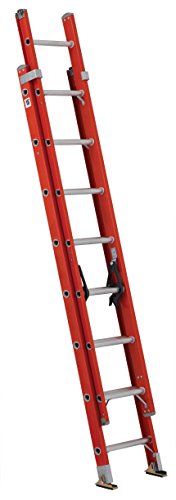
3. Louisville Ladder 16-foot Fiberglass Extension Ladder — Best for pros
The reach pick that keeps the fiberglass safety and the published 300-lb Type IA rating.
Best for: roofers and siding crews reaching real height Skip it if: your work stays indoors at platform height
This is how you get height without abandoning the two things that decide the category. The FE3216 extends to 16 ft, publishes a 300-pound Type IA rating, and keeps the non-conductive fiberglass frame that the Velocity trades away for aluminum. For anyone working above head height near a service drop, that combination is rare.
Louisville lists model FE3216, a weight of 30 lb, and a limited warranty. The listing describes a MaxLock rung lock made from a molecular polymer, a QuickLatch system that secures the fly and base sections, and a steel swivel safety shoe for uneven ground. Those are the manufacturer's claims, and they read as extension-specific engineering rather than generic bullets.
The trade-off against the step ladders is bulk and handling. At 100 inches folded and 30 lb, it is a two-hand carry and needs a wall to lean on, so it does nothing for freestanding indoor work. It is also the slowest seller of the six, though that says nothing about the ladder.
Pros:
- Published 300-lb Type IA rating
- Non-conductive fiberglass at 16 ft
- Steel swivel safety shoe per listing
- MaxLock rung lock claim
- Limited warranty stated
Cons:
- Needs a wall, no freestanding use
- 100-inch folded length is awkward to store
- Single-seller listing
- Heavier than both step ladders
4. SINMEIRUN Telescoping Ladder — Runner-up
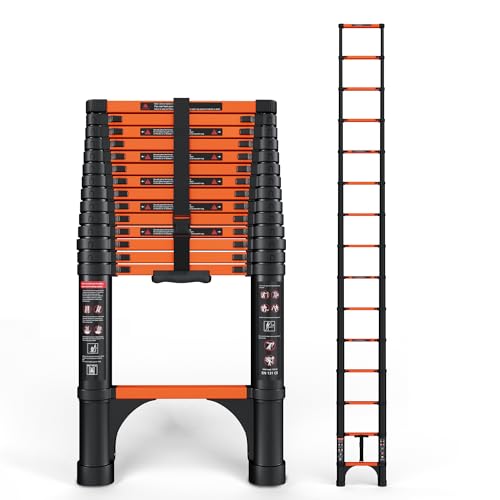
A 14.5-ft ladder that collapses to 37 inches and fits most car trunks.
Best for: mobile trades who store a ladder in a car trunk Skip it if: you distrust telescoping locks on a daily driver
Portability is what earns the SINMEIRUN its place. It reaches 14.5 ft yet collapses to 37 inches, and the listing includes storage straps and a carrying handle. At 26 lb it is lighter than either full-size Louisville. For someone loading a car rather than a work van, that folded length is the whole argument.
SINMEIRUN states ANSI A14.2 certification and a Type IA Heavy Duty rating supporting up to 330 lb, with 11.8-inch step spacing and an oxidized aluminum surface. Read the 330-lb figure as an attributed claim in a feature bullet rather than a published capacity, because that is where it appears. Two sellers list it, one more than most picks here.
The trade-off is mechanical. A telescoping ladder relies on many small locks instead of one solid frame, and any single stuck or unlatched rung is a problem you feel at the top. It also lists no warranty. For occasional reach it is compelling; for daily climbing, the fiberglass Louisville pair inspire more confidence.
Pros:
- Collapses to 37 inches
- Lighter than both Louisville ladders at 26 lb
- ANSI A14.2 certification claim
- Carrying handle and storage straps
- 330-lb Type IA rating per listing
Cons:
- No stated warranty
- Many locks mean more failure points
- Load rating is a claim, not published capacity
- Aluminum frame conducts electricity
5. UC UP CLIMBER Telescoping Ladder — Best budget pick
The cheapest of the six, reaching 12.5 ft in a compact, foldable frame.

Best for: occasional height work on a tight budget Skip it if: you climb every working day
This is the entry point. The UC UP CLIMBER is the cheapest pick in this set and still reaches 12.5 ft, folding down for storage in a home or vehicle. At 23.1 lb it is manageable one-handed. If your height work is a few times a month, spending more is hard to justify.
UC UP CLIMBER describes a high-strength stainless steel build that is rust-resistant, a 330-pound capacity, anti-slip bottom caps and a collapsible design. Those are the listing's claims. Note that the 330-lb figure is marketing copy, not a published capacity field, and there is no stated warranty or ANSI reference in the specs.
The honest weakness is the thinnest documentation of the six. Where the Louisville ladders publish a Type IA rating and a warranty, this one leans entirely on feature bullets, and it is the only pick where I could confirm neither an independent rating nor a warranty. For occasional use that gap is tolerable. For a daily tool, buy the certainty instead.
Pros:
- Cheapest of the six
- Folds compact for car or closet
- Light at 23.1 lb
- Anti-slip bottom caps per listing
- Stainless steel frame claim
Cons:
- No published load rating in specs
- No stated warranty
- No ANSI reference on the listing
- Aluminum-class frame conducts electricity
6. Little Giant MightyLite 6 ft Fiberglass Stepladder — Best for beginners
A full standing platform and an audible Ground Cue that tells you when you've hit the bottom rung.

Best for: someone new to platform work who wants standing room Skip it if: you need a non-conductive rating on the listing
The MightyLite is the confidence-builder. Little Giant describes 165 square inches of flat standing platform, extra-wide 3-inch steps with textured treads, and a patented Ground Cue that gives an audible, felt click when you reach the bottom rung. For someone still learning to move on a ladder, that feedback removes the guesswork that causes missteps.
It stands 6 ft, weighs 22.5 lb and shares the step-ladder format with the Louisville FS1506. Little Giant also lists an easy-release handle for single-motion setup and a top cap with accessory slots and gear ports. Those are the manufacturer's claims, and the platform and Ground Cue are genuinely beginner-friendly features the Louisville does not mention.
The trade-off against the Louisville step ladder is documentation. The specs publish no load rating and no warranty, and the fiberglass frame is not paired with the stated Type IA rating that makes the FS1506 the safe default. For a beginner working indoors at low height, the comfort features are worth it. For a pro who needs the number, the Louisville wins.
Pros:
- 165 sq in standing platform per listing
- Ground Cue audible bottom-rung feedback
- Wide 3-inch treaded steps
- Fiberglass frame
- Easy-release single-motion setup claim
Cons:
- No published load rating
- No stated warranty
- Heavier than the Louisville step ladder
- Single-seller listing
Fiberglass or aluminum: which frame should you buy?
Fiberglass or aluminum is the first fork, and it is a safety decision before it is a preference. The rule is short.
- Near electricity: buy fiberglass, always. It does not conduct. The Louisville FS1506, the Louisville FE3216 and the MightyLite are the fiberglass picks here.
- Never near electricity, weight matters most: aluminum is fine and often lighter to carry. The Velocity, SINMEIRUN and UC UP CLIMBER are the metal-frame picks.
Fiberglass is heavier for the same reach, which is the cost of the non-conductive property. The 30-lb Louisville extension weighs more than the 26-lb SINMEIRUN for less reach, and that is exactly the fiberglass tax. You pay it in weight and buy safety.
If you cannot say for certain that your work stays clear of live wires, treat fiberglass as the default. One accidental contact with a service drop erases every gram you saved on a lighter frame.
Does the professional label mean anything here?
The search that surfaced these six did not verify that any of them is built for professionals specifically. So treat "professional" as a shopping filter you apply yourself, not a promise the listings make.
Here is how to judge it on your own:
- Check for a published load rating, not a bullet claim. A Type IA rating stated in the specifications is stronger evidence than "heavy duty" in the marketing.
- Look for a warranty. A daily tool that fails should be replaceable. Only three of these six publish one.
- Match the frame to your work. Fiberglass for anything near current.
- Weigh the daily carry. A ladder you dread moving gets used badly or not at all.
By that test, the two Louisville ladders and the Velocity make the strongest professional case, because they publish the numbers or the warranty a pro can rely on. The telescoping pair are capable, but their pro credentials live in feature bullets rather than published fields.
When a different ladder wins
The Louisville FS1506 is the default, but a few concrete conditions flip it.
- If you reach a second-storey gutter, the 6-ft step ladder is useless and the 16-ft Louisville extension wins on published reach and rating.
- If you need one ladder for four shapes, the Velocity's A-frame, extension, staircase and wall positions replace a rack of ladders, and the limited lifetime warranty backs the higher price.
- If your ladder lives in a car trunk, the SINMEIRUN's 37-inch folded length beats any fixed frame here.
- If budget is the hard limit and you climb rarely, the UC UP CLIMBER is the cheapest way to reach 12.5 ft.
- If you're new to platform work, the MightyLite's Ground Cue and wide platform build confidence the Louisville does not advertise.
Each flip turns on a checkable fact: your working height, whether you carry gear up stairs, where the ladder is stored. Match the fact to the pick.
The verdict
If you work indoors near live wires at low height, buy the Louisville FS1506. It is the only pick that pairs a published 300-pound Type IA rating with a non-conductive fiberglass frame at just 20 lb, and that combination is the whole reason it leads the best professional ladder for professionals. Nothing here matches it for stated safety numbers at a carryable weight.
If you work at real height, the cutoff is your reach. Below head height, the FS1506 wins. Above it, near electricity, the Louisville FE3216 extension is the answer: it keeps the fiberglass frame and the 300-lb Type IA rating but stretches to 16 ft. The trade is 10 lb and a 100-inch folded body.
The runner-up's exact advantage is versatility, not safety. The Little Giant Velocity reaches 26 ft, locks into four positions, and carries the only limited lifetime warranty in the set. Its cost is a 54-lb frame, the highest price position here, an aluminum body that conducts, and no published load rating. Buy it for what one frame replaces, not for a number you can quote to an inspector.
FAQ
Is a professional ladder worth the extra money over a hardware-store one?
A professional ladder is worth the extra money when you climb regularly and need documented safety. The Louisville pair publish a 300-pound Type IA rating and a warranty; the cheapest telescoping picks state neither in their specs. If you climb daily, the published rating and the replacement cover justify spending more. For a few uses a year, the budget UC UP CLIMBER is defensible.
What load rating do I need for professional use?
The load rating you need is Type IA, a 300-pound working load, for most professional use. That figure must cover your body weight plus tools plus anything you carry up, not just your body. The two Louisville ladders publish 300 lb and Type IA in their specifications. The telescoping pair claim 330 lb in a feature bullet, which is a manufacturer statement rather than a verified capacity field.
Should I buy fiberglass or aluminum for electrical work?
For electrical work, buy fiberglass without exception. Fiberglass does not conduct electricity, so it protects you if the frame touches a live wire; aluminum does conduct and offers no such margin. Among these six, the Louisville FS1506, the Louisville FE3216 and the MightyLite use fiberglass. The Velocity, SINMEIRUN and UC UP CLIMBER use metal frames and belong nowhere near current.
How does the Louisville FS1506 compare to the Little Giant Velocity?
The Louisville FS1506 compares to the Velocity as safety versus versatility. The FS1506 publishes a 300-lb Type IA rating and a non-conductive fiberglass frame at 20 lb, but tops out at 6 ft. The Velocity reaches 26 ft, locks into four positions and carries a limited lifetime warranty, but weighs 54 lb, conducts electricity, and lists no load rating. Pick the FS1506 for safety, the Velocity for reach.
What mistake do buyers make choosing a professional ladder?
The mistake buyers make is shopping on reach first and ignoring the load rating and frame material. A tall ladder that buckles under your working load or conducts a current is dangerous, not a bargain. Read the published capacity, confirm it exceeds your body weight plus tools, and match the frame to your work. Reach is a range you fit to the task; safety is not negotiable.
Start with your working height and your proximity to electricity, then let those two facts choose for you. If you climb low and near wires, the Louisville FS1506 is the ladder I'd put in a truck first: a published Type IA rating, a non-conductive frame, and 20 lb you can carry one-handed all day. It does one thing, and it does it with numbers you can quote. Reach the FS1506's listing, confirm the 300-pound rating still reads as stated, and buy the certainty rather than the marketing.