Best Fencing Pliers for Barbed Wire and U-Nails

One tool has to hammer, pull, cut, splice and grip. I lined up five fencing pliers on published jaw width, weight, cutting capacity and warranty terms to find which one earns a spot in the truck.

By Dexter GillUpdated 15 min read
On this page
- Best fencing pliers at a glance
- How I screened these fencing pliers down to five
- What actually decides a fencing plier: the staple claw
- 1. Channellock Fence-Tool Pliers 85 — Best overall
- 2. Bates Multi-Plier Fence Tool — Runner-up
- 3. TEKTON 10-1/2 Inch Fencing Pliers — Best minimal setup
- 4. IRWIN VISE-GRIP Fencing Pliers — Best for pros
- 5. Saiveina Fencing Pliers — Best budget pick
- Which fencing pliers cut which wire?
- How much weight do you want swinging on a fence line?
- What the listings do not tell you
- The verdict
- FAQ
The best fencing pliers here are the Channellock Fence-Tool Pliers 85, a 10 in tool with a 3/4 in jaw that handles staple pulling, gripping and side cutting without you swapping tools. If you want a published cutting range before you commit, the TEKTON PSP10010 lists 8 to 18 AWG galvanized wire and 12.5 to 18 AWG barbed strands. Get this wrong and you find out the hard way: a claw that skates off a rusted U-nail costs you a knuckle, and a chipped striking face turns your fencing plier into a paperweight halfway down the line.
Best fencing pliers at a glance
| Pick | Key spec | Weight | Price |
|---|---|---|---|
Best overall Channellock Fence-Tool Pliers 85 |
3/4 in jaw 10 in long |
1.38 lb | Check Price |
Runner-up Bates Multi-Plier Fence Tool |
7/32 in cut claim 10.8 in long |
1.48 lb | Check Price |
Best minimal setup TEKTON 10-1/2 Inch Fencing Pliers |
8-18 AWG claim 10.5 in long |
1.68 lb | Check Price |
Best for pros IRWIN VISE-GRIP Fencing Pliers |
Nickel chromium steel 13.6 in listed |
1.55 lb | Check Price |
Best budget pick Saiveina Fencing Pliers |
Forged steel claim 10.63 in long |
Not listed | Check Price |



How I screened these fencing pliers down to five
I started from the listing data, not from brand loyalty. Every candidate had to be a single-piece fencing tool with a hammer face, a staple claw, wire grips and a cutting edge, because that combination is the whole reason this category exists. Anything sold as a plain side-cutter or a dedicated wire cutter got dropped.
From there I compared four things across the survivors:
- Published jaw or cutting figures. A stated 3/4 in jaw or an 8-18 AWG range is checkable. "Heavy duty" is not.
- Weight. Four of the five publish it. That figure decides how your forearm feels at post 40.
- Overall length. More length is more leverage on a seized staple, and more length is also more tool binding in a corner brace.
- Warranty language. Only two listings say anything at all here, and one of them says a great deal.
What got cut: tools with no dimensional data of any kind, combo kits where the fencing plier was an afterthought, and anything where the listing gave no cutting or jaw figure and no weight. That last screen is why this list is five picks and not fifteen. The five that survived all sit within roughly 0.6 in of each other on length, which tells you the category has settled on a size that works.
What actually decides a fencing plier: the staple claw
Most guides to the best fencing pliers open with cutting capacity. That's the wrong lens. Cutting is the easy part of fence work, and every tool here does it. The job that eats your day is prying U-nails out of weathered posts, and that comes down to two things the listings barely advertise: how the claw is shaped, and how the striking face survives being hit.
Here's the trick with staples. You seat the claw under the crown, tap the back of the tool with a hammer to drive it home, then lever. That means the striking surface takes repeated steel-on-steel blows. TEKTON is the only brand here that addresses it directly, saying the flat striking face resists chipping and deformation better than the serrated surfaces most fencing pliers use. Bates goes the other way and describes a corrugated hammer head. Neither claim is measured, but it is a real design fork and you should pick a side.
The second half is jaw geometry. Channellock publishes a 3/4 in jaw on a 10 in body, which is the only hard jaw figure in this set. TEKTON describes parallel jaws that grip the staple crown or nail head. Parallel jaws stay square on the crown as you rock the tool back, and that matters more than raw cutting numbers when the staple is rusted into oak.
Skip the spec race and ask one question instead: will this claw still seat under a staple after a hundred hammer strikes? That is the criterion.
1. Channellock Fence-Tool Pliers 85 — Best overall
A published 3/4 in jaw on a 1.38 lb body makes this the most balanced fencing tool in the set.
Best for: anyone pulling staples and cutting wire on the same fence line Skip it if: you need a published cutting capacity range before you buy
Two figures separate this from the rest. The jaw is listed at 3/4 in, the only jaw dimension published anywhere in this group, and the tool weighs 1.38 lb, the lightest of the four picks that state a weight. That pairing is unusual. Wide jaws normally arrive with a heavy head, and this one doesn't.
At 10 in overall it is also the shortest tool here, tied with the Bates. Shorter means less leverage on a seized U-nail, and it also means you can work inside a corner brace or against a post that sits tight to a wall without the handles fouling. If most of your fence work happens in awkward spots rather than open pasture, that trade favours you.
Channellock's listing leans on versatility, describing the tool as usable for cables, wires and fencing, and calling out chainlink repair. Those are the manufacturer's words rather than a measured range. The company doesn't state a wire gauge capacity, which is the one place TEKTON clearly beats it on paper.
It also carries the highest price position in this set, and it publishes no warranty terms. You're paying for the jaw dimension and the weight, not for stated coverage.
Pros:
- Only pick with a published jaw width, at 3/4 in
- Lightest of the four tools listing a weight, at 1.38 lb
- Shortest overall length here for tight corner work
- Single-tool coverage of cutting, gripping and staple pulling
Cons:
- No cutting capacity or wire gauge figure published
- No warranty terms stated on the listing
- Highest price position in this set
- Shortest handles mean the least leverage on stubborn staples
2. Bates Multi-Plier Fence Tool — Runner-up
A stated 7/32 in cutting capacity at the second-lowest price position in this group.
Best for: a first fencing tool for occasional pen and paddock repairs Skip it if: you want a stated warranty behind the tool
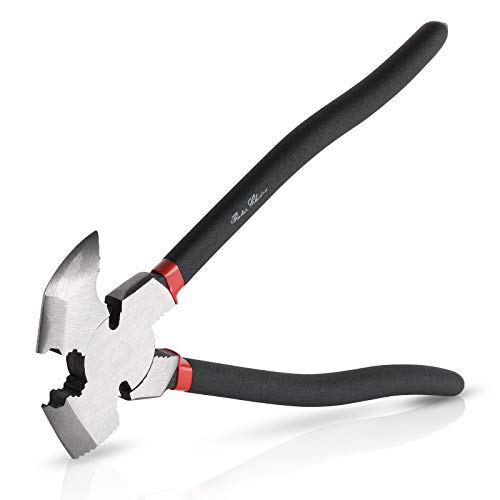
This is the pick that sells fastest of the five, and the specification sheet explains part of it. Bates publishes a 7/32 in cutting capacity, which is a number you can hold against a wire diameter before you buy. Only TEKTON offers anything comparable, and TEKTON sits two price positions higher.
The head is described as having a corrugated hammer face, two wire cutters, staple grips and a wire grip for stretching. Two separate cutting positions is a genuinely useful layout on a fence line, because you can put the heavier strand on the cutter with more leverage and leave the fine work to the other. Bates also describes polished steel alloy for rust resistance, which is a claim rather than a coating spec.
At 1.48 lb and 10 in long it sits right in the middle of the pack on both counts. Nothing about the dimensions stands out, and that is arguably the point of a general-purpose fence tool.
Against the Channellock, it gives up the published jaw width and the lighter head. Against TEKTON, it gives up the wire gauge range and the warranty language entirely. There is no stated coverage on this listing at all.
Pros:
- Published 7/32 in cutting capacity, rare at this price position
- Two separate wire cutters plus a dedicated wire grip
- Sells faster than any other pick in this group
- Second-cheapest of the five
Cons:
- No warranty terms stated anywhere on the listing
- Corrugated hammer face rather than a flat striking surface
- No jaw width figure published
- Rust resistance is a finish claim, not a stated coating
3. TEKTON 10-1/2 Inch Fencing Pliers — Best minimal setup
The only pick here publishing a full wire gauge range and a no-limits warranty.
Best for: one tool in a truck box that has to cover every wire gauge Skip it if: you want the lightest tool on your belt
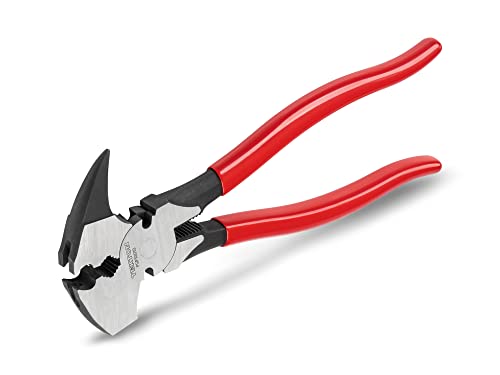
If you keep exactly one fencing tool and it has to handle whatever the fence throws at it, this is the listing with the most published detail behind that promise. TEKTON states a cutting capacity of 8 to 18 AWG for solid galvanized or coated steel wire, 6 to 18 AWG for solid aluminum, and 12.5 to 18 AWG for barbed or barbless two-strand wire. No other fencing pliers in this set breaks the range out by material.
The design notes are equally specific. TEKTON says the shears sit close to the pivot pin to increase leverage, and that the teeth are angled at 80 degrees to create a slicing action rather than a crush. It also claims the flat striking face resists chipping better than the serrated faces common in this category, and describes parallel jaws for gripping a staple crown or nail head.
The warranty is the other differentiator: no time limits and no receipts required. That is stated coverage, not an implied one.
The cost is heft. At 1.68 lb this is the heaviest pick here, 0.3 lb more than the Channellock, and at 10.5 in it is longer than three of the four alternatives. It also carries a premium price position, second only to the Channellock.
Pros:
- Cutting capacity broken out by material and gauge
- Warranty with no time limit and no receipt requirement
- Flat striking face claimed to resist chipping
- Parallel jaws designed to grip staple crowns squarely
Cons:
- Heaviest tool in this set at 1.68 lb
- Premium price position with no jaw width published
- Longer body than three of the four alternatives
- Listed colour data is unusable, so finish is unclear
4. IRWIN VISE-GRIP Fencing Pliers — Best for pros
Machined jaws in nickel chromium steel, with a stated warranty and the longest listed body here.

Best for: full days on metal T-posts and wood posts alike Skip it if: you work in a tight corner where a 13.6 in tool binds
The material call is what marks this out. IRWIN specifies nickel chromium steel with machined jaws, and machined rather than cast jaw faces are what hold a grip on a smooth staple crown after the tool has been in a wet truck bed for a season. The listing describes it as the only tool you need for metal and wood posts, which is the manufacturer's framing rather than a measured claim.
The comfort story is the ProTouch grip, described as anti-pinch and non-slip to cut hand fatigue. On a fence line where you're twisting and wrapping wire for hours, handle design does real work, and this is the pick that says the most about it.
Dimensions are where you need to pay attention. The listing shows 13.6 in on its longest axis, well beyond the 10 to 10.63 in of everything else here, and 4.37 in across. Some of that is likely packaging, but the tool is described as 10-1/4 in, so plan for a longer profile than the Channellock. At 1.55 lb it sits second-heaviest.
It's mid-priced in this group, and unlike TEKTON the warranty is stated only as "yes" with no terms attached. That is thinner coverage information than the price position suggests.
Pros:
- Nickel chromium steel with machined jaw faces
- Anti-pinch ProTouch grips aimed at long sessions
- Warranty confirmed on the listing
- Mid-range price position rather than premium
Cons:
- Longest listed dimension here at 13.6 in
- Warranty stated with no terms or duration given
- No cutting capacity or gauge range published
- Second-heaviest at 1.55 lb
5. Saiveina Fencing Pliers — Best budget pick
The cheapest fencing pliers here, at 10.63 in, with a forged steel claim and the thinnest specification sheet.

Best for: a spare tool for the shed or the side-by-side Skip it if: you need published weight or cutting capacity figures
Every fence needs a second tool somewhere it can be reached without a walk back to the truck. That's the job this fills. It's the cheapest of the five and the second-longest at 10.63 in, so the handles give you slightly more leverage than the Channellock on a staple that doesn't want to move.
Saiveina describes high-carbon forged steel with a polished anti-rust finish and a solid head, and lists the functions you'd expect: hammer head, staple puller, nail puller, wire splicer and wire cutter. The long non-slip handles are described as giving steadier control when twisting and wrapping wire. The listing frames it around goat pens, loose wire and small U-nails, which reads as light to medium duty rather than commercial fencing.
Here is the honest limitation. There is no published weight and no cutting capacity, so two of the four figures I use to compare fencing pliers are simply absent. It's also the only pick filed under nail pullers rather than pliers or multitools, which hints at where the maker sees it fitting.
It sells at a middling rate for this group, and it carries no stated warranty.
Pros:
- Cheapest pick in this set
- 10.63 in body gives more leverage than the 10 in options
- Long non-slip handles for twisting and wrapping wire
- Covers hammer, staple pull, splice and cut in one head
Cons:
- No weight published anywhere on the listing
- No cutting capacity or gauge range given
- No stated warranty
- Forged steel and anti-rust finish are unverified claims
Which fencing pliers cut which wire?
Only two picks here tell you. That gap is the single biggest information asymmetry in this category, and it's worth understanding before you order.
- TEKTON PSP10010: 8-18 AWG solid galvanized or coated steel, 6-18 AWG solid aluminum, 12.5-18 AWG barbed or barbless two-strand.
- Bates Multi-Plier: 7/32 in cutting capacity.
- Channellock 85, IRWIN 2078901, Saiveina: no cutting figure published.
What do you do with that? Match it to your fence. Standard barbed wire runs in the 12.5 to 15.5 AWG range, so TEKTON's stated 12.5-18 AWG two-strand figure covers common barbed work with nothing to spare at the heavy end. Bates gives you a diameter instead of a gauge, and 7/32 in is a little over 5.5 mm, which comfortably clears typical fence wire.
For the three picks with no published number, judge by the rest of the tool. IRWIN's machined nickel chromium jaws and Channellock's side-cutting design both point at capable cutters, but the listing doesn't commit to a figure and neither will I. If your fence uses anything heavier than standard barbed strand, buy the tool that publishes a range.
How much weight do you want swinging on a fence line?
This is the specification most buyers ignore and then regret. The spread here is 0.3 lb, from 1.38 lb to 1.68 lb, which sounds trivial until you multiply it by a few hundred staple pulls.
The heavier tools earn their weight two ways. Mass in the head drives a staple claw home with fewer hammer taps, and a longer body puts more leverage on the pry. TEKTON, the heaviest at 1.68 lb, is also the pick claiming the most about striking-face durability, and those two things go together: a tool designed to be hit needs metal where it's hit.
The lighter argument is simpler. Channellock's 1.38 lb over a full day of fence walking is 0.3 lb your shoulder doesn't carry, and its 10 in length is easier to work in a corner. In practice I'd split it by workload. Occasional repairs, go light. A whole fence line to rebuild, take the weight and the leverage.
Saiveina publishes no weight at all, which is worth noting when you're comparing on this axis.
What the listings do not tell you
A few gaps run right across this category, and knowing them stops you overreading the specification sheets.
Handle grip material is described, not specified. Bates says soft plastic coated. IRWIN says ProTouch, anti-pinch and non-slip. Saiveina says non-slip red handles. None of that is a durometer or a compound, so you cannot compare them on paper.
Steel is named inconsistently. IRWIN specifies nickel chromium. Saiveina claims high-carbon forged. Bates says polished steel alloy. Channellock says metal and plastic. Four different levels of disclosure for the same kind of tool.
Warranty is the cleanest signal in the set. TEKTON publishes terms you can read. IRWIN confirms a warranty exists without stating what it covers. The other three say nothing. If long-term coverage matters to you, that narrows the best fencing pliers for your situation to one, quickly.
Two-strand versus single-strand cutting is rarely broken out. Barbed wire is two strands twisted together, and cutting it is harder than cutting one strand of the same gauge. TEKTON is the only pick here that separates the two in its published capacity.
The verdict
Split this by what you're willing to spend, because the tiers here divide cleanly.
At the entry tier, the Bates Multi-Plier is the smarter of the two cheap picks. It publishes a 7/32 in cutting capacity, gives you two separate cutters and a wire grip for stretching, and sells faster than anything else here. The Saiveina undercuts it and works fine as a second tool for the shed, but with no weight and no cutting figure published, you're buying on description alone.
In the middle, the IRWIN VISE-GRIP is the pick for someone who works fences for a living. Machined jaws in nickel chromium steel and a confirmed warranty are the right things to pay for, and the ProTouch grips address the fatigue that a mid-priced tool usually ignores. Watch the 13.6 in listed dimension if you work tight corners.
At the premium tier the choice is genuinely close. The Channellock 85 takes it overall on the strength of a published 3/4 in jaw and the lightest body here at 1.38 lb, which is the combination you want for all-day carry and awkward-angle work. TEKTON's exact advantage is disclosure: an 8-18 AWG range broken out by material, plus a warranty with no time limit and no receipt. If paper certainty matters more to you than a third of a pound, buy the TEKTON.
FAQ
Are the best fencing pliers worth buying over regular pliers?
The best fencing pliers are worth it the moment you own more than one gate. A standard plier cannot pry a U-nail, drive it back in, or grip a staple crown squarely. These tools combine a hammer face, a staple claw, wire grips and cutters in one head, so you stop walking back to the truck for a second tool every few posts.
Which of these fencing pliers gives the best value?
The fencing pliers giving the best value here is the Bates Multi-Plier. It sits second-cheapest, publishes a 7/32 in cutting capacity that most entry-priced tools omit, and includes two separate wire cutters plus a wire grip for stretching. It sells faster than any other pick in this set. The gap is warranty language, which the listing doesn't provide at all.
What wire gauge can these tools cut?
The wire gauge these tools cut is published for only two of the five. TEKTON lists 8-18 AWG for solid galvanized or coated steel, 6-18 AWG for solid aluminum, and 12.5-18 AWG for barbed or barbless two-strand wire. Bates lists a 7/32 in cutting capacity. Channellock, IRWIN and Saiveina publish no cutting figure, so match those to your fence carefully.
Channellock 85 or TEKTON PSP10010: which should I pick?
Channellock 85 or TEKTON comes down to weight against disclosure. Channellock is lighter at 1.38 lb versus 1.68 lb, shorter at 10 in, and the only pick publishing a jaw width at 3/4 in. TEKTON gives you a full cutting range by material and a warranty with no time limit or receipt requirement. Choose Channellock for carry comfort, TEKTON for certainty.
What mistake do first-time buyers make with fencing pliers?
The mistake first-time buyers make is shopping on cutting capacity alone. Cutting is the easy part of fence work. Prying rusted U-nails out of weathered posts is what wears a tool out, and that depends on claw geometry and whether the striking face chips after repeated hammer blows. Look at jaw design and striking surface first, then check the wire figures.
Pick the tool by the job in front of you. Rebuilding a whole line means the leverage and the published gauge range are worth carrying, so take the TEKTON. Patching gates and pens across a property, and the Channellock 85 is the one you'll actually keep on your belt, because 1.38 lb and a 10 in body stop being a specification and start being a reason you finish the row. Whichever you choose, put a second tool in the side-by-side. Fence failures never happen within walking distance of the shed, and the cheapest pick here earns its keep sitting under a seat.