Best Electronic Water Softener for Hard Water Pipes

Six electronic descalers and softeners, ranked by pipe fit, treatment strength and published specs. What each one actually does, and why the terminology trips buyers up.

By Dexter GillUpdated 15 min read
On this page
- Descaler or softener: what these devices really do
- Best electronic water softener at a glance
- How I ranked these six against the listings
- 1. iSpring ED2000 Whole House Water Descaler — Best overall
- 2. Aquasure Harmony Series 48 — Best premium
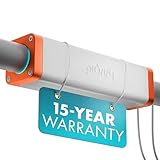
- 3. PIURIFY Over-Pipe Whole House Electronic Water Descaler — Best for beginners
- 4. YARNA Electronic Water Descaler — Best for small spaces
- 5. VQP Time Type 5600SXT Water Softener Control Head — Best for heavy use
- 6. Timilge Electronic Water Descaler System — Best budget pick
- Will it fit your pipe run?
- What more money buys across this set
- Which one matches your water?
- The verdict
- FAQ
The best electronic water softener for most homes is the iSpring ED2000, a 2 x 7 x 3.5 in salt-free descaler built for very hard water areas of 10 to 19 grains per gallon. If you actually need minerals removed rather than conditioned, the tank-based Aquasure Harmony Series 48 with its 48,000-grain capacity is the better buy. Here's the trap buyers fall into: most guides compare wattage or output voltage, and that's not what decides this. What decides it is whether you need descaling or true softening.
Descaler or softener: what these devices really do
This is the split that trips up nearly every buyer, so let's clear it before the picks. An electronic descaler and a salt-based softener are not the same machine, and the listings say so plainly.
- A descaler conditions the water. It changes how minerals behave so they don't stick as scale, but the minerals stay in the water.
- A softener removes the minerals. Calcium and magnesium come out, usually via a salt-based resin tank.
The PIURIFY listing states it outright: "NOT A WATER SOFTENER. Our product is an electronic descaler, not a salt-based water softener system. It does not remove minerals or reduce TDS, sulfur, or iron." The iSpring copy echoes this: it "does not change the chemistry of water." So does YARNA, which calls itself an alternative to softening.
That's why the modifier here matters. Four of these six picks are electronic descalers, not softeners in the strict sense. The Aquasure is a genuine salt-based softener. The VQP is a control head for a softener tank you supply. If you searched for a best electronic water softener expecting salt-free mineral removal, that product does not exist here or anywhere, so judge each pick by what it claims to do, not the search box label.
Best electronic water softener at a glance
| Pick | Type | Fit / Capacity | Price |
|---|---|---|---|
Best overall iSpring ED2000 |
Salt-free descaler | Any pipe, PEX/PVC | Check Price |
Best premium Aquasure Harmony Series 48 |
Salt-based softener | 48,000 grains | Check Price |
Best for beginners PIURIFY Over-Pipe Descaler |
Salt-free descaler | Up to 15 GPG claim | Check Price |
Best for small spaces YARNA CWD24 |
Salt-free descaler | Pipes to 1 in | Check Price |
Best for heavy use VQP 5600SXT Control Head |
Softener control valve | DN25 ports | Check Price |
Best budget pick Timilge Descaler |
Salt-free descaler | All pipe types | Check Price |




How I ranked these six against the listings
I set the criteria before I opened a single listing, then weighed each pick against them. Here's the order they carried.
- Fit and match to your water. The highest weight. A descaler that can't wrap your pipe, or a softener sized wrong for your home, fails no matter how good the marketing reads.
- Published, comparable specs. Dimensions, weight, capacity, model number. Real figures beat adjectives.
- Type honesty. Whether the listing is clear about descaler versus softener. Vague copy lost points.
- Set fit. How each pick serves a buyer the others don't.
Why those weights? Because this category punishes mismatches harder than almost any other. Buy a 62-inch tank for a closet that's 40 inches tall and you've wasted the most expensive pick here. Wrap a coil descaler on a 1.25-inch pipe when the listing caps at 1 inch and it may not work at all.
The iSpring ED2000 topped the list on the first two criteria: a small 2 lb body, a clear "10-19 grains per gallon" target range, and a stated lifetime tech support line. It's also the one buyers here choose more often than the other descalers. That combination of a defined target range and a compact footprint made it my default best electronic water softener recommendation for scale-focused homes.
1. iSpring ED2000 Whole House Water Descaler — Best overall
A compact salt-free descaler with a clearly stated hardness target, which is more than most of this set offers.
Best for: very hard water areas, 10 to 19 grains per gallon Skip it if: you need actual mineral removal
What sets the ED2000 apart within this group is a named target range. iSpring states it's "designed for very hard water areas (10-19 grains per gallon)," which is more precise than most descalers here bother to be. The unit weighs 2 lb and measures 2 x 7 x 3.5 in, so it mounts on almost any wall near your main line. iSpring says it needs no plumbing modifications and works on any pipe, "even PEX and PVC."
The listing frames this as a conditioner, not a softener: it "keeps healthy minerals in the water by preventing scale deposits from forming" and "does not change the chemistry of water." So temper expectations. Scale on pipes and heaters is the target, not softness at the tap. iSpring also lists a one-year money-back window and lifetime tech support, the clearest backing statement in the set.
The trade-off against the Aquasure is fundamental: this conditions, it doesn't remove minerals. And against the PIURIFY, iSpring publishes no output-voltage figure, so you're comparing on target range rather than claimed strength.
Pros:
- Named target of 10 to 19 grains per gallon
- Compact 2 lb, 2 x 7 x 3.5 in body
- Works on PEX and PVC per listing
- One-year money-back and lifetime support stated
- Chosen more often than the other descalers here
Cons:
- Conditions scale, does not remove minerals
- No published output-voltage figure
- Only two sellers list it
- Effectiveness depends on your exact water
2. Aquasure Harmony Series 48 — Best premium
The only genuine salt-based softener here, sized for a whole home at 48,000 grains.

Best for: a 3 to 4 bathroom home wanting true softening Skip it if: you have no floor space or plumbing access
This is the pick that actually removes minerals. Aquasure rates it "to treat 48,000 Grains of hardness by removing skin damaging hard minerals like calcium and magnesium." That's a different job from every descaler here, and it's why the Aquasure is the answer when conditioning isn't enough.
The scale is real. It weighs 120 lb and stands 62 x 10 x 10 in, so it needs floor space and plumbing access, not a wall bracket. Aquasure describes it as "perfectly designed for 3-4 bathrooms" and includes "a fully programmable backlit digital display" for setting auto-flush intervals. The tank is a "corrosion-resistant, fiberglass-lined polyethylene" build with a bypass valve, per the listing.
It's the most expensive pick here, and it's the fastest seller of the six by a wide margin. That popularity tells you something: buyers who want soft water, not just less scale, keep coming back to a proper tank.
The trade-off is everything the descalers avoid. Salt refills, floor footprint, and a real install. If you rent, or your utility space is tight, this is the wrong tool.
Pros:
- Genuine mineral removal at 48,000 grains
- Programmable backlit digital control head
- Built for 3 to 4 bathrooms per listing
- Fiberglass-lined tank with bypass valve
- Fastest seller of the six
Cons:
- Heavy at 120 lb, tall at 62 in
- Needs salt refills and real plumbing
- Most expensive pick here
- Not viable in tight or rented spaces
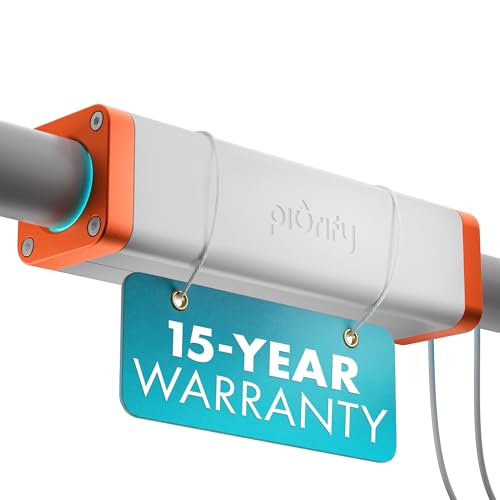
3. PIURIFY Over-Pipe Whole House Electronic Water Descaler — Best for beginners
An over-pipe descaler that leads on claimed output strength and a long treatment zone.
Best for: first-time buyers on moderate to high hardness Skip it if: you want the cheapest way in
The PIURIFY is the easiest of the descalers to reason about, which earns it the beginner spot. It's an "over-pipe" design at 1.6 lb and 2.2 x 8.5 x 2.2 in, so it sits outside the pipe with no cutting. PIURIFY says the external parallel electrodes create "a stable external electric field with no pipe cutting or modifications," across a "7.1′′ treatment zone."
It also carries the boldest strength claim in the set: "168V peak-to-peak output — up to 5× stronger than many leading brands," engineered for "Moderate to High Water Hardness (up to 15 GPG / 250 PPM)." Treat that as the manufacturer's claim, not a measured fact. The listing is honest about limits, stating plainly it "does not remove minerals or reduce TDS, sulfur, or iron."
This is a premium-priced descaler, the second-most expensive pick here, and only one seller lists it. So you pay more than the iSpring for a device doing the same category of work. The published strength figure is the argument for that premium, if you believe it.
Pros:
- Over-pipe design, no cutting needed
- 168V peak-to-peak output claim
- Long 7.1-inch treatment zone claim
- Light at 1.6 lb, easy to mount
- Honest about descaler limits
Cons:
- Premium price for descaler-class work
- Only one seller lists it
- Strength figure is unverified claim
- No mineral removal, by its own copy
4. YARNA Electronic Water Descaler — Best for small spaces
The smallest footprint here, aimed squarely at pipes up to 1 inch.

Best for: tight utility closets with a 1-inch pipe Skip it if: your pipe runs wider than 1 inch
If space is your constraint, the YARNA CWD24 is built for you. At 2 x 5.9 x 1.8 in, it's the most compact unit in this group, and the listing spells out exactly what it needs: "access to a minimum of 10" of free pipe space with a maximum pipe diameter of 1"." That's a hard limit worth checking before you buy.
YARNA describes it as "a Patented alternative water softner" that "treats water with electric pulses generated within the electronic unit and controlled by a micro-chip." Like the others in this class, it conditions rather than removes: the copy notes it "won't eliminate beneficial minerals from water." The size ("CWD24 - 1" Pipe") and model (35435) are the concrete facts you can hang a decision on.
The trade-offs are two. First, the 1-inch pipe cap rules out larger mains, where the iSpring claims to work on any pipe. Second, only one seller lists it, and it publishes no weight or warranty figure. So you're buying on footprint and pipe fit more than on documented backing.
Pros:
- Smallest body here at 2 x 5.9 x 1.8 in
- Clear 10-inch free-pipe requirement stated
- Micro-chip controlled pulse system
- Keeps beneficial minerals per listing
Cons:
- Hard 1-inch maximum pipe diameter
- No published weight or warranty
- Only one seller lists it
- Conditions scale, no mineral removal
5. VQP Time Type 5600SXT Water Softener Control Head — Best for heavy use
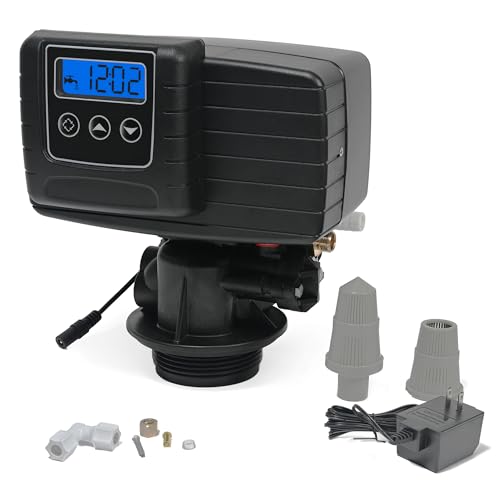
A digital control valve for a real softener tank, for DIY builders who want to assemble their own system.
Best for: DIY builders adding a control head to a tank Skip it if: you want a plug-in, no-plumbing device
The VQP is the odd one out, and useful because of it. This isn't a standalone descaler. It's a 110V control head for a salt-based softener tank you supply separately. It measures 9.5 x 7.8 x 7.8 in and uses "rotary threads (DN25)" for the inlet and outlet, so it bolts onto a proper resin tank system.
VQP says the 5600SXT is "designed to intelligently soften water hardness, reducing it from 0.8 to 0.03mg·N/L," with a "Digital Display" for operation and settings. It's made from "PP plastic," which the listing calls "lightweight yet hard and solid," and it ships with "all necessary screws and other accessories for installation."
Here's the honest picture: this is for someone building or servicing a softener, not a plug-and-go buyer. It's the slowest seller of the six by a large gap, which fits a niche part. If you don't already have a tank and resin, this alone won't soften your water.
Pros:
- True metered softening control at DN25 ports
- Digital display for settings
- Ships with screws and accessories
- Handles heavy, continuous softening duty
Cons:
- Control head only, needs a separate tank
- Slowest seller of the six
- Not a standalone device
- Real plumbing knowledge required
6. Timilge Electronic Water Descaler System — Best budget pick
The cheapest way into coil-wrap descaling, with the thinnest published spec sheet.

Best for: trying coil-wrap descaling at the lowest cost Skip it if: you want published warranty and treatment specs
The Timilge is the entry point, and it's the cheapest of the six. It's a coil-wrap descaler: the listing says "just wind the coil outside the pipeline," with "no need to damage the pipeline," and calls it "suitable for all kinds of pipelines." At 1.43 lb and 1.81 x 7.83 x 3.62 in, it's light and small.
Timilge explains its method as "conducting complex frequency-modulated electromagnetic signals into the water," and is clear on type: "No salt, No chemical involves into your water, No PH changes." So it does the same conditioning job as the iSpring and YARNA, at a lower price of entry.
The reason it's last is documentation. There's no stated hardness range like the iSpring's 10 to 19 grains per gallon, no output figure like PIURIFY's, and no warranty statement. Only one seller lists it. You're paying the least and getting the least detail to judge fit against your water. For a low-risk first try at electronic descaling, though, it does the trick.
Pros:
- Cheapest of the six
- Light at 1.43 lb, easy coil install
- Works on all pipe types per listing
- No salt, no chemicals, no pH change
Cons:
- No stated hardness range
- No published warranty or output figure
- Only one seller lists it
- Least documented pick in the set
Will it fit your pipe run?
Before you buy any of these, measure. Fit is the criterion that sinks the most orders in this category, and every pick has a different requirement.
- iSpring ED2000: works on any pipe including PEX and PVC, per the listing. The most forgiving fit here.
- YARNA CWD24: needs at least 10 inches of free pipe and a maximum 1-inch diameter. Check both.
- PIURIFY: an over-pipe design with a 7.1-inch treatment zone claim, no cutting.
- Timilge: a coil you wind around the pipe, listed as suitable for all pipe types.
- VQP 5600SXT: threaded DN25 ports, so it plumbs into a tank, not a wall.
- Aquasure Harmony: 62 x 10 x 10 in of floor space and full plumbing access.
Two measurements settle most of it. First, your pipe's outer diameter, which decides whether the YARNA's 1-inch cap rules it out. Second, the floor clearance in your utility area, which decides whether the 62-inch Aquasure even stands up where you'd put it. Do both with a tape measure before you commit.
What more money buys across this set
Price position and capability don't move together here, so it's worth mapping what the tiers actually get you.
At the entry end, the Timilge and iSpring are both coil-or-clamp descalers. The iSpring costs a little more but adds a stated 10 to 19 grains per gallon target and a lifetime support line, which is real value over the barely-documented Timilge.
In the middle, the YARNA and VQP do different jobs. The YARNA is a compact descaler; the VQP is a softener control head. You're not paying more for a better descaler there, you're paying for a different function.
At the top, the PIURIFY and Aquasure are the two most expensive. But they're not comparable. PIURIFY is a premium-priced descaler leaning on its 168V output claim. The Aquasure is the only genuine softener, with a 48,000-grain tank. That's the honest lesson: more money here doesn't reliably buy stronger descaling. Past a point, it buys a different category of machine entirely.
Which one matches your water?
Rules of thumb, tied to the specs in these listings:
- Scale on heaters and pipes, no space for a tank: the iSpring ED2000, targeting 10 to 19 grains per gallon.
- You genuinely want soft water at the tap: the Aquasure Harmony at 48,000 grains, if floor space allows.
- First descaler, moderate to high hardness: the PIURIFY, with its no-cut over-pipe fit.
- A cramped closet and a 1-inch pipe: the YARNA CWD24 at 2 x 5.9 x 1.8 in.
- Building your own softener system: the VQP 5600SXT control head.
- Lowest cost to try electronic descaling: the Timilge.
Match the device to the problem, not the search term. The word "softener" gets used loosely across every listing here, so read what each one claims to do.
The verdict
The best electronic water softener for most homes is the iSpring ED2000. It's a salt-free descaler, so be clear on that, but it gives you what the other descalers here mostly don't: a named target of 10 to 19 grains per gallon, a compact 2 lb build that fits any pipe including PEX and PVC, and a stated lifetime support line. For scale control without salt, floor space, or plumbing work, it's the sensible default.
Two conditions flip that. First, if you want minerals actually removed rather than conditioned, only the Aquasure Harmony Series 48 does that, with a 48,000-grain tank built for a 3 to 4 bathroom home. Its exact advantage is real softening at the tap, at the cost of 120 lb and 62 inches of floor space. Second, if you're assembling your own softener system, the VQP 5600SXT control head is the piece you want, not a standalone descaler.
Everything else serves an edge case: the YARNA for the tightest spaces, the PIURIFY for beginners who trust its strength claim, the Timilge for the lowest entry cost. Start with the iSpring, and step up to the Aquasure only if conditioning won't cut it.
FAQ
Is an electronic water softener worth it?
An electronic water softener, in the descaler sense, is worth it if your goal is less scale on pipes and appliances rather than truly soft water. Devices like the iSpring ED2000 claim to condition minerals without salt, floor space, or plumbing. They keep minerals in the water, so if you want the slick feel of softened water, a tank softener suits you better.
Is an electronic descaler worth it over a salt softener?
An electronic descaler is worth it when you can't run a salt system. It needs no floor space, no salt refills, and no plumbing cuts, unlike the 120 lb, 62-inch Aquasure Harmony. The trade-off is real: descalers condition scale but leave minerals in the water. A salt softener actually removes calcium and magnesium. Match the tool to whether you need scale control or true softening.
What hardness range does the best electronic water softener handle?
The best electronic water softener for hardness clarity is the iSpring ED2000, which states a target of 10 to 19 grains per gallon in its listing. The PIURIFY claims coverage up to 15 GPG, or 250 PPM. Others, like the Timilge, publish no hardness range at all. Check your water's grains-per-gallon reading against these figures before buying, since a mismatch undercuts the whole point.
iSpring ED2000 or Aquasure Harmony: which should I buy?
Between the iSpring ED2000 and Aquasure Harmony, choose by what you need. The iSpring is a salt-free descaler at 2 lb that conditions scale on any pipe with no plumbing. The Aquasure is a 120 lb, 48,000-grain salt softener that removes minerals for a 3 to 4 bathroom home. Pick iSpring for scale control in tight spaces; pick Aquasure for genuinely soft tap water.
What's the biggest mistake buyers make with these?
The biggest mistake buyers make is confusing descalers with softeners. Most picks here, including the iSpring, PIURIFY, YARNA, and Timilge, are descalers that condition water and keep minerals in. Only the Aquasure removes minerals, and the VQP is just a control head needing its own tank. Buying a descaler while expecting salt-softener results leads to disappointment. Read each listing's stated function first.
Start with your water and your space, not the product name. Get a grains-per-gallon reading, measure your pipe diameter and any floor clearance, then decide whether you need scale conditioned or minerals removed. For most homes fighting scale in tight quarters, the iSpring ED2000 is the low-commitment default: 2 lb, no plumbing, and a clear 10 to 19 grains per gallon target that tells you upfront whether your water fits. If you want soft water at the tap and have the floor space, step up to the Aquasure tank instead.