Best Claw Hammer for Contractors Who Pull Nails

A GreatNeck 8 oz wood-handled hammer leads a five-hammer comparison, with two one-piece Estwing rip hammers, an IRWIN fiberglass 16 oz and an adjustable-claw newcomer close behind.

By Dexter GillUpdated 15 min read
On this page
- Best claw hammer for contractors at a glance
- Who each of these five hammers is really for
- 1. Great Neck GreatNeck Saw M8C Wood Claw Hammer — Best overall
- 2. IRWIN Hammer, Fiberglass — Best for pros
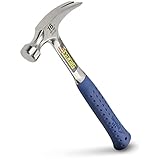
- 3. ESTWING Rip Hammer, E3-16S — Best large-capacity
- 4. ESTWING Rip Hammer, E16S — Best premium
- 5. SEESE Adjustable Nail Puller Hammer: Magnetic Nail Starter — Runner-up
- Curved claw or rip claw: which do you need?
- What handle material actually changes
- Does the listing prove it's a contractor hammer?
- How much hammer do you overpay for?
- The verdict
- FAQ
The best claw hammer for contractors here is the GreatNeck M8C, an 8 oz smooth-face hammer on a fire-finished hardwood handle that gives you control on trim and cabinet work. If you're driving 16d framing nails instead, the Estwing E3-16S is the better buy at 16 oz with a one-piece forged body. Pick wrong and you find out fast: an 8 oz head on a framing wall means twice the swings and a wrist that quits by lunch, while a 16 oz rip claw on a door casing splits the wood and marks the face.
Best claw hammer for contractors at a glance
| Pick | Head weight | Handle | Price |
|---|---|---|---|
Best overall Great Neck GreatNeck Saw M8C Wood Claw Hammer |
8 oz claim | Fire-finished hardwood | Check Price |
Best for pros IRWIN Hammer, Fiberglass |
16 oz | Fiberglass, ProTouch grip | Check Price |
Best large-capacity ESTWING Rip Hammer, E3-16S |
16 oz | One-piece steel, shock grip | Check Price |
Best premium ESTWING Rip Hammer, E16S |
16 oz | One-piece steel, leather | Check Price |
Runner-up SEESE Adjustable Nail Puller Hammer |
Not listed | Cast steel, anti-slip grip | Check Price |




Who each of these five hammers is really for
I lined up the published specifications side by side and sorted these five by the buyer who'd actually reach for them. That's more useful than a spec sheet, because four of the five carry a 16 oz head and the differences live in the handle and the claw.
- Finish carpenter. Small head, wood handle, smooth face. The GreatNeck M8C.
- Remodeler doing a bit of everything. One 16 oz hammer that stays comfortable through a long day. The IRWIN fiberglass.
- Framer or roofer. Longer handle, rip claw, vibration control. The Estwing E3-16S.
- Someone buying a tool for twenty years. Lifetime warranty, leather, made in Rockford. The Estwing E16S.
- Demo and salvage. Adjustable puller slot for nails that won't come out straight. The SEESE.
Notice what's missing from that list: a heavy 20 oz or 22 oz framing hammer. None of the five published a head weight above 16 oz. If you're sheathing walls all week, the best claw hammer for contractors in your bag probably sits outside this set entirely, and I'd rather tell you that than pretend a 16 oz rip claw is a framing gun replacement.
1. Great Neck GreatNeck Saw M8C Wood Claw Hammer — Best overall
An 8 oz curved-claw hammer on a hardwood handle, and the pick I'd hand to anyone whose work is trim, casing and cabinet backs rather than studs.
Best for: trim, cabinetry and finish work where control beats mass Skip it if: you swing all day into framing nails
This is the only hammer in the set with a wood handle and the only one with a claimed head weight under 16 oz. GreatNeck describes it as an 8 oz hammer built from steel with a light hardwood handle, and calls the claw curved rather than ripped, which matters more than the brochure suggests. A curved claw gives you leverage against the workpiece without needing a block under the head, so you can pull a bent finish nail out of a jamb without crushing the paint line. The smooth face leaves fewer marks on softwood.
Wood also does something fiberglass and steel can't: if you crack the handle, you rehang the head. The listing publishes no warranty, and the weight figure in the specifications reads 27.2 g, which is clearly a listing artifact rather than a hammer, so treat the 8 oz claim as the manufacturer's number.
The trade-off is real. It's the cheapest of the five and the slowest seller here, and 8 oz of head means more swings per nail than any 16 oz pick in this lineup.
Pros:
- Only wood handle in this five-hammer set
- Curved claw pulls without a spacer block
- Smooth face marks softwood less
- Replaceable handle, unlike the one-piece steel picks
- Cheapest of the five
Cons:
- No published warranty on the listing
- 8 oz head is too light for framing nails
- Published weight and dimension figures are unusable
- Slowest seller of the five here
2. IRWIN Hammer, Fiberglass — Best for pros
A 16 oz fiberglass general-purpose claw hammer with a 12.8 in overall length, and the one buyers choose most often in this group by a wide margin.

Best for: a general-purpose 16 oz hammer that stays comfortable Skip it if: you want a one-piece steel body
The IRWIN publishes the most complete numbers of anything here: 16 oz head, 1.54 lb total, 1.13 x 12.8 x 5.75 in. That 12.8 in length puts it between a stubby trim hammer and a long framing handle, which is why I'd call it the default general-purpose pick. It sells faster than the other four by a large distance, and it sits in the same entry price position as the GreatNeck.
IRWIN calls the head forged steel and says the fiberglass core absorbs vibration to reduce fatigue. The handle description is the specific part: a rounded hybrid shape with a curved base to stop your hand sliding off the end and a hardened end cap. Those are the manufacturer's claims, not measured figures, but the end cap is a genuine design difference from the leather-wrapped Estwing.
Fiberglass is the compromise material. It kills more vibration than bare steel and costs less than a one-piece forging, but a fiberglass handle that cracks at the head is scrap. The two Estwings can't separate, and the GreatNeck can be rehung. This one can't do either.
Pros:
- Most complete published specifications in the set
- 16 oz head at an entry price position
- 12.8 in length suits general remodeling
- Hardened end cap and curved handle base
- Sells faster than any other pick here
Cons:
- Fiberglass handle can't be rehung if it cracks
- No warranty listed in the specifications
- Vibration and comfort claims are unverified marketing
- Head-to-handle joint is a failure point the Estwings don't have
3. ESTWING Rip Hammer, E3-16S — Best large-capacity
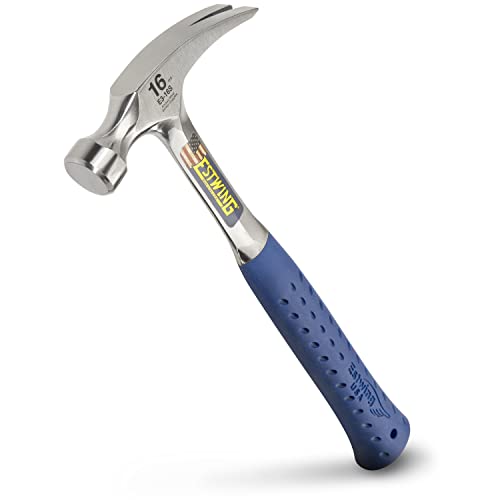
A 16 oz one-piece forged rip hammer with Estwing's molded shock grip, and the strongest all-round contractor tool in this comparison.
Best for: framing, prying and demolition with vibration control Skip it if: you prefer a wood handle you can replace
Here's the trick with one-piece hammers: there is no joint to fail. Estwing forges the head and shank from a single piece of American steel, and the company is explicit that this means no castings or welds. That's the whole argument for spending more, and it's a structural argument rather than a feature bullet. The E3-16S sits in the middle price position of the five.
The claw is a rip claw, straight rather than curved, which is what you want for prying sheathing and splitting old lumber. Estwing says the molded shock reduction grip cuts impact vibration by 70%, a manufacturer figure I'd treat as directional. What's not in dispute is that a rubber overmold grips better than lacquered leather when your hands are wet, which is the practical split between this hammer and its own more expensive stablemate.
The specifications list a manufacturer warranty rather than the lifetime coverage its sibling publishes, and the dimensions read 1 x 1 x 1 in, so you get no real length figure. That's the cost of picking this one over the IRWIN, which tells you exactly how long it is.
Pros:
- One-piece forged steel, no head-to-handle joint
- Rip claw suited to prying and demolition
- Molded shock grip works in wet conditions
- Mid price position, cheaper than the leather E16S
- Manufacturer warranty published
Cons:
- Published dimensions are placeholder values
- Warranty is not the lifetime term its sibling lists
- Bare steel shank transmits more shock than fiberglass or wood
- Nothing to rehang if the grip wears through
4. ESTWING Rip Hammer, E16S — Best premium
The leather-gripped 16 oz Estwing, at 12.5 in long with a lifetime warranty and the highest price position in the set.

Best for: someone who wants a lifetime-warranted leather-gripped classic Skip it if: your hands sweat or the job site gets wet
This is the only hammer in the five with a published lifetime warranty. That single line in the specifications is worth more than most feature bullets, because it's a term the seller has to honour rather than a claim about comfort. It's also the only pick giving you both a real length figure and warranty coverage: 1.25 x 12.5 x 4.88 in, 16 oz head, 1 lb listed weight.
Mechanically it's the same one-piece forging as the E3-16S. The difference is the handle. Stacked leather, hand sanded and lacquered, which Estwing frames as function plus style. Leather feels warmer in cold weather than rubber and it develops a grip pattern to your hand over years. It also absorbs sweat, darkens, and gets slick in rain, and a lacquered finish scuffs when you drop the tool on concrete.
So the honest read: you pay the most in this group for a warranty and a handle material, not for extra capability. The E3-16S drives the same nail with a grip that handles wet hands better. Buy the E16S because you want it to last decades and you like leather, not because it hits harder.
Pros:
- Only lifetime warranty published in this set
- One-piece forged American steel body
- Full published dimensions at 12.5 in long
- Rip claw for prying and nail pulling
- Leather grip moulds to your hand over time
Cons:
- Highest price position for no extra published capability
- Leather gets slippery when wet or sweaty
- Lacquered finish scuffs on rough sites
- Bare steel shank without a rubber overmold
5. SEESE Adjustable Nail Puller Hammer: Magnetic Nail Starter — Runner-up
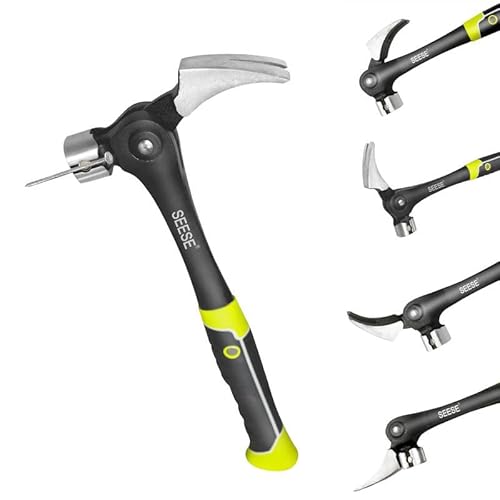
An adjustable-claw hammer with a magnetic nail starter slot, interesting on paper but the thinnest listing here by a wide margin.
Best for: pulling stubborn nails out of reclaimed lumber Skip it if: you need published weight and length figures first
Two features here don't appear on any other pick. SEESE says the claw is adjustable, letting you set the pulling angle so a nail comes out flush instead of levering sideways and tearing the surface. It also says there's a magnetic slot that holds a nail upright so you can start it one-handed. If you've ever tapped a nail into your thumb starting a joist hanger, you'll see the appeal.
The problem is what the listing doesn't say. The specifications carry one entry, a model name. No head weight, no length, no handle length, no warranty. SEESE describes the body as one-piece cast steel in medium carbon steel, which is a different process from the Estwings' forging, and cast steel is generally the weaker of the two for repeated impact. The company also claims trust from over 100,000 carpenters and DIYers, which is marketing copy, not evidence.
It shares the top price position with the leather Estwing while publishing almost nothing you can check. For salvage and demo, the adjustable claw might earn it. As your only hammer, I'd take the E3-16S.
Pros:
- Only adjustable-angle claw in this set
- Magnetic nail starter slot for one-handed starts
- One-piece body with no head-to-handle joint
- Anti-slip shock-absorbing handle claim
Cons:
- Only one specification published: the model name
- No head weight, length or warranty listed
- Cast steel rather than forged, unlike both Estwings
- Premium price position on the least verifiable listing
Curved claw or rip claw: which do you need?
This is the decision most guides skip, and it changes which hammer belongs in your bag more than head weight does.
A curved claw sweeps back toward the handle. That curve is a built-in fulcrum, so you can hook a nail head and roll the hammer to pull it without wedging anything under the head. The GreatNeck M8C is the only curved-claw pick here, and GreatNeck says you won't need a spacer to pull nails with it. That's the finish carpenter's claw.
A rip claw runs almost straight out from the head. You lose the easy pulling leverage and gain a prying tool: you can drive it between two boards, twist, and separate them. Both Estwings and, effectively, the SEESE go this way. Estwing calls its rip claws suited to pulling nails, prying boards and demolition.
- Mostly trim, doors, cabinets: curved claw.
- Mostly framing, sheathing, tear-out: rip claw.
- Mostly pulling old nails from salvaged wood: the SEESE adjustable slot.
If you own one hammer, a 16 oz rip claw covers more ground. If you own two, the second one should be small and curved.
What handle material actually changes
Four materials appear across these five hammers, and each one trades something away.
Hardwood flexes and damps shock naturally, and it's the only option you can replace. The GreatNeck uses a fire-finished hardwood handle. Wood also dries out, shrinks in a hot truck, and loosens the head over years.
Fiberglass sits between wood and steel. The IRWIN pairs a fiberglass core with a moulded ProTouch grip and a hardened end cap. It won't dry out. It also can't be rehung, so a crack at the eye ends the tool.
One-piece steel with a rubber overmold removes the joint entirely. Estwing's E3-16S claims a 70% cut in impact vibration from the moulded grip, which is the manufacturer's figure and the reason people put up with a solid steel shank.
One-piece steel with stacked leather is the E16S. Same forging, warmer feel, worse in the wet.
Here's what most shoppers miss: the failure point on a cheap hammer is almost never the head. It's the handle or the joint. That's the whole reason a one-piece forging costs more.
Does the listing prove it's a contractor hammer?
Short answer: not really, and I'd rather say so than sell you a story. "Contractor" is not a specification, and Amazon's results for the best claw hammer for contractors mix genuine trade tools with homeowner hammers that carry the word in the title.
Two of the five make a direct trade claim. Both Estwing listings describe the tool as built for framers, roofers, carpenters, contractors and tradesmen. The GreatNeck title includes contractor, handyman and carpenter. Those are marketing categories, not certifications, and no listing here publishes a duty cycle, a hardness rating or a drop test.
So judge it yourself against things you can check:
- Is the head weight published? Four of five say 16 oz or 8 oz. One says nothing.
- Is there a joint that can fail? The two Estwings and the SEESE claim one-piece bodies.
- Is there a warranty on record? Only the E16S publishes a lifetime term.
- Is the length published? The IRWIN at 12.8 in and the E16S at 12.5 in are the only two you can trust.
That last point matters more than it sounds. A hammer's handle length sets your striking power. Two picks here list placeholder dimensions of 1 x 1 x 1 in, which tells you nothing.
How much hammer do you overpay for?
Money buys three things in this category, and only one of them is capability.
The cheapest two picks are the GreatNeck and the IRWIN, both in the entry position. Between them you get an 8 oz wood-handled trim hammer and a fully specified 16 oz fiberglass general-purpose tool. If your work is occasional, stop here. The IRWIN in particular is the value pick of the whole set: 16 oz, 12.8 in, complete numbers, entry pricing.
The middle position is the Estwing E3-16S. The step up buys a one-piece forging and a shock grip. That's a durability purchase, not a performance one, and it's the one I'd make if hammers are a daily tool.
The two top positions are the E16S and the SEESE. The E16S adds a lifetime warranty and leather over the E3-16S, nothing else. The SEESE adds an adjustable claw and a magnet, and subtracts every published figure you'd use to compare it.
What you never need to pay for: a claimed vibration percentage, a made-in claim, or a bullet about how many carpenters trust the brand.
The verdict
Three price tiers, three different right answers.
At the entry tier, the GreatNeck M8C takes best overall on merit for finish work: it's the cheapest of the five, the only curved claw, and the only replaceable wood handle, and an 8 oz head is what keeps you from denting a casing. If you want one entry-tier hammer to cover everything instead, the IRWIN is the smarter buy, and it's the only pick that publishes head weight, total weight and length together at 16 oz, 1.54 lb and 12.8 in.
In the middle tier the Estwing E3-16S is the strongest tool here. One-piece American steel, rip claw, moulded shock grip, mid pricing. If you swing a hammer for a living and want one purchase to stop being a question, this is it.
At the top tier, the E16S is the same forging with a lifetime warranty and a leather grip. Buy it if you value the warranty and the feel and your work stays dry. The SEESE occupies that tier too, and I can't recommend a premium hammer whose listing publishes one specification.
FAQ
Is a claw hammer for contractors worth paying extra for?
A claw hammer for contractors is worth paying extra for when the extra money removes a failure point. The Estwing E3-16S buys you a one-piece forged body with no head-to-handle joint, which is a structural upgrade over the IRWIN's fiberglass. Paying past that, as with the leather E16S, mostly buys a warranty and a handle finish rather than more capability.
What head weight should I look for in a contractor hammer?
Head weight in a contractor hammer sets the trade between control and drive. The GreatNeck is a claimed 8 oz, which suits trim, casing and cabinet work where a heavy head splits wood. The other three with published figures are all 16 oz, which handles framing nails and general remodeling. Nothing in this set goes above 16 oz, so heavy framing needs a different tool.
Estwing E3-16S or IRWIN fiberglass: which should I buy?
Between the E3-16S and the IRWIN, both carry a 16 oz head, so decide on handle construction. The Estwing is forged from one piece of steel with a shock grip, so there's no joint to fail, and it costs more. The IRWIN publishes a 12.8 in length, uses fiberglass to damp vibration, sits at an entry price, and sells faster than anything else here.
Do I need a rip claw or a curved claw?
Whether you need a rip claw or a curved claw depends on your daily task. A rip claw runs straight and pries boards apart, which is why both Estwings use one. A curved claw, like the GreatNeck M8C, acts as its own fulcrum and pulls nails without a spacer block underneath. Finish carpenters want curved; framers and demo crews want rip.
What's the biggest mistake when buying a claw hammer?
The biggest mistake when buying a claw hammer is judging it on head weight alone and ignoring the handle. The head almost never fails. The joint between head and handle does, which is why one-piece forgings cost more. The second mistake is trusting a listing with no published weight or length figures, as with the SEESE, and hoping the marketing copy is accurate.
Start with the question of what you nail most days, then match the claw to it. Trim and cabinet work points at the 8 oz curved-claw GreatNeck M8C, and that's why it leads here: it's the one hammer in this group that won't bruise a finished surface, and a wood handle is the only handle you can replace. Everyone else is choosing between a 16 oz fiberglass IRWIN at 12.8 in and the one-piece Estwing E3-16S, and that decision comes down to whether you'd rather pay less now or own a hammer with no joint in it. Open both listings and compare the numbers yourself.